The alpha, twice a week
That was 6 min.
Get the best new moments in your inbox every Wednesday and Saturday. It's free.
Check your inbox
We sent a link to your address. Click it to finish signing up. Not there in a minute? Look in spam.
or
Prof G Markets · 6 min · Nov 19, 2026
Oversubscription can mask an engineered exit
 Paul Kedrosky
 argues that underwriters engineer IPO demand and that oversubscribed offerings often underperform.
The episode’s best minutes
Full analysis- 4:31Oversubscription can mask an engineered exit6 min
- 10:07AI financing is tightening for marginal compute providers5 min
- 2 more moments in the full episode
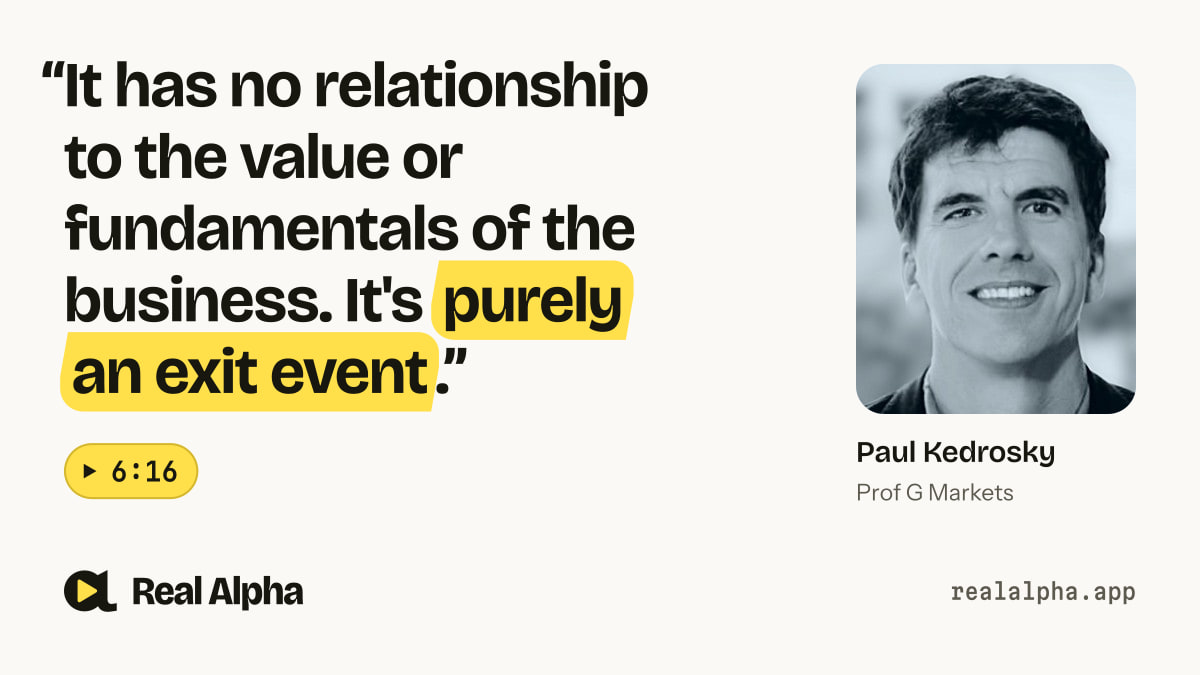
“It has no relationship to the value or fundamentals of the business. It's purely an exit event.”
 Paul Kedroskyat 6:16 · Prof G Markets
Takeaways
- Oversubscription is built into the IPO process, not proof of strong fundamentals.
- A small float and institutional support can engineer a first-day pop.
- Selling products that compete with distributors may threaten Anthropic’s access to them.
About this segment
Paul Kedrosky argues that underwriters engineer IPO demand and that oversubscribed offerings often underperform. He also points to distribution conflicts and a costly shift in Anthropic’s business model.

Managing Partner, SK Ventures
Invests in science-driven startups and founded HSBC James Capel’s technology equity research practice.

Ed Elson, Host
From “Anthropic’s $1.5 Trillion IPO Is A Trap”, Nov 19, 2026. Watch the full episode
Thanks. We'll look at and fix what's off.
Transcript
Transcribed by machine (Whisper) from the episode’s audio, so a word may be off here and there.
- 4:43
And turning it around, what the data says in terms of really dramatically oversubscribed IPOs is that they actually tend to underperform badly over the next 12 months. worldwide data on this, the US, China, or sorry, Hong Kong, Europe, and so on. So even insofar as it tells you anything, it mostly tells you that you're looking at an IPO that's likely to underperform if it is that oversubscribed. Well, this is the thing, because it does seem that this IPO, all IPOs are engineered by the underwriters. They're always priced such that the first day you get a good pop and bang, you have a successful IPO. If you don't have a pop, then something went horribly, horribly wrong. But this does seem especially engineered. And two reasons it seems like that to me, at least. One, they have $26 billion coming in in investment
- 5:37
coming in from a lot of their partners, Google, Amazon, NVIDIA, all of these tech giants. So that helps the price. And then number two, the float like SpaceX is very small. It's around 5% of the company averages 15 to 20 percent for most IPOs. So it seems as though they are setting this up such that it cannot go wrong. You'll have so much price support from the institutions coming in to support a relatively small amount of shares compared to the number of shares that they could be selling in this IPO, which makes me think this is going to be, they're going to be fine, but it might not actually tell us that much about the company fundamentally. It might not actually tell us what the markets are really thinking. Would you say that that is accurate?
- 6:24
That could hardly be more accurate. That is exactly what's happening. It's engineered for exactly that purpose. It has no relationship to the value or fundamentals of the business. It's purely an exit event. It's an engineered exit event, partly for the series A, B, C, D, E, F, G, H investors, and partly for the people who are coming in at the late stage and hoping to flip it to retail or whomever that happens to be on the other side of it. So it's engineered for that exit, but doesn't tell us anything about what people think in terms of the prospects for the business. And then more fundamentally, we also know that when this phenomenon happens, it is highly predictive of underperformance over the next 12 months. We saw that with SpaceX. We've seen that with a host of others. So that gets to probably the more important question was,
- 7:03
what do we think is going to happen over the next 12 months? This thing will go out. It sounds like you and I both agree. It'll be fine. It'll get that pop. It'll probably, people will say, okay, good. It was a success. By the way, anchoring from a much smaller number than previously reported, which was $2 trillion. So we've reduced the price quite significantly. We'll see exactly what it goes out over the course of the day. But what is your expectation for this company and this stock over the next 12 months and perhaps even longer than that because that's a time frame in which you might see something closer to true price discovery and where the true feelings and emotions of wall street are actually reflected in the price yeah so i think you probably will see that kind of at least modest spike on the day um i'll hang my ass
- 7:58
in the breeze and say that. But I also think you'll see a SpaceX-like 20 to 30% decline over the next sort of six months as price discovery actually happens that's separate from this phenomenon of artificial scarcity and an engineered price. And so you'll see something like that. And then as you look forward and you say, at the current run rate, what's a reasonable price? You know, 10x, the current run rate wouldn't be too far.
- 8:19
I would put you to $1 to $1.2 trillion, something like those kinds of numbers. It still looks, I'll say, rich at the price. And that's all not even talking about these two things we've talked about before. One is they're in this rapid transition from Anthropic 1 to Anthropic 2. Anthropic 1 largely leased compute and sold access to models. Anthropic 2 is building compute and is selling applications that sit on models.
- 8:43
So you're in the middle of this really dramatic transition between two very different architectures of the same company. So the opportunities for revenue to look much less predictable than is implied by the valuation are dramatic. So I feel really comfortable with that kind of number. What do you make of the business at this point? Because as you say, they, you know, they reduced their losses last year, but that doesn't really tell us much about what's going to happen in the future because they're going to spend roughly $900 billion.
- 9:11
So things are going to look very different, which tells me they're going to have to go out and raise a lot more after this IPO. And not only that, people are, they're also going to be, if you look at the data, they've been in the last 18, 24 months, launching more apps, if you will, more verticalized products than they have new frontier models. And most people haven't noticed this, but it's really dramatic. This is a company already in the process of launching products that compete directly against people for whom they are distributors, Microsoft and others. So Microsoft distributes the product and yet competes with them. So they have to be very concerned about having their oxygen supply cut off by their own distributors as they race up market. And then at the same time, as the people they're competing with
- 9:54
are also users of their product and say, wait a minute, am I providing you with data that helps you compete against me more successfully? So the old game of being able to ingest lots of data to compete more effectively is already over. And so this is going to make it so much more difficult for them to pull this transition off for those two reasons, loss of distribution and competitors or former customers who now see you as a competitor and are much more leery about giving you data.