The alpha, twice a week
That was 5 min.
Get the best new moments in your inbox every Wednesday and Saturday. It's free.
Check your inbox
We sent a link to your address. Click it to finish signing up. Not there in a minute? Look in spam.
or
Newcomer Pod · 5 min · Nov 17, 2026
Palo Alto buys when a startup can beat it to market
 Nikesh Arora
 weighs whether to build faster or acquire a team that has already solved the problem.
The episode’s best minutes
Full analysis- 11:20Palo Alto buys when a startup can beat it to market5 min
- 17:27OpenAI and Anthropic could reach $10 trillion2 min
- 20:47Product quality and founder talent shape Arora’s leadership3 min
- 4 more moments in the full episode
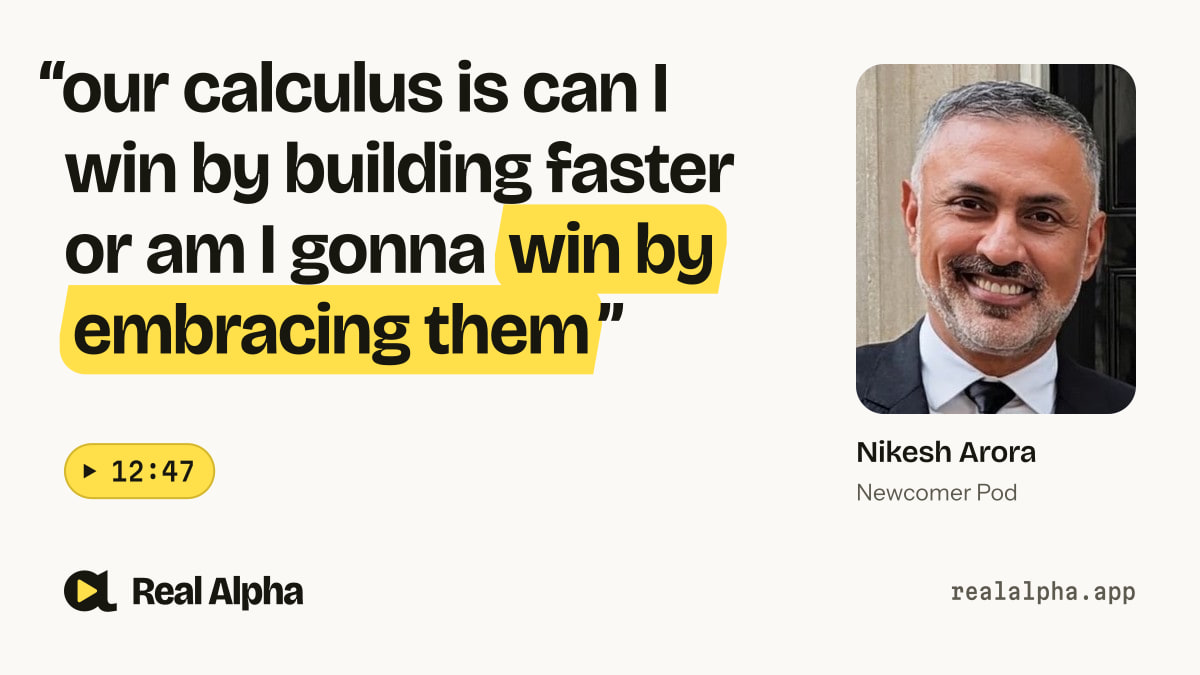
“our calculus is can I win by building faster or am I gonna win by embracing them”
 Nikesh Aroraat 12:47 · Newcomer Pod
Takeaways
- Compare the time to build against the time to buy and integrate.
- Acquisitions bring a team and its product strategy, not just progress.
- Founders who beat Palo Alto often keep leading their products.
About this segment
Nikesh Arora weighs whether to build faster or acquire a team that has already solved the problem. He also explains why founders usually keep running the products they built.

Nikesh Arora is CEO of Palo Alto Networks.
Chairman and CEO of Palo Alto Networks, which he grew into a $300 billion cybersecurity leader.
- EN
Eric Newcomer, Host · Newcomer
From “Palo Alto CEO: If You Can’t Beat Them, Buy Them”, Nov 17, 2026. Watch the full episode
Thanks. We'll look at and fix what's off.
Transcript
Transcribed by machine (Whisper) from the episode’s audio, so a word may be off here and there.
- 11:24
What is your philosophy or someone who's? Acquired a number of companies thinks about that is sort of a key component of growing Palo Alto networks like what is your philosophy both from someone here who's like oh might he be interested in me like and someone who wants to learn from you in terms of how you think about it what is what is your guiding set of principles and acquiring businesses so look the funny part is in cyber security every bad actor is trying to attack you in that new way they're not trying to do it the way they did yesterday because we probably found an antidote to the way they attacked you yesterday so we've You've got to be.
- 12:00
constantly on our toes looking for where does innovation live in the realm of cybersecurity. It's very hard to believe that my 7,000 developers at Palo Alto have every idea and can knock everything out of the park. There's approximately 2,000 to 3,000 cybersecurity companies funded every year from everywhere from Silicon Valley to India to Israel and these are really smart people and they actually understand the problem really well and they're very focused on trying to solve that specific problem. So more often than not I can only have one thesis on how to solve the problem there's probably 30 thesis in the market in terms of how the problem could be solved so my job is to stay vigilant and say wait if we haven't cracked and somebody else has cracked it I have a choice I can rush as hard as I can to try and beat them at it or I can
- 12:43
think about it and say how long will it take me to beat them or should I go talk to them about being part of our auto and that's usually our calculus our calculus is can I win by building faster or am I gonna win by embracing them because we got it the wrong the first time so it's more of a how quickly can I get products in the market how quickly can I build a team around it is it better to buy than to build because it's gonna take me a lot to build because I'm behind or whether I can buy an integrate and get out there much faster that's usually the logic that goes in our industry is extremely innovative so in the last eight years I would say we've bought approximately 40 companies and And when we do, we're fundamentally buying not just their progress so far, we're buying the team and their strategy in terms of where they're going to take that product.
- 13:30
Because, you know, it's kind of interesting. In enterprise, the hardest thing is customer acquisition, as all the founders will find. It's very hard to go convince a customer to buy something from you and keep spending money with you. So once you've acquired a customer, eventually the debate becomes you want to be really out to enterprise company, is you have to be able to sell a lot more to them.
- 13:49
And if you've exhausted your current product line, the question is do you have more product you can sell? So my job my product leaders to make sure we bring enough product which is cohesive Which makes sense which appeals to the same buyer and works better together as soon as my customers have exhausted Purchasing my existing product. So it's kind of like a bit of a build your product portfolio to both generally you're trying somewhat uniquely to acquire companies where you're saying the management team of that company can say and really run that product line or how do you decide or sometimes you keep your people running it or how do you decide generally 99% of the time my people got their ass kicked by somebody out of the field who raised less money was extremely resource constrained it'd be silly to have them come and say now work
- 14:35
for the guys who you beat so generally it's the other way around we acquire the founders they get to drive the product vision and the execution they may be part of an organizational structure can't have 40 founders report to me but usually they work for very smart people who understand the the desire for me to make sure these people get supported and they can execute fast but usually is the founders are running these things for us and we do interesting things to keep them motivated interested empowered to get stuff done is there a size valuation headcount progress do you prefer or obviously it's been a range but how do you it's a range historically from a product perspective we especially new innovation areas you think about 25 to 30 customers 50 customers proves product market fit shows that it's not just a feature that somebody may not want in
- 15:24
the future the fact that you can be able to convince real practitioners that you want to use they want to use your product is usually good anywhere from 60 to 200 people give or take and anywhere where they haven't gotten so much error that I'm paying for customers which I don't need because I have all the customers in the world they just need the product so I don't need to go acquire the customer again so definitely roughly that's where it works but again having said that we did buy uh cyber arc which is a 28 billion dollar asset where we literally bought our way into a large category called identity which we didn't play in so people look at it and say how do we build a footprint in a category we don't live in i know i'm