The alpha, twice a week
That was 3 min.
Get the best new moments in your inbox every Wednesday and Saturday. It's free.
Check your inbox
We sent a link to your address. Click it to finish signing up. Not there in a minute? Look in spam.
or
Silicon Valley Girl · 3 min · Nov 5, 2026
Patients can use AI to prepare for medical appointments
Anne Wojcicki describes the Foundation’s awareness work, then recommends using AI to interpret health records and prepare for appointments.
In this episode
Full analysis- 5:04Susan protected family time with strict work boundaries2 min
- 9:35Lung cancer can go undetected without obvious symptomsPro pick 4 min
- 13:56A lung cancer data community could support earlier detectionPro pick 3 min
- 17:24Patients can use AI to prepare for medical appointments3 min
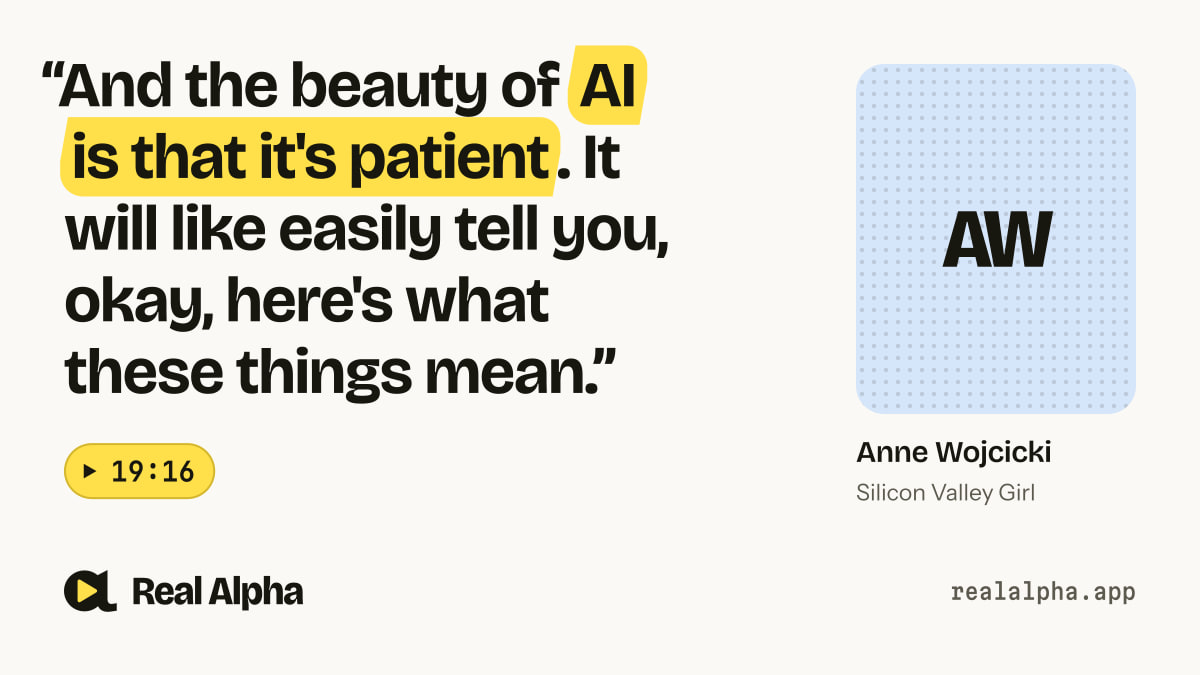
“And the beauty of AI is that it's patient. It will like easily tell you, okay, here's what these things mean.”
Takeaways
- Use AI to clarify genetic results, medications and lab values.
- Ask it to suggest follow-up questions before a doctor’s appointment.
- Record visits so you can transcribe and review them.
About this segment
Anne Wojcicki describes the Foundation’s awareness work, then recommends using AI to interpret health records and prepare for appointments. This can help patients organize complex information and ask more useful questions.

Marina Mogilko, Host · Host, Silicon Valley Girl
Co-founded LinguaTrip and built Linguamarina, an English-learning YouTube channel with almost 9M subscribers.
From “From Google’s 16th Employee to YouTube CEO: Susan Wojcicki’s Family Shares Her Story”, Nov 5, 2026. Watch the full episode
Thanks. We'll look at and fix what's off.
Transcript
Transcribed by machine (Whisper) from the episode’s audio, so a word may be off here and there.
- 17:35
That's fascinating. I think raising awareness is part of your foundation's mission and you're starting a YouTube channel. And I'm proud to be part of a creator advisory board. What kind of stories are you going to tell on the channel? The most important thing is the awareness. You know what Janet says, like anyone with lungs can get lung cancer. And I think that we want to have also stories of optimism, of stories like the Pope.
- 17:56
It's a great story. He got screened, he had surgery, and he's done. So how do we get the people who need screening, how do we get that for them? How do we engage people in research? Like every single... person has the opportunity to contribute. So we want every single person who's newly diagnosed with lung cancer or who has lung cancer to get a kit, to spit, to join that community. And we want to do that. We want to inspire people that like research is coming where we're going to be able to detect it early, but it requires, you know, investment of into research. It requires like us working with the science community, but it's inspiring because it's coming and there are these opportunities. And I think that we see both the tragic, which is more and more people are developing lung cancer, but the optimistic that people can potentially detect it early,
- 18:42
cut it out and be done. I wanted to wrap up with some advice to people who are listening who have been dealing with health issues. What would you say that should be proactively doing now with all the advancements that we have? I mean, there's such spectacular advances with people being able to leverage the AI tools and get insights into it. And so it's one of the things that was complicated with Susan is like the blood tests, the genetic tests, like the medical records.
- 19:14
Like it's a lot of work to keep track of everything. I am really inspired by how you can take a picture of your genetic results. You can take a picture of your medications, your blood values. And the beauty of AI is that it's patient. It will like easily tell you, okay, here's what these things mean. These are other questions. You can ask your AI and say, make sure that you're always giving me five follow-up questions.
- 19:38
I'm going to a doctor's appointment. Tell me what are the five things I should ask for. I do feel inspired by this opportunity for people to at least get that information about themselves and like, what are all the, what does everything mean? What do your lab tests mean? What does your genetics mean? And get the right questions. What should you walk into your clinician's office with? And what is it that you should be asking and expecting? I mean, I also encourage anyone who can go in and record the conversation, record it, because then you can transcribe it and then you can keep track of it. Like, all of that is happening now.