The alpha, twice a week
That was 3 min.
Get the best new moments in your inbox every Wednesday and Saturday. It's free.
Check your inbox
We sent a link to your address. Click it to finish signing up. Not there in a minute? Look in spam.
or
The Diary Of A CEO · 3 min · Nov 12, 2026
Perlmutter favors exercise over metformin for healthy adults
He explains why he does not advise healthy, non-diabetic people to take metformin, citing possible trade-offs with exercise.
In this episode
Full analysis- 14:00Physical activity may offset APOE4-related dementia riskPro pick 4 min
- 23:47Metabolic stress can push brain immune cells toward synapse lossPro pick 6 min
- 1:10:2340 Hz light and sound may restore protective brain rhythms3 min
- 8:18Alzheimer’s research is shifting from amyloid toward metabolism4 min
- 31:06Alzheimer’s may reactivate a childhood brain-pruning process4 min
- 34:54One poor night of sleep can alter blood sugar and decision-making7 min
- 1:13:38Early sugar exposure was linked to lower later-life Alzheimer’s risk3 min
- 1:26:12Perlmutter favors exercise over metformin for healthy adults3 min
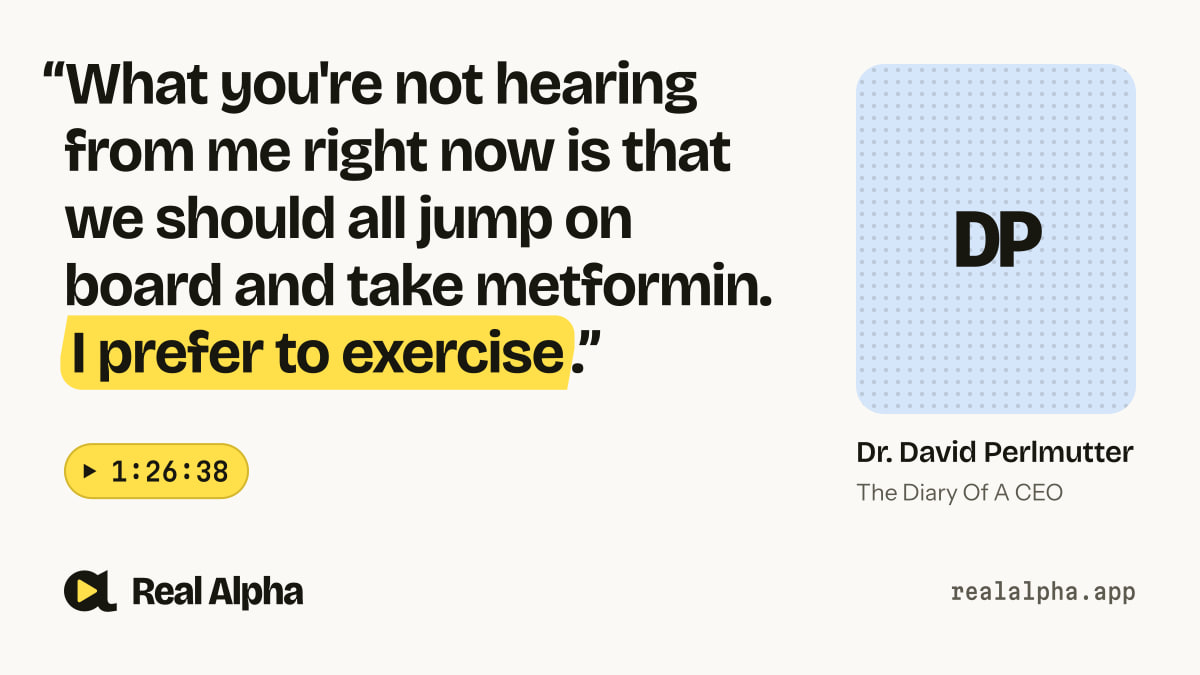
“What you're not hearing from me right now is that we should all jump on board and take metformin. I prefer to exercise.”
Takeaways
- Perlmutter says he prefers exercise to routine metformin use.
- He discusses evidence that metformin can blunt exercise adaptations.
- He says the TAME trial has struggled to secure funding because metformin is generic.
About this segment
He explains why he does not advise healthy, non-diabetic people to take metformin, citing possible trade-offs with exercise. He says a large longevity trial has struggled to get funding because the drug is generic.
Dr. David Perlmutter is a board-certified neurologist and author.

Steven Bartlett, Host · Host, The Diary Of A CEO
From “The Brain Doctor That Figured Out The Cause Of Dementia - Dr. David Perlmutter”, Nov 12, 2026. Watch the full episode
Thanks. We'll look at and fix what's off.
Transcript
From the transcript The Diary Of A CEO publishes with the episode.
- 1:26:17
It's not targeting beta amyloid. But the average person shouldn't be taking that, should they? That's a great question. I was at a conference dealing with a health span, aging. And it was a very small conference, about 20 people. The question was asked, how many of you are taking metformin? This was about eight years ago. And I think 80% of the scientists raised their hands. What you're not hearing from me right now is that we should all jump on board and take metformin.
- 1:26:49
I prefer to exercise. But there is a big study called the TAME trial. Neil Barzilai at Albert Einstein is trying to get this started, but looking for funding. It's, I think, about a $70 million project. He can't get funding. Because metformin has gone off patent, so nobody's going to get the brash ring at the end of the day. But it's looking at the intervention of taking this drug, metformin, to see what effect it has on longevity and dementia for that matter.
- 1:27:19
For generally healthy, non-diabetic people, the current scientific consensus is not to take metformin because there are some potential consequences. Why routine use in healthy adults is problematic. Number one, it blunts the benefits of exercise, apparently. Exercise is the single most validated reproducible longevity intervention available. Multiple randomized control trials have demonstrated that metformin actively interferes with exercise's adaptations.
- 1:27:47
Number two is risk of masking lifestyle fundamentals in long-form clinical data. Intensive lifestyle modification consistently outperforms metformin in reducing cardiovascular risk. Relying on a pill to simulate metabolic health cannot replicate the systemic vascular and psychological benefits of movement, sleep, and whole foods. And there's a bunch of other known side effects. Okay, so interesting.
- 1:28:11
It's almost like replicating some of the effects of exercise. Yes, but as you wonderfully point out, look at the potential downsides. And I don't think mentioned in this article was the possibility of B12 deficiency that we see in people taking metformin. You know, Dr. Davis-Hinclair, you've had him on the program, on the podcast. He recently put out a paper several months ago that looked at all these kind of cool interventions as it relates to these aging clocks that he talked about.
- 1:28:42
And it ranked them. And metformin was described and rapamycin was described as... What led the list, and he's a big NAD guy, as you know, what led the list was exercise in terms of these aging clocks. So, again, it gets back to this, what did our ancestors do? They were active. They didn't suffer from the sedentarity, this idea that we're just sitting on our butts all day, flying here and there in front of the computers.