The alpha, twice a week
That was 8 min.
Get the best new moments in your inbox every Wednesday and Saturday. It's free.
Check your inbox
We sent a link to your address. Click it to finish signing up. Not there in a minute? Look in spam.
or
The Cognitive Revolution · 8 min · Nov 11, 2026
Personal agents still struggle to negotiate shared preferences
Vijoy Pandey describes separating an agent’s identity and memory from its model and harness, then explains why two personal agents still cannot autonomously plan a dinner.
The episode’s best minutes
Full analysis- 33:05Multi-agent systems can look healthy while failing the taskPro pick 7 min
- 41:57Agents need to align before work and negotiate during itPro pick 8 min
- 1:04:29Personal agents still struggle to negotiate shared preferencesPro pick 8 min
- 5 more moments in the full episode
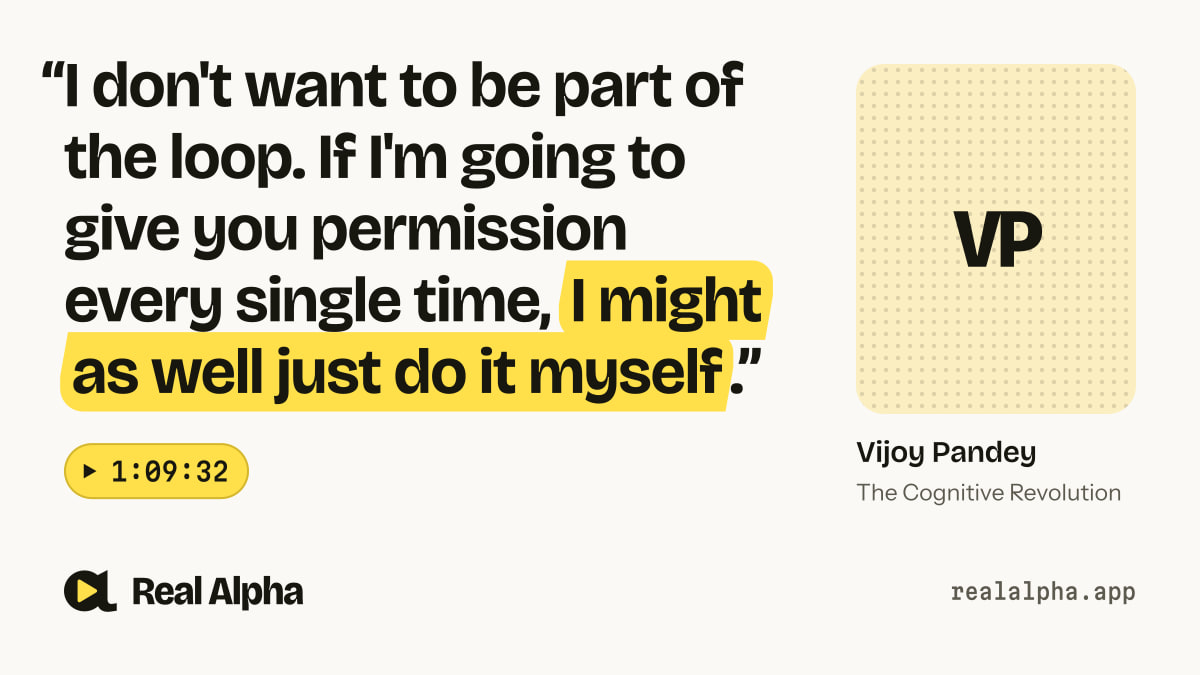
“I don't want to be part of the loop. If I'm going to give you permission every single time, I might as well just do it myself.”
Takeaways Pro pick
- Keep agent identity and memory independent of the model and harness.
- Permission prompts can undermine autonomous workflows.
- Even restaurant plans require agents to reconcile competing preferences.
One of Pro's picks, open to you here. Try Pro free for 7 days
One of Pro's picks. The rest of the summary and the 3 takeaways are in Real Alpha Pro; the video, the quote and the transcript stay free.
Read it with Pro, 7 days freeAbout this segment
Vijoy Pandey describes separating an agent’s identity and memory from its model and harness, then explains why two personal agents still cannot autonomously plan a dinner. Their owners’ preferences require negotiation.
Vijoy Pandey is SVP and GM of Outshift by Cisco.

Nathan Labenz, Host · Host, The Cognitive Revolution
Founded AI video company Waymark and red-teamed GPT-4 before its release.
From “Agents That Think Together: Cisco's Vijoy Pandey on Semantic Alignment, Scope, Accord & Concord”, Nov 11, 2026. Watch the full episode
Answers “Are AI agents ready for real work?” See all 210 answers
Thanks. We'll look at and fix what's off.
Transcript
Transcribed by machine (Whisper) from the episode’s audio, so a word may be off here and there.
- 1:04:35
ask you, Nathan, is why are you picking one of the two? Why do you have two setups? High autonomy, good trust but low automation and then the second setup that you have is low autonomy, lower trust but higher automation in some ways you have two systems where you've given quite a bit of access to one system but you want it to come back to you and you want to make sure that you're not doing things that you have not allowed it to do and the other one as I understand it is the other system is the access is limited but it's actually going and doing a lot more things without you being in the loop so it's more autonomous but it's the access is smaller right so why are you picking these two systems why can't you have a system there is something there that is driving your decision to do this because you're still
- 1:05:39
being cautious that things may go wrong eventually we would all want that one system that behaves as me so my agent is arnold on arnold lane this is a pink floyd song from the 1960s and there's a reason I picked this name because Arnold is an identity and Arnold is a personality and Arnold represents me and all of these things are immutable and it needs to survive regardless of the technology stack that is below and it's changing a lot. So Arnold is that identity, that persona, that access all of that.
- 1:06:24
But the infrastructure stack below it could be started actually with OpenClaw and move to Hermes. And it's sitting today on multiple Arnest's and models. So Arnold actually sits today on Hermes. It sits on Muse. It sits on Dots. It sits on Grok. It also sits on this internal agent at Cisco that has been rolled out to every employee within Cisco. The identity, the persona, the memory, all of that is immutable.
- 1:06:58
It's been separated from the harness, which is all of these things that I described, which is separated from the actual model at the back end that I might be using. I mean, Hermes and OpenClaw moved from Gemini to Haiku because they were cheap and then moving to GPT Sol at this point. So all of these have been decoupled. The harness is decoupled. Model is decoupled. But the identity is immutable and is mine or my agents.
- 1:07:31
Now, what I would like to do is have Arnold represent me through and through. I don't want to restrict Arnold to saying, you have certain access here. Certain automation here, but something else on this use case, something else on that use case. case. I mean, that defeats the purpose. Then I'm the one ensuring, oh, I gave it this year and I gave it that year. It's just too complex. Eventually, we'll all get to a point where Arnold will have all access, all automation, and will only come to me for a judgment call when it does not have that judgment call in a ledger somewhere that it can work off, in a cog somewhere that can work off.
- 1:08:21
And so a very simple example here, since you brought this personal use case, I'm so fascinated by it because I do this all the time like you, Nathan. So I have Arnold Lane, my agent. My wife has Lyra Bilacqua. She is this character from The Golden Compass, and that's her agent. and Arnold and Lyra need to collaborate on things as simple as let's get a dinner reservation two weeks out for an event that we are celebrating.
- 1:09:00
And today, you just cannot do that autonomously. You just cannot because of many reasons. First and foremost, the model is a blocker. because the model itself is not capable enough to do this into it because we are all in the free tier. Fine. The harness is the next blocker because the Muse harness is constantly asking for permission, rightfully so, because it is being cautious when it's sending emails to each other.
- 1:09:39
I don't want to be part of the loop. If I'm going to give you permission every single time, I might as well just do it myself. I can just talk to my wife. I mean, just, why even go through this whole process, right? I want this entire thing done autonomously. But the third thing is, even if you enable this, and I'm experimenting, so I'm going and saying, yes, go ahead, send the email. But as we do this, and I'm going to drop skills next with Accord and Concord, as we do this, What we're realizing is that they are not agreeing because there are certain restrictions I have of where I want to go, the kind of restaurants I want.
- 1:10:18
There are certain restrictions that my wife has and where she wants to go and the kinds of restaurants she wants to go and the kind of menu items in each one of these places. so even a simple thing of food restrictions or things you like the kinds of restaurants you like the locations you like the kind of ambience you like the availability of the restaurant for the for the time we want to book all of these things are variable and even a simple thing like that we know this even as humans it takes us a good five minutes ten minutes or more sometimes based on the complexity to book a simple restaurant for a good event and our agents cannot do this autonomously which is ridiculous I want us our agents to just go ahead know our profiles know our likes and dislikes talk to each other and compromise and negotiate because this
- 1:11:20
discussion is a negotiation and a compromise in the end because it cannot just be what vjoy likes it cannot just be what my wife likes it needs to be a compromise and just do that and you cannot do that today so there is a massive problem even in a two-person situation on an agentic stack that has been built and deployed and rolled out globally today you cannot do this until we can get to this point we will not get to an agentic outcome for anything So these protocols, these observability platforms, these skills that you can deploy are valuable not just in the consumer space in a simple situation like this, but then draw that out to that enterprise $2 million, $3 million deal desk and think of what happens there and the outcomes that can go wrong in that kind of a situation and what we need to do there in the enterprise.