The alpha, twice a week
That was 5 min.
Get the best new moments in your inbox every Wednesday and Saturday. It's free.
Check your inbox
We sent a link to your address. Click it to finish signing up. Not there in a minute? Look in spam.
or
The Information's TITV · 5 min · Nov 9, 2026
Personal AI agents may build affinity through memory and personality
 Bing Gordon
 predicts people will form relationships with agents that remember them, drawing on how games create affinity.
The episode’s best minutes
Full analysis- 12:13AI data centers need to make nearby communities partners3 min
- 16:13Personal AI agents may build affinity through memory and personalityPro pick 5 min
- 36:23Microsoft measures AI by business outcomes, not one ROI metric3 min
- 4 more moments in the full episode
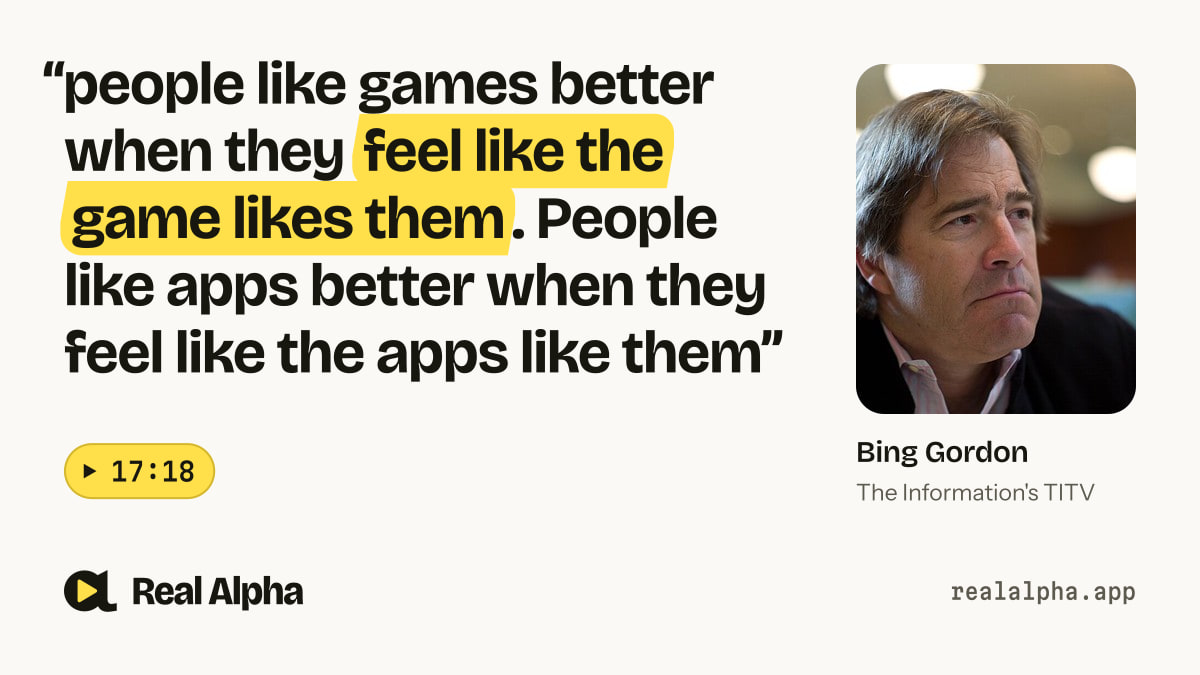
“people like games better when they feel like the game likes them. People like apps better when they feel like the apps like them”
 Bing Gordonat 17:18 · The Information's TITV
Takeaways Pro pick
- Some agents will be ephemeral tools; others will have personality and memory.
- People engage more when they feel a product likes them.
- Cooperation builds friendship; competition creates drama.
One of Pro's picks, open to you here. Try Pro free for 7 days
One of Pro's picks. The rest of the summary and the 3 takeaways are in Real Alpha Pro; the video, the quote and the transcript stay free.
Read it with Pro, 7 days freeAbout this segment
Bing Gordon predicts people will form relationships with agents that remember them, drawing on how games create affinity. He distinguishes those agents from anonymous, task-specific automation.

Advisor, Kleiner Perkins
Former Electronic Arts chief creative officer who helped build The Sims and Madden; now a Kleiner Perkins advisor.

Akash Pasricha, Host · Host, TITV
Led The Information's Pro subscription and co-wrote its flagship newsletter, The Briefing.
From “Nvidia Probes Jensen Huang; Inside Microsoft’s AI Payoff”, Nov 9, 2026. Watch the full episode
Thanks. We'll look at and fix what's off.
Transcript
Transcribed by machine (Whisper) from the episode’s audio, so a word may be off here and there.
- 16:16
I became digital first. You know, I grew up analog first, but there's a generation, two generations younger than me, they grew up always digital. and uh we we just see the always digital generation feels presence in um in virtual worlds you know i i grew up reading books my my metaverse was books when i grew up but um you know we're we're in a battle to create um this sense of presence through screens and uh i i do believe we're going to have two kinds of agents going forward. There's going to be the if this then that anonymous age.
- 17:00
who are ephemeral, who come and go, who are basically the equivalent of a light switch in the house. And then there's going to be agents with personalities and memory, I think probably dedicated to you and me. We're going to have our own agent. We're going to have a relationship with them. They're going to remember everything. And one of the things we found out in games is that people like games better when they feel like the game likes them. People like apps better when they feel like the apps like them we like our e-commerce better when we feel that the e-commerce system likes us right so we're going to be in the we're going to be in the business of tuning personal agents that have affinity with us and we've learned we've learned a lot in the history of games about how to create affinity with characters probably the sims was the most
- 17:52
sophisticated ever. And I was delighted to see that the understanding of the affinity and social math in the Sims was highly expert among a gender that some people think don't like math. The math of social, once we had people connected, we could actually see that teamwork and cooperation trumps competition i don't know if i can use that word anymore uh that it beats competition and um you can see it it's somewhat personality based and in the end i think um i think competition is great for drama and viewing and cooperation is great for um um building friendships and getting people to come back but what about okay so what about when the friendship they're going to come back i hear you i mean they're using this agent they feel like they have a relationship with the agent when the friendship is with a bot is that a good thing well good or bad it's um um
- 19:06
i don't know i've got a bunch of screen names um i i grew up hitchhiking and i used back at back of the days is cb radio and uh when when a trucker is cb radioing you're finding out if there's a cop two miles ahead or the gas the gas station he's going to is full and somebody else with a made-up name you know a cb buddy tells them something at that point does it matter if that's you know a human truck driver or an autonomous truck driver because in the you know in the end if you've got an ongoing relationship um that you know that probably matters it's it's really clear that in person that eye contact and um you know you have to be good at this you got to do eye contact all day long but i i contact and uh body mirroring is pretty important um my matter at usc could prove that um that an ai on a screen fires up the brain less effectively
- 20:12
than an ai in a 3d um a 3d extension she started a company called embodied just because of that so we do react as humans differently to physical things than flat screen things right which is the fun of robots so you know in the end am i are we going to have a robot friend absolutely right right um let me we can come back to the book and there's there's there's i mean each of these checklist items is worth a conversation but i i want to ask you about the current state