The alpha, twice a week
That was 3 min.
Get the best new moments in your inbox every Wednesday and Saturday. It's free.
Check your inbox
We sent a link to your address. Click it to finish signing up. Not there in a minute? Look in spam.
or
Bloomberg Law · 3 min · Oct 24, 2026
Personal attacks on judges can reach their families
 Jeremy Fogel
 says focus on a judge's courtroom anger can distract from whether the government violated an order.
In this episode
Full analysis- 1:16Election officials are preparing for possible federal interference7 min
- 21:02Attacks and recusal motions are eroding trust in DOJ3 min
- 29:31A temporary SEC quorum fix could become a lasting strategy3 min
- 26:39The SEC's quorum rule builds on a 1990s precedent3 min
- 8:53Election fraud claims still need evidence in court3 min
- 13:01Fast-moving construction can outrun court review2 min
- 15:14Personal attacks on judges can reach their families3 min
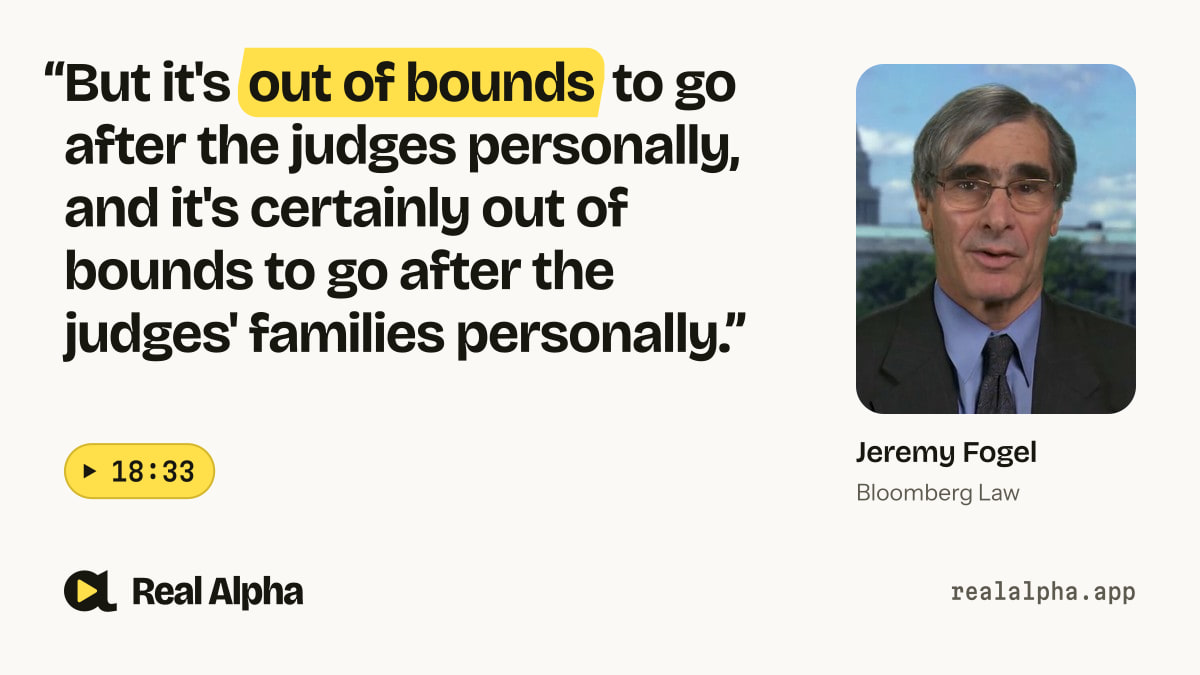
“But it's out of bounds to go after the judges personally, and it's certainly out of bounds to go after the judges' families personally.”
 Jeremy Fogelat 18:33 · Bloomberg Law
Takeaways
- Courtroom anger should not eclipse whether an order was violated.
- Sharp criticism of rulings is protected, Fogel says.
- Personal attacks can draw threats toward judges' families.
About this segment
Jeremy Fogel says focus on a judge's courtroom anger can distract from whether the government violated an order. He distinguishes criticism of rulings from personal attacks that can bring threats to families.

Judge, US District Court for the Northern District of California
Directed the Federal Judicial Center and founded Berkeley’s institute connecting judges with legal scholars.
- JG
June Grasso, Host
From “Weekend Law: Election Fears, Judges Frustrated & SEC Changes | Bloomberg Law”, Oct 24, 2026. Watch the full episode
Thanks. We'll look at and fix what's off.
Transcript
From the transcript Bloomberg Law publishes with the episode.
- 15:16
Judge Reyes said she was furious about the government cutting down those hundreds of trees over a holiday weekend with little notice. And she said in her memorandum, breakneck speed to clear trees that pose no harm, the reason disputed, the budget unclear, the environmental impact unstudied, the urgency none, next steps, bulldoze, hundreds more. She said that she was furious in the courtroom and, you know, she chastised the government attorney. Apparently, she raised her voice. At what point does it cross the line?
- 15:53
Well, judges shouldn't yell in the courtroom ever, in my humble opinion. And I was a judge for 37 years and I tried very hard not to yell at people. I just think I think judicial demeanor is really important. It's what people remember the most sometimes, even more than the ruling that's made. You know, in a high stakes case like this, that's not really true. But, you know, I think it is unusual for a judge to be so pushed by circumstances that she or he does that.
- 16:17
One of the things that troubles me here is I'm not defending Judge Reyes or any judge losing their temper in the courtroom, but what's happening here is that it's been used as a diversion. It's been used as a distraction from what the actual issues are. I don't blame her for being angry. I mean, one can look at how that anger was regulated or not regulated in the particular situation, but the fact that she was angry is totally understandable given the circumstances. So It is somewhat disingenuous to use one of my least favorite words that lawyers use.
- 16:44
It's somewhat disingenuous to say, well, this is all about Judge Reyes being emotional in the courtroom. And it's much more about, well, the government had a court order which it disregarded. And that's what that's about. And I have to add here, I think Judge Reyes has been quite unfairly targeted, not only in this case, but in other cases she's handled. And personal attacks referring to her gender, her sexual orientation, her national origin, all sorts of things that are really kind of irrelevant to the legal issues in the cases before her. And I think that's really unfortunate.
- 17:14
Judge Reyes was the first Latina and first openly gay judge on the D.C. District Court. And after Trump called her a crazed lunatic in a Truth Social post, she said she got death threats.
- 17:28
But what happens is when they use language like that, when they make these ad hominem attacks and they call people crazed lunatics and worse, that incites other people. And you see it on social media. You see within minutes after things like that are said, you can see the viral comments on social media, which... do involve threats. And some of the threats are taken quite seriously by the marshal service, which needs to protect the judges. And I need to say, it's not just against the judges. I mean, the judges are used to controversy. A judge has to have a certain amount of thick skin to deal with controversy.
- 17:58
It comes with the job. But your family didn't sign up for it. And threats are being directed against them. You know, I have to say it's not partisan in the sense that it's not only against judges who are on the Democratic side. Justice Barrett's family was threatened when she made a ruling the president didn't like. And Justice Kavanaugh was threatened with assassination by somebody who didn't like rulings that he had made. So it is kind of bipartisan, but there's an atmosphere where rhetoric that attacks judges personally.
- 18:23
I want to be really clear. I mean, under the First Amendment, if people want to criticize a ruling, they have every right to do that. And they can criticize the ruling in very sharp terms and they can appeal the ruling and they can... try to stir up public outcry against the ruling, that's fine. But it's out of bounds to go after the judges personally, and it's certainly out of bounds to go after the judges' families personally.
- 18:42
And that's what's happened.