The alpha, twice a week
That was 4 min.
Get the best new moments in your inbox every Wednesday and Saturday. It's free.
Check your inbox
We sent a link to your address. Click it to finish signing up. Not there in a minute? Look in spam.
or
Odd Lots · 4 min · Nov 3, 2026
Polling errors are correlated, but not always in the same way
 Nate Silver
 explains why polling misses can cluster across similar states, while midterms may differ from presidential elections.
The episode’s best minutes
Full analysis- 7:37Polling errors are correlated, but not always in the same wayPro pick 4 min
- 36:39Prediction markets combine polls with sentiment and fast updates4 min
- 40:54AI makes complex modeling work faster, with expert oversight3 min
- 2 more moments in the full episode
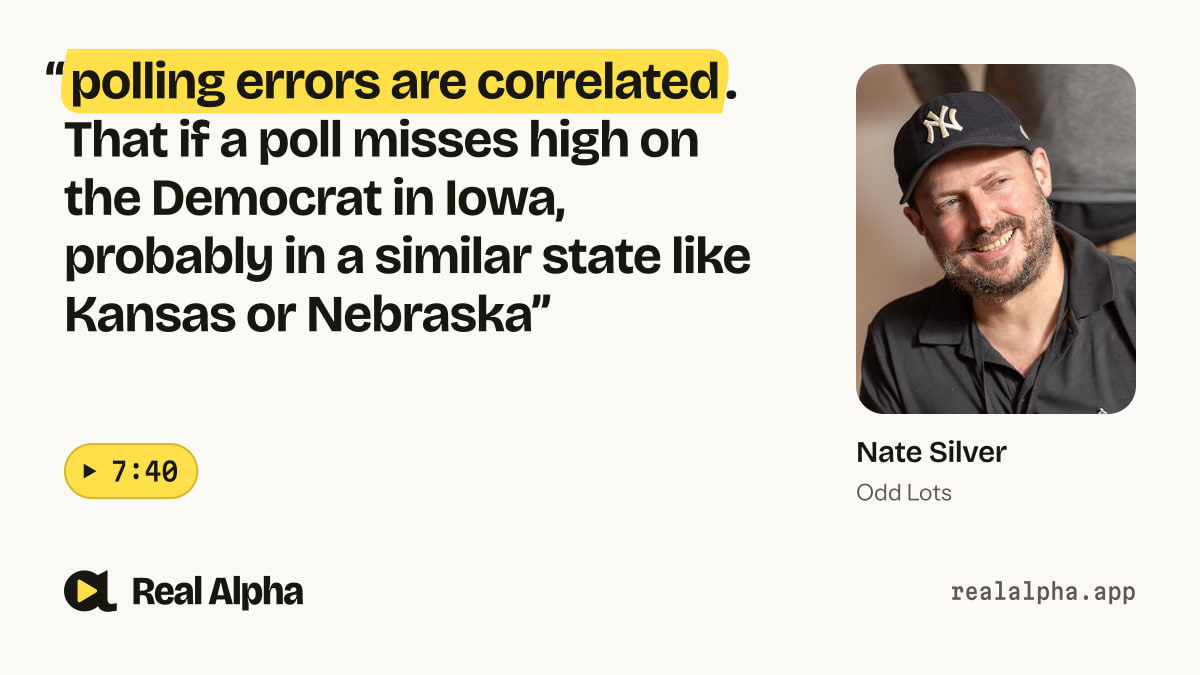
“polling errors are correlated. That if a poll misses high on the Democrat in Iowa, probably in a similar state like Kansas or Nebraska”
 Nate Silverat 7:40 · Odd Lots
Takeaways Pro pick
- Errors in similar states can move together.
- Midterm polling errors are less correlated than presidential-year errors.
- Some voters who are hard to poll may not turn out without Trump.
One of Pro's picks, open to you here. Try Pro free for 7 days
One of Pro's picks. The rest of the summary and the 3 takeaways are in Real Alpha Pro; the video, the quote and the transcript stay free.
Read it with Pro, 7 days freeAbout this segment
Nate Silver explains why polling misses can cluster across similar states, while midterms may differ from presidential elections. He also points to evidence that Trump’s hard-to-reach voters may not turn out for other Republicans.

Nate Silver is founder of Silver Bulletin.
Founded FiveThirtyEight and correctly predicted 49 states in 2008 and all 50 in the 2012 presidential election.
- JW
Joe Weisenthal, Host · Bloomberg
- TA
Tracy Alloway, Host · Bloomberg
From “An Election Day Special With Nate Silver | Odd Lots”, Nov 3, 2026. Watch the full episode
Thanks. We'll look at and fix what's off.
Transcript
From the transcript Odd Lots publishes with the episode.
- 7:50
So what we know, number one, is that polling errors are correlated. That if a poll misses high on the Democrat in Iowa, probably in a similar state like Kansas or Nebraska, all three states are competitive this year, good chance you'll have a correlated error. So therefore, you cannot look at individual races as a Monte Carlo random. But A, they're less correlated in midterms than in presidential years because you have different candidates on the ballot in every state.
- 8:19
That's important. In 2022, we saw this kind of really big red wave in like New York, New Jersey, tri-state area. And Republicans did really well in Florida. The rest of the map was relatively good for Democrats. John Fetterman won and people like that, given that Biden had like a 39% approval rating. You know, number two, we have had systematic polling errors that underestimated Trump in 2016, 2020, 2024, a little bit more modest, but still direction the same, right?
- 8:52
In every election in the Trump era where Trump is not on the ballot, You have not had that error. And in fact, in like New Jersey and Virginia last year, you had a massive underestimation of Democrats and governors races. And so like, first of all, it could all be noise, right? If you like code up a, you know, have Claude or whatever, or GPT code up a SIM to just show you like what random polling error looks like in the past 20 elections, it looks kind of like, you know, it's impossible to distinguish it.
- 9:21
Right. But one story might be that like Trump has this kind of magical power to attract voters low turnout voters that also happen to be hard for pollsters to reach and where they get screened out as being unlikely voters. Those voters don't seem to want to show up for like a Roger Marshall in Kansas or a Ken Paxton in Texas, right? It seems very, you know, Trump got a lot of young men last year who flipped to 2024, who flipped to him. Young men don't usually turn out in terms of watching the NFL or whatever, right? And like there's a consistent story where like conveniently this problem of like these missing voters aren't an issue if they don't vote.
- 10:10
This was actually going to be my next question. But like what are you seeing in terms of early signs of turnout? And then what are the chances that a former Trump voter actually votes Democrat rather than just decides not to show up?
- 10:25
As compared to general elections or presidential elections, turnout is relatively speaking more important. in midterms. Differential turnout is almost always a factor in some of these bigger waves. I'm not an early voting expert, but there are people who are pretty good at it, right? It can be very ad hoc if you don't kind of set clear rules ahead of time. And they seem to be seeing good numbers for Democrats, better numbers in the polls. I don't know, because the polls are really good for Democrats, right? But it provides some more consensus evidence for it, particularly high turnout among Black voters who may fear being disenfranchised. high turnout or not high turnout, but comparatively high turnout among unlikely voters, people who in the voter files have voted no more than one in the past four elections. Democrats
- 11:09
are getting a lot of those, but they're getting more than Republicans, right? I think some pollsters are finding there's very little D to R crossover. If you're any type of Democrat at all, this is not the year to indulge in a moderate Republican, right? Maybe a little bit of the reverse. But like, I mean, things tell a consistent story. It's just kind of this existential thing about whether people believe the story or not.