The alpha, twice a week
That was 3 min.
Get the best new moments in your inbox every Wednesday and Saturday. It's free.
Check your inbox
We sent a link to your address. Click it to finish signing up. Not there in a minute? Look in spam.
or
Balance of Power · 3 min · Oct 26, 2026
Post-Labor Day polling expanded the House battleground
 Erin Covey
 says post-Labor Day polling and new spending revealed more competitive House districts.
In this episode
Full analysis- 32:27Kessler sees a plausible Democratic path to 51 Senate seats5 min
- 21:15Data center opposition is rooted in local costs and jobs3 min
- 17:02Anthropic warns government action could spill into its commercial businessPro pick 2 min
- 6:37Post-Labor Day polling expanded the House battleground3 min
- 11:27Republicans may gain fewer seats than their maps targeted3 min
- 28:17Lula faces an election dispute and a conservative Congress3 min
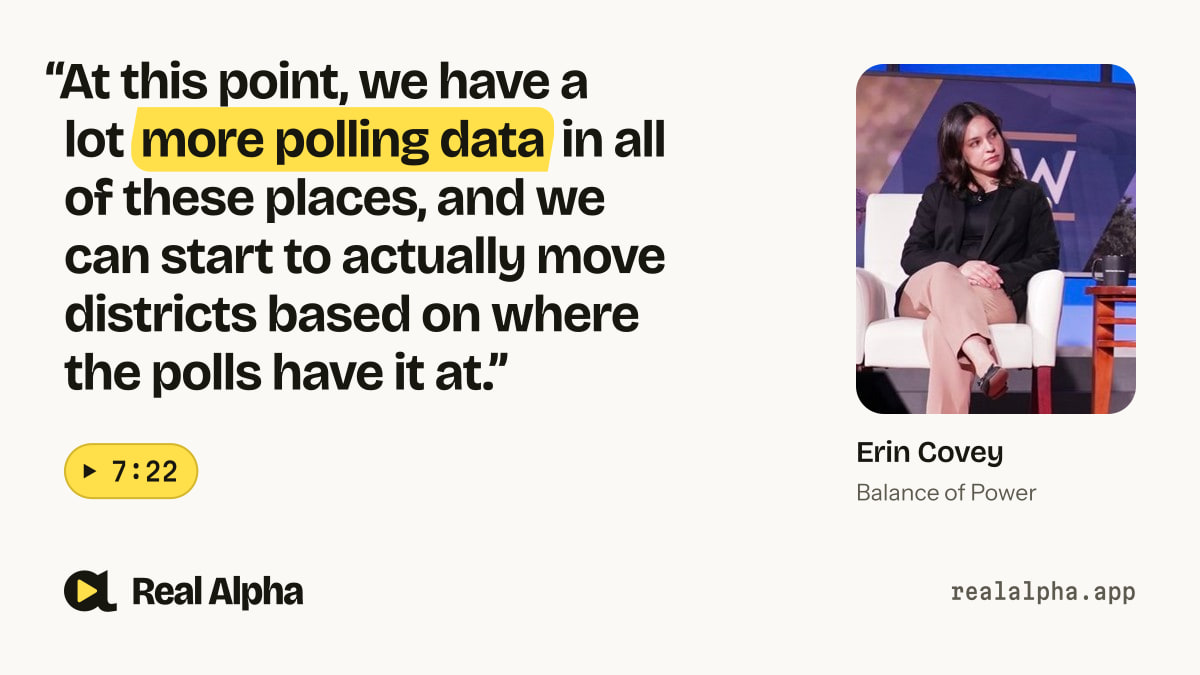
“At this point, we have a lot more polling data in all of these places, and we can start to actually move districts based on where the polls have it at.”
 Erin Coveyat 7:22 · Balance of Power
Takeaways
- Ratings moved as post-Labor Day polling gave Cook more data.
- Trump super PAC spending brought formerly safe districts into play.
- Covey projects 12–22 Democratic House gains, possibly 25.
About this segment
Erin Covey says post-Labor Day polling and new spending revealed more competitive House districts. She projects a 12–22 seat Democratic gain, possibly as many as 25.

US House of Representatives Editor, The Cook Political Report
Leads Cook Political Report’s U.S. House coverage and analyzes and handicaps House, Senate and gubernatorial races.

Joe Mathieu, Host · Washington Correspondent, Bloomberg
Co-anchors Bloomberg’s Balance of Power and covers Washington; founded and hosted SiriusXM’s POTUS political news channel.

Kailey Leinz, Host · Washington Correspondent, Bloomberg
Co-anchors Bloomberg’s Balance of Power, interviewing presidential candidates, administration officials, lawmakers and regulators on policy.
From “Trump, GOP Rally for Mississippi Seat | Balance of Power”, Oct 26, 2026. Watch the full episode
Thanks. We'll look at and fix what's off.
Transcript
From the transcript Balance of Power publishes with the episode.
- 6:39
I've been looking forward to it because I want to get to the why. We know that affordability is a huge issue, that the war in Iran has been a huge issue, tariffs and so forth, all colliding on this affordability matter. But how do we, eight days out. Explain the continued erosion, the acceleration toward Democrats that you're seeing? Or should we believe that prices are continuing to rise? Are people just starting to pay attention? Or are they trying to latch on to what they see as a winner?
- 7:10
It's more that people are starting to pay attention. It's not necessarily that the environment itself has shifted that much. But we are now seeing, particularly the house level, we do not see a lot of heavy ad spending until after Labor Day. And so. At this point, we have a lot more polling data in all of these places, and we can start to actually move districts based on where the polls have it at.
- 7:33
And so that is the result. That is the reason for a lot of these moves at the House level. In particular, we're also seeing the party's spending decisions. We have seen the Trump super PACs go into a number of what were previously fairly safe or Republican-leaning.
- 7:50
Districts that now look increasingly competitive. So This is seen by both parties that the map has really been expanding over the last couple of weeks.
- 7:59
Well, do you see Democrats as having the resources to really play to the extent that the possibilities may present themselves in some of these areas? Erin, are there areas that you are seeing that you believe could have gone to a Democrat if the resources were provided and they aren't being?
- 8:17
I think there are definitely going to be districts that have closer races than expected that neither party invested in. And there is going to be a lot of questions about, OK, if there had been some Democratic super PAC money that came in here, could they have closed the gap? But I think we're also seeing a lot of Republican incumbents are anticipating a blue wave cycle. And we're seeing Republican incumbents in seats that Trump won by more than 20 points go up on TV with ads touting what they're doing to address the affordability crisis. And that's just an indication, not necessarily that these folks are going to lose, but that they're seeing polls that show that they're in much closer races than they were in last cycle. And so I do think that, you know, Democrats, um, money disadvantage is going to probably prevent them from picking up some
- 9:01
of these seats that may have been riper for pickup had the Republican spending not been as strong. But I think Democrats are poised to pick up probably anywhere from 12 to 22, maybe even 25 seats in the House. So they look like they're on track to have a pretty decent majority regardless.