The alpha, twice a week
That was 3 min.
Get the best new moments in your inbox every Wednesday and Saturday. It's free.
Check your inbox
We sent a link to your address. Click it to finish signing up. Not there in a minute? Look in spam.
or
Sourcery · 3 min · Feb 7, 2026
Power limits make AI’s largest buildout plans unrealistic
 Naveen Rao
 argues that AI’s power demand makes some announced data-center plans physically impractical.
The episode’s best minutes
Full analysis- 15:15Biology pushed Rao toward a new computing substrate7 min
- 35:31Power limits make AI’s largest buildout plans unrealistic3 min
- 57:16Unconventional designs for silicon, not a literal brain copy3 min
- 5 more moments in the full episode
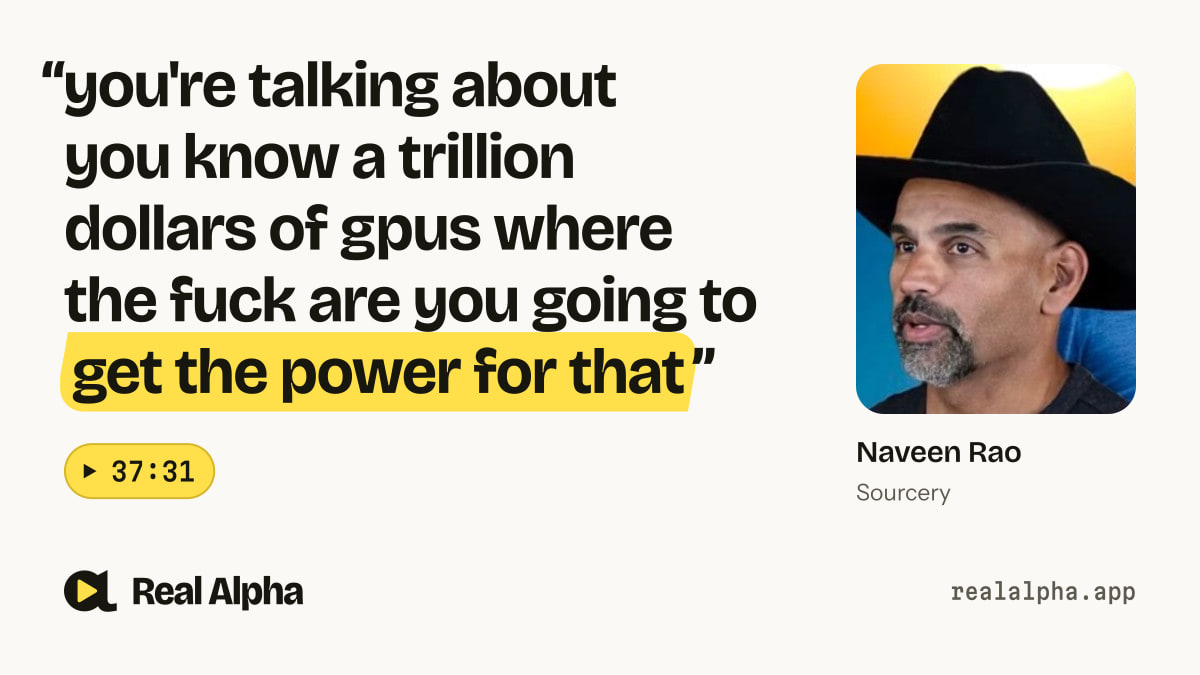
“you're talking about you know a trillion dollars of gpus where the fuck are you going to get the power for that”
 Naveen Raoat 37:31 · Sourcery
Takeaways
- Rao says power, not capital, is the binding constraint.
- A trillion dollars of GPUs still needs power that may not exist.
- He values systems that can be repeated and keep getting cheaper.
About this segment
Naveen Rao argues that AI’s power demand makes some announced data-center plans physically impractical. He sees durable scale—not one-off infrastructure—as the real test of a compute breakthrough.

CEO & Co-Founder, Unconventional AI
Co-founder and CEO of Unconventional AI; founded and sold Nervana Systems to Intel and MosaicML to Databricks.
- PB
Peter Barrett, Host · General Partner, Playground Global

Molly O'Shea, Host · Founder, Sourcery
Ex-Upfront Ventures investor; has interviewed Alex Karp and Palmer Luckey.
From “Inside the $4.5B Startup Building Brain-Inspired Chips for AI”, Feb 7, 2026. Watch the full episode
Answers “Is there enough power for AI?” See all 61 answers
Thanks. We'll look at and fix what's off.
Transcript
Transcribed by machine (Whisper) from the episode’s audio, so a word may be off here and there.
- 35:38
Yeah. no not really because this is uh i don't know i just feel like this is the the path i was meant to be on right because i feel like this is the thing that we need to do like as a society i mean just kind of put it in context i'm sure someone in this room knows how much money do we spend on energy generate electricity generation in the world Does anyone have an idea? I don't know, actually. I know it's a really big number. I should know this number. A lot, Naveen. 20 trillion? 10 trillion? 20 trillion? Something in this other order, right? Half a billion dollars is a drop in the fucking bucket. If you can solve one-tenth of a percent of that problem, you've made an enormous company. So I think that's what it comes down to here, is that the scale of the problem is so big. No, I don't feel pressure,
- 36:28
Because are we going to hit 1,000x in the first go? Maybe, maybe not. I don't know. There's some percentage chance that we will hit it. But I think we're going to hit 50x with a very high chance. If we do that and we have a path to getting to 1,000 and then getting to 10,000 and 100,000, now we've created something really big. So to me, it's about like, let's keep pushing this and be as unconventional as we can, get to a new paradigm, and then keep on pushing that.
- 36:55
That's another 20 or 30 years of innovation. So all I can think about is excitement. Honestly, I don't think about pressure at all. Of course, I have investors and I have to, you know, make sure that I take care of them. But at the same time, like, I think they're on the journey with me, you know. We were talking about this a little bit beforehand, but clearly capital is not a bottleneck. Power is a bottleneck.
- 37:19
And you have a hot take on this. Do you want to share what your take was? Yeah. I mean, you know, everybody here, I'm sure, has heard all the hype, right? everything about oh we're going to do all this build out in data centers we're going to have this giant advantage i'm not going to name company names but you probably know who i'm talking about none of this is physically realizable right that's what's really kind of annoying to me i'm like okay you're talking about you know a trillion dollars of gpus where the fuck are you going to get the power for that i'm sorry right like you're just you're not going to be able to build these things physically and and the things that have been realized um i mean like the xai clusters and stuff like that you know valiant efforts no doubt about it and it's amazing to push through and get
- 37:55
it done but it broke a lot of rules and is doing a lot of stuff very inefficiently so it's not really something you can do over and over again to me you really start changing the world when you make something that's repeatable and you can sustain it when i sustain say sustain i don't necessarily necessarily mean from any ideological standpoint i mean just economically like can you do this thing over and over again does it get cheaper you know can you keep scaling it and so that's important you have to have this so doing something as a one-off is not super exciting to me Doing something where I can now go from that one-off to something that's scalable, repeatable, will continue to get cheaper, will continue to scale, and will kind of hit these Jeevan's paradox sort of dynamics, that's interesting to me.