The alpha, twice a week
That was 2 min.
Get the best new moments in your inbox every Wednesday and Saturday. It's free.
Check your inbox
We sent a link to your address. Click it to finish signing up. Not there in a minute? Look in spam.
or
Bloomberg Businessweek · 2 min · Nov 7, 2026
Prediction markets are best judged by calibrated probabilities
 Nicole Kagan
 says markets aggregate information and forecast probabilities, not certainties.
The episode’s best minutes
Full analysis- 5:36Prediction markets are best judged by calibrated probabilitiesPro pick 2 min
- 18:00Robinhood is opening its trading platform to AI agents3 min
- 33:33Games keep players engaged through shared progress and tuned challenge3 min
- 4 more moments in the full episode
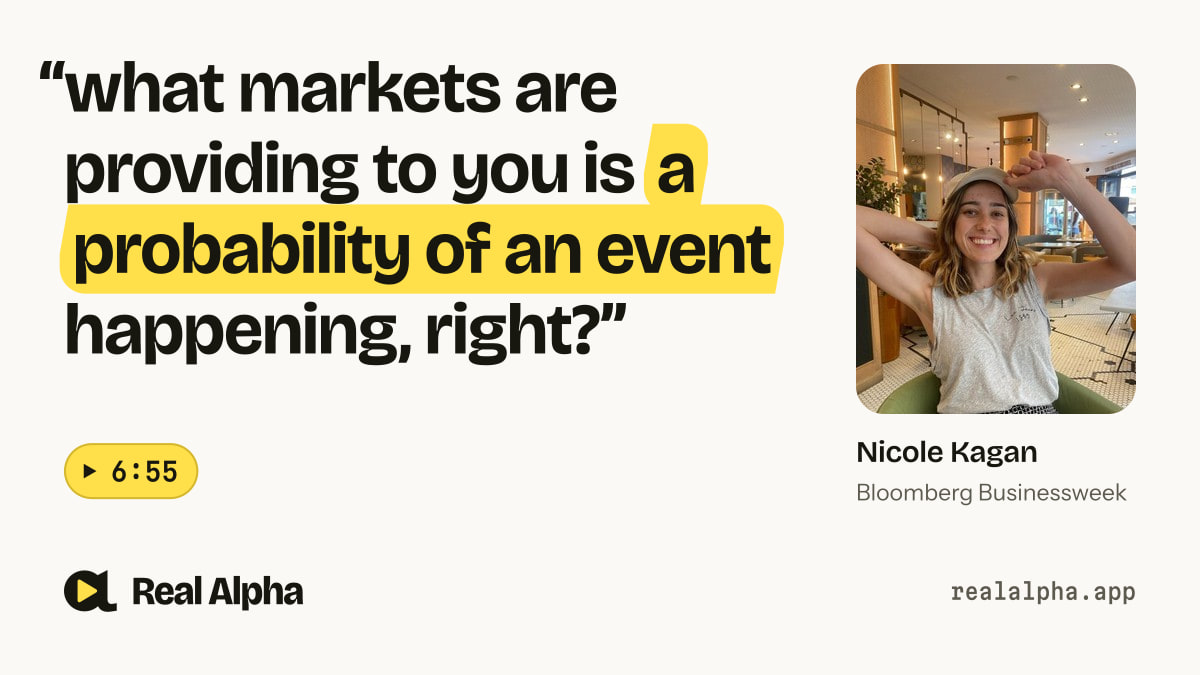
“what markets are providing to you is a probability of an event happening, right?”
 Nicole Kaganat 6:55 · Bloomberg Businessweek
Takeaways Pro pick
- Traders combine information from polls and other sources.
- A 20% outcome can happen without making a forecast unreliable.
- Calibration measures whether stated odds match long-run outcomes.
One of Pro's picks, open to you here. Try Pro free for 7 days
One of Pro's picks. The rest of the summary and the 3 takeaways are in Real Alpha Pro; the video, the quote and the transcript stay free.
Read it with Pro, 7 days freeAbout this segment
Nicole Kagan says markets aggregate information and forecast probabilities, not certainties. That makes a single surprising result a poor test of how well a market forecasts.

Head of research & market structure, Kalshi
Leads Kalshi Research and writes the event contracts underpinning the exchange’s prediction markets.
- CM
Carol Massar, Host

Tim Stenovec, Host · Co-host, Bloomberg
Interviewed leaders including Reed Hastings, Stephen Schwarzman and Mary Barra as a Bloomberg Businessweek co-host.
From “Bloomberg Businessweek Weekend - November 6th, 2026 | Bloomberg Businessweek”, Nov 7, 2026. Watch the full episode
Thanks. We'll look at and fix what's off.
Transcript
From the transcript Bloomberg Businessweek publishes with the episode.
- 5:39
But you're pulling on data from those polls, right? I mean, I guess the traders are polling on. They're the ones who are taking all the information in the available universe and making that a decision based on that. So essentially it should be an aggregate, and correct me if I'm wrong, it should be an aggregate of all the information out there, right? That's exactly right.
- 6:00
And I think one thing that we'll see in research that is to follow is, you know, which pieces of information did traders seem to pay the most attention to? So were there certain endorsements? Were there certain polls that came out that meaningfully moved trader perception? And were there others that they ignored? And if they did ignore them, why did they seem to ignore them?
- 6:17
So going into the midterms, there was some concern that There was a miss with Brazil's election recently, or Kalashie and the other prediction markets didn't quite get the Israeli election right recently. What's the distinction between those? Was it a volume issue? Was it who was placing the trades and where they were based in the world? What was unique about those that weren't necessarily so accurate, but these were?
- 6:41
Well, it's a good question. And I think it fundamentally comes down to what the markets represent. So earlier, I spoke a little bit about accuracy, which is probably one of the more naive ways of viewing our markets. It's the simplest way to understand them. If you round up from 50%, you know, do you end up with the correct candidate or not? But really what markets are providing to you is a probability of an event happening, right?
- 7:00
And so for the Brazilian election, what we saw was that there was an 80% chance of Flavio Bolsonaro winning that election, according to the Calci markets, in advance of that election happening, and a 20% chance for Lula. But what that would mean, you know, to a person living their daily life is like you might expect something to happen one of five days of the week that you go to work. So it's actually really not that unlikely a scenario that occurs. And we know from the research that we've done in the past that if you take kind of over two million markets over the context of the entire history of the exchange and you look at, you know, if we say something happens 60 percent of the time, does it actually happen 60 percent of the time?
- 7:36
The answer is yes. You know, we are very, very good at forecasting in those probabilistic terms. And so taking just one example, like what happened in Brazil, is not quite the best way of representing what should really be viewed in a large sample context.