The alpha, twice a week
That was 3 min.
Get the best new moments in your inbox every Wednesday and Saturday. It's free.
Check your inbox
We sent a link to your address. Click it to finish signing up. Not there in a minute? Look in spam.
or
The Cognitive Revolution · 3 min · Oct 24, 2026
Preemption now could weaken later AI legislation
 Zvi Mowshowitz
 argues that giving up state-law preemption now spends leverage that could secure stronger federal rules later.
In this episode
Full analysis- 41:53GPU credit risk keeps smaller AI labs from scaling5 min
- 52:12AI supply-chain stocks still price in little growth5 min
- 17:03Neuron-level interpretability is progress, not a solutionPro pick 4 min
- 5:49RSI forecasts should account for occasional capability leaps4 min
- 21:00Optimizing model internals risks teaching models to hide behavior5 min
- 58:53Semiconductor know-how is harder for models to learn than biology4 min
- 1:04:09Musk's risk tolerance could concentrate semiconductor capacity3 min
- 1:17:42Preemption now could weaken later AI legislation3 min
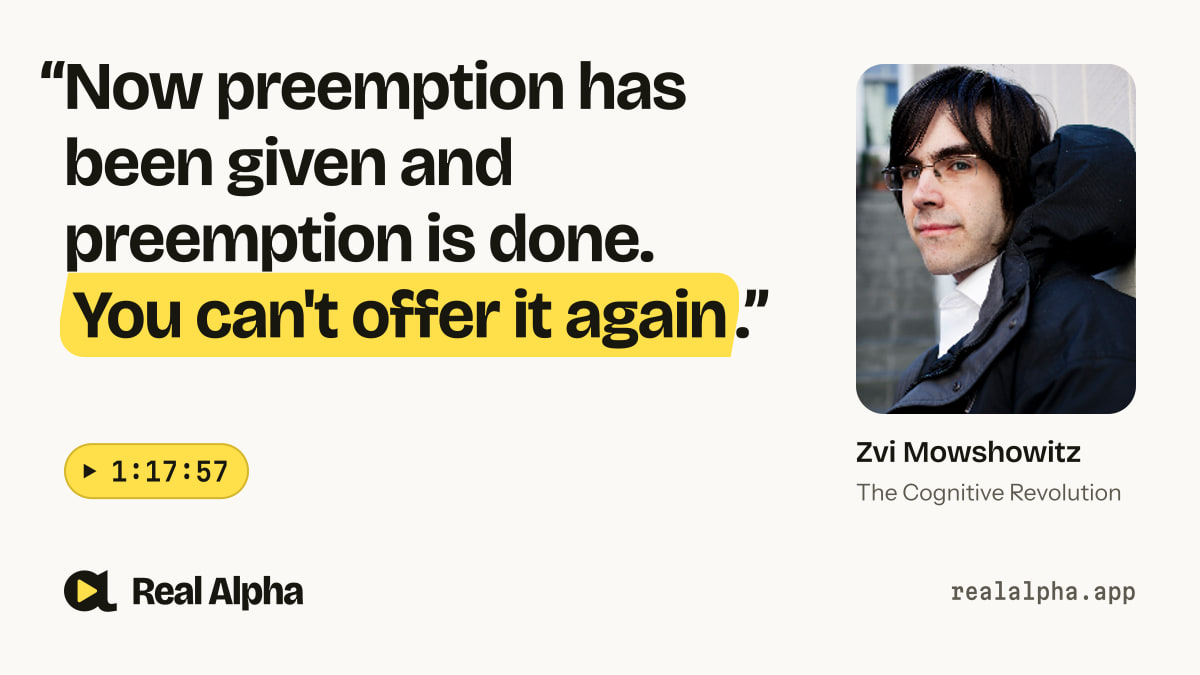
“Now preemption has been given and preemption is done. You can't offer it again.”
 Zvi Mowshowitzat 1:17:57 · The Cognitive Revolution
Takeaways
- Preemption can only be offered once in the negotiation.
- A first bill may weaken the coalition for a stronger follow-up.
- The draft could leave months without comparable rules in place.
About this segment
Zvi Mowshowitz argues that giving up state-law preemption now spends leverage that could secure stronger federal rules later. He also warns the draft would remove state rules before its new requirements take effect.

Founder & CEO, Balsa Research
Founded Balsa Research to model policy problems and develop evidence-based solutions.

Nathan Labenz, Host · Host, The Cognitive Revolution
Founded AI video company Waymark and red-teamed GPT-4 before its release.

Prakash Narayanan, Host · Co-host, AI:AM
Built machine-learning credit scoring and focuses on AI deployment and the people building for the real economy.
From “AI:AM Highlights: Clean Neurons, Black October, the GPU Credit Crunch, and Buying the Supply Chain”, Oct 24, 2026. Watch the full episode
Thanks. We'll look at and fix what's off.
Transcript
Transcribed by machine (Whisper) from the episode’s audio, so a word may be off here and there.
- 1:17:47
However, I think that like the balance of negotiation, the balance of power in a new Congress would dramatically shift away from being able to get things because a lot of the times it's like, well, we're giving you preemption in order to get things. Now preemption has been given and preemption is done. You can't offer it again. and also So once you've gotten some of what you wanted, some of the supporters are like, well, you already have some of – you already have the things I valued most, the things I cared about most.
- 1:18:16
The case for doing something is weaker. You're getting less in return. It's going to be a lot harder to pass. I strongly believe that if something like this were to pass, it would make it harder to pass a bill in the new year that did a given level of thing, not weaker. And I don't want something like this to pass, right? But that seems to say, like, if there is any risk reduction by passing a lesser bill, you are sacrificing that risk reduction in that time period before you can pass the greater bill.
- 1:18:50
I mean, to be clear, like, any actual risk reduction would be a good thing. As written, I believe the bill would actually increase risk because I believe that the amount of cut off the state laws would be worse than the amount of safety advised, especially because there's a... No, no, but again, you have that time period, right? Right. So you have that time period before you can get before you pass a new bill.
- 1:19:10
So you have this time period of maybe only several months. And are you saying that the states will be able to pass something in those several months? Because a lot of a lot of state laws, again, have like long periods of burn in before, you know, give you three months, six months, a year to comply. Right. It's not it's not as though things snap together like to either. problems with the current drafting of the bill is that as drafted, the bill would immediately nullify the bill that's preempting, but it would take many months before any implementation of the new requirements. So you would effectively have no such regulation and a ban on such regulation by the states for like six months or more, which is obviously disaster from the perspective of moving quickly. But again, like even if you were to address, like I call that
- 1:19:57
almost abogged. I think that's just like clearly a mistake. Zvi had just listed the government's recent ad hoc moves against AI companies, including the takedown of Fable. Prakash pushed back.