The alpha, twice a week
That was 5 min.
Get the best new moments in your inbox every Wednesday and Saturday. It's free.
Check your inbox
We sent a link to your address. Click it to finish signing up. Not there in a minute? Look in spam.
or
Bloomberg Surveillance · 5 min · Nov 23, 2026
Private equity deals need exit options and measurable risks
Jennifer Fox Bensimon outlines exit routes, cash-flow-positive businesses and the case for co-investing.
The episode’s best minutes
Full analysis- 14:16Nvidia is positioning for both open and frontier AI models2 min
- 7:32When fundamentals hold, waiting can beat reacting to selloffs3 min
- 25:29Private equity deals need exit options and measurable risksPro pick 5 min
- 3 more moments in the full episode
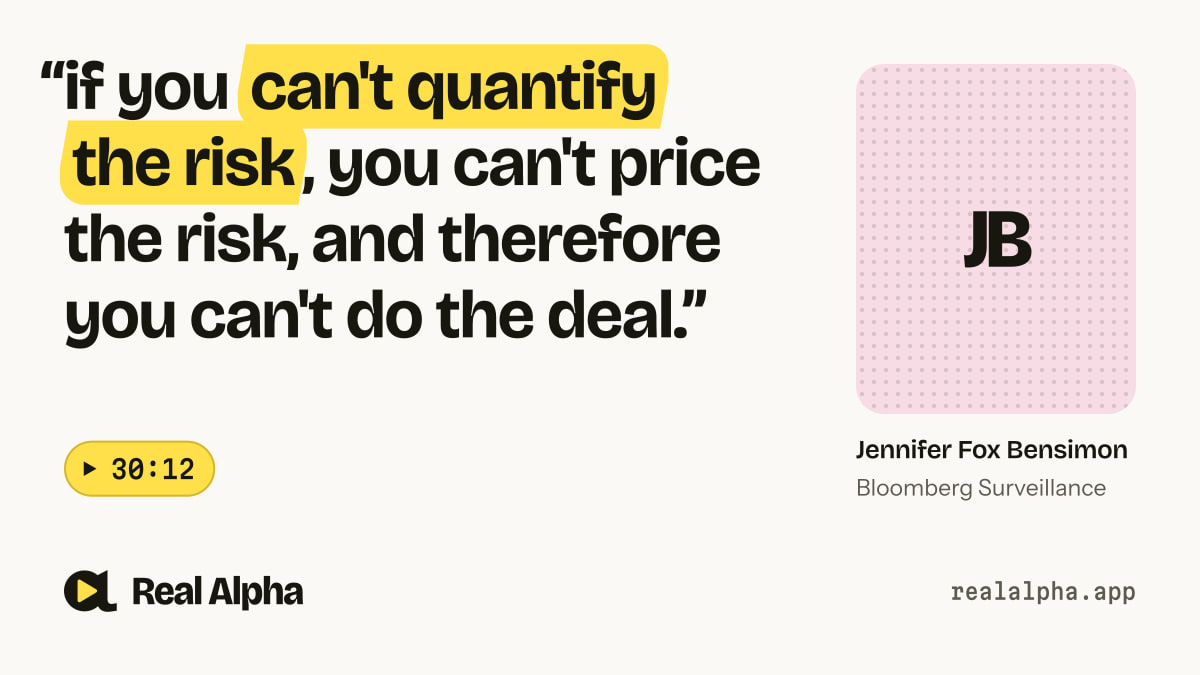
“if you can't quantify the risk, you can't price the risk, and therefore you can't do the deal.”
Takeaways Pro pick
- Plan for strategic, financial and IPO exits.
- Cash-flow-positive businesses can offer additional liquidity options.
- Avoid deals with risks that cannot be quantified.
One of Pro's picks, open to you here. Try Pro free for 7 days
One of Pro's picks. The rest of the summary and the 3 takeaways are in Real Alpha Pro; the video, the quote and the transcript stay free.
Read it with Pro, 7 days freeAbout this segment
Jennifer Fox Bensimon outlines exit routes, cash-flow-positive businesses and the case for co-investing. She argues illiquidity must be earned through differentiated value creation, and risks must be quantifiable before investing.
Head of Co-Investments, Partners Capital
Expanded Partners Capital’s co-investment program, deploying over $1 billion across more than 25 deals.
- TK
Tom Keene, Host
- PS
Paul Sweeney, Host
From “Jensen Huang Returns to Nvidia | Bloomberg Surveillance”, Nov 23, 2026. Watch the full episode
Thanks. We'll look at and fix what's off.
Transcript
From the transcript Bloomberg Surveillance publishes with the episode.
- 25:32
Yeah, that's a great question. And honestly, it's a key topic that we talk about a lot as LPs investing both in primary funds as well as in co-investments. I'd make a few comments. First, we need to have multiple pathways to exit, broadly speaking, but in particular in today's environment. So what that means is that not just an IPO is a potential exit, but a potential strategic buyer. So a larger company buying a smaller company that we've invested in within its sector or a financial buyer, which would be another private equity firm or something that looks similar from an institutional perspective. So again, having those multiple pathways.
- 26:05
To exit is really critical. The second component that I'd mention is that we're very focused on businesses that are cash flow positive within the private equity landscape. And so certainly there's the opportunity for a dividend recap or other forms of taking liquidity. As you know, the CV. Market is also another area that folks are very focused on these days, including secondary transactions.
- 26:27
Jennifer, when you think about the ideal investor for a co-investment structure, who comes to mind? What is their time horizon? And how do you find them? Sure.
- 26:36
So as a reminder, Partners Capital, we are an $ 84 billion investment office. And our clients or investors are really across the spectrum. So institutions, foundations, endowments, as well as esteemed high net worth individuals. But again, it's someone who's really focused on private markets investing. So that 7 to 10 year horizon is Sometimes it can be a little shorter because, as a reminder, if you're investing in a fund, it could take a handful of years to deploy that fund.
- 27:02
If you're investing in co-investing, you're investing directly into the business day one. So mitigating that J curve or that fee drag earlier on. Talk to us about.
- 27:12
The debt side of the business, where do you guys source your debt capital for the capital structure these days? Is it the banks? Is it private equity? Where's the most reliable, most efficient sorts of debt capital for you guys? Sure.
- 27:23
As a reminder, as a co-investment partner, we are partnering with other private equity firms. So those are the folks that are really finding the debt for any of our underlying businesses. That being said, it's typically debt financial institutions, more broadly speaking, depending on the size of the company and the sector, et cetera.
- 27:40
Certainly, you know, P has been such a hot topic in recent years. And you talked a little bit about sort of like investing over the long term in terms of being sort of aware of the ebbs and flows of it, but trying to really be disciplined in your investing. How in the world do you talk about private equity to somebody who might have a very rigid idea of what it might be? How do you communicate what it can be through your investment vehicle?
- 28:06
Yeah. Sure. So it's a great question. And we talk a lot about the benefit of diversification, both by asset class, but also by underlying risk factor. So it's important when we're talking to someone about accessing private markets as opposed to public markets is that, yes, there is illiquidity. And we have seen historically, and in particular in the last few years, that the illiquidity premium has come down a bit, which means that you have to earn that illiquidity premium, which means that where you play in private equity is actually more critical than just access to the asset class itself. And so when we talk to folks about accessing private equity, it's really accessing a differentiated value creation strategy for earlier stage businesses that maybe aren't accessible in public markets today.
- 28:51
Is your activity all AI? Can a company raise private equity if they don't have AI in their name? Absolutely.
- 29:01
We have many of them as part of our platform. What I would say there is that AI is an enabler for many of our businesses that are outside of the technology sector. And so while obviously there are certain headwinds in certain sectors, there are also a lot of tailwinds in sectors where we find many more efficiencies that companies need. can use as part of optimizing their profit margins within private equity. From a specific investment perspective, we're diversified across sectors. So we're not just investing in technology or AI, but really across multiple different sectors, again, that can have that benefit of the tailwind of AI.
- 29:36
Jennifer, I'm going to push on Paul's question a little bit more too. What is your due diligence? process and how do you think through basically mitigating the risk involved in what that could miss out on or could maybe over-represent in your due diligence? Yes. Great question.
- 29:54
So first of all, we have a dedicated co-investment team that is looking specifically at the asset itself, the company, not just the private equity firm. We also have a deep primary funds program that is evaluating the firm and the fund to make sure there's the right asset, fund, or sponsor fit. That being said, from a specific what is the risk and can we diligence it, I always say if you can't quantify the risk, you can't price the risk, and therefore you can't do the deal. So I think in today's environment where we're We do have certain concerns around the impact of AI. If we think it's a potential benefit and tailwind, great. If we think it's a potential headwind that we can't quantify, we're not going to lean in. And certainly we have plenty of deal flow that we can be very selective in terms
- 30:35
of where we're playing today. Jennifer, thanks so much for joining us. Really appreciate it. Jennifer Fox, Bensimon.