The alpha, twice a week
That was 6 min.
Get the best new moments in your inbox every Wednesday and Saturday. It's free.
Check your inbox
We sent a link to your address. Click it to finish signing up. Not there in a minute? Look in spam.
or
The Real Eisman Playbook · 6 min · Oct 19, 2026
Private equity's fundraising model is colliding with exits
 Danny Moses
 and Eisman discuss slower realizations, fund gates and the pressure to keep raising capital.
The episode’s best minutes
Full analysis- 16:50AI financing echoes the warehouse lines behind subprime4 min
- 22:38Private equity's fundraising model is colliding with exits6 min
- 3 more moments in the full episode
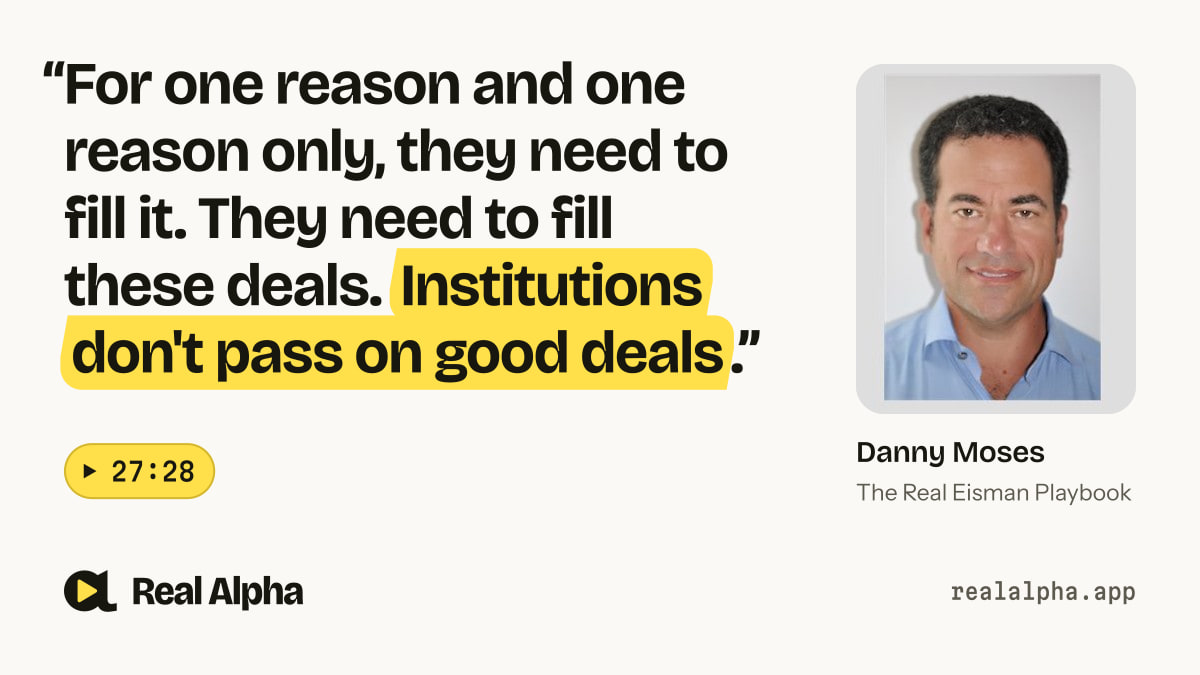
“For one reason and one reason only, they need to fill it. They need to fill these deals. Institutions don't pass on good deals.”
 Danny Mosesat 27:28 · The Real Eisman Playbook
Takeaways
- Private equity has not faced a prolonged shutdown since its growth accelerated.
- Slow realizations and fund gates expose the gap between marks and liquidity.
- Retail investors may be offered deals institutions have passed on.
About this segment
Danny Moses and Eisman discuss slower realizations, fund gates and the pressure to keep raising capital. They warn that private assets can hide volatility and that retail distribution may signal a need to fill deals.

Danny Moses is a former Big Short partner and host of On The Tape.
Spotted the housing bubble before the crisis and helped execute the trade chronicled in The Big Short.

Steve Eisman, Host
From “Big Short Reunion w/ Danny Moses: Rising Rates, AI & Private Equity | The Real Eisman Playbook Ep 80”, Oct 19, 2026. Watch the full episode
Thanks. We'll look at and fix what's off.
Transcript
Transcribed by machine (Whisper) from the episode’s audio, so a word may be off here and there.
- 22:41
hopefully it's not catastrophic. Right. Okay. Let's go to our good friends in the private equity world. Okay. I mean, one thing that's been happening is, I mean, if we were talking five, six, seven years ago, that amount of time for monetization was three to four years. Now it's seven. Maybe it's going to 10. Do you have any thoughts on the future of private equity? It's an incredible business model in the sense of permanent capital. Management fees just go on forever. It's not an area. You can trade them. So let me go back. You can trade them at massive inflection points when people get so scared that private credit's going to blow up and they destroy the stocks. You have a chance to buy them. And the flip side of that is when it looks like the Fed's going to be in a rate cutting cycle and these things explode higher. But for the most part,
- 23:28
Like I said before, they have replaced the traditional banks as far as lending goes. Yes, they have. And because they're not regulated, but they're smart, they all own a piece of their business, they're not trying to blow their firms up, they had one job. Go out and raise as much money as you can. We've been around that world. We know that. So, your salespeople go out, insurance companies, pension companies, go out and raise as much as you can from them.
- 23:48
Let's close fund one, fund two, fund three, fund four, fund five, fund six. So, there's a tail here. So, they have the ability to keep investing, whether it's in the same companies that they want to invest or whatever. So it was an AUM game, gathering game for them, because that's where they can make... Now, to your point, distributions and realizations is really where they want to make their money. And those go through cycles. We haven't had a true shutdown cycle since COVID, which was a one-off in that sector, since it's been a secular growth story after taking assets away from the banking system. So it hasn't been tested yet. We haven't seen anything other than during COVID. And what happened during COVID? The Fed and Treasury were buying HYG. They resurrected a lot of companies that probably they'd lend to that
- 24:31
should have gone to zero, and they didn't. So, they were more focused on it. And what do they have to do? They're paid to put the assets to work, the cash to work. So, they lend. And I'm concerned about some of the coverage ratios, the EBITDA ratios. I know you probably do a teach-in on your sub-stack on that, on covenants and things like that, covenant-light loans, so to speak, because they needed to deploy. So, you underwrite in a different way when you have so much money, because you have to deploy that money to raise more money. Fund seven, let's go. We're almost done with fund six. It's already accounted for.
- 25:03
I think it became an AUM gathering game over a maximizing- Let me pause you on that point, because I think this industry really took off post-GFC, like exploded. Amazing. Now, in its defense, one of the reasons why it exploded was because the banks had to pull back, so somebody had to replace them. But on the other hand, there's another aspect to this, which I think is really hurting them, which is, you're an institution.
- 25:28
You were not previously invested in private equity. You were in public markets. 2008 was unbelievably painful, because you lost basically 40% of your money like that. You don't want that volatility anymore. So what you did was, you put money into private equity, because at least you could pretend that it wasn't volatile. Now, the private equity is just as volatile as the public markets. It's just that you don't get a price every single day.
- 25:59
So, you could sleep at night pretending to yourself, I got my money with some real great professionals in private equity who are going to make me a lot of money, and it's not volatile. And I think that's one of the big reasons why that industry grew so much. Now, no one's getting monetized. Rates keep going higher. This business really only works in low rates, because it's a leverage business. I think the private equity business is going to go through a long period of very troubled times.
- 26:28
So this is like, this reminds me of definitely one of your favorite movies, definitely one of mine, Willy Wonka with Gene Wilder, right? Where he brings out the contract at the end. You lose! And he brings out this long thing, goes, Article 4, Section 3, whatever. This whole thing with gating, okay, which you never think about when times are great. Gating of a fund. All these private funds are gating.
- 26:47
Demand for redemptions is exceeding what they wanted to give. So they all, we're done at 5%. There's a built-up amount of money that needs to go out the door. And the second thing is, to the point you just bring up, is the mark-to-model versus the mark-to-market. There's no incentive to mark-to-market, if you don't have to, to your point, because the AUM changes. Everything changes at that point. And the last thing, Steve, is that if you're a retail investor, which a lot of people that watch you here are, and I've been saying this for years, how do I have the good fortune of being able to invest in this particular product?
- 27:20
Why am I the lucky one that sees this, you know, this private deal that comes to my, why am I getting this in my inbox? Like, you know, this whole distribution into retail, getting access to these sophisticated products happens. For one reason and one reason only, they need to fill it. They need to fill these deals. Institutions don't pass on good deals. There's always, it's like an IPO in equities.
- 27:41
When did the IPO doesn't work? When the hedge funds and all the large institutions and Wellington and Fidelity don't want it. And they stuff retail. What did we used to do on our desk? Happy Thanksgiving in July. You know, they stuffed us. Oh, we asked for 200,000 shares. Steve, hey, Danny, what did we get out of that IPO? 200,000 shares. Fuck. You know, you don't want 200,000 when you ask for 200,000.
- 28:02
Anyway, my point is that they might be overstaying their welcome in that. And I think that's another thing that has happened, is allow retail investors to have everything that institutions have. Careful what you wish for.