The alpha, twice a week
That was 4 min.
Get the best new moments in your inbox every Wednesday and Saturday. It's free.
Check your inbox
We sent a link to your address. Click it to finish signing up. Not there in a minute? Look in spam.
or
Lightcone · 4 min · Nov 14, 2026
Product direction becomes the bottleneck as execution gets cheap
Roman Ugarte says teams increasingly need alignment on what to build, not more engineering capacity.
The episode’s best minutes
Full analysis- 16:09Bots should earn broader access as people learn to trust them7 min
- 40:06Agents improve when they can run and check their own code3 min
- 52:17Product direction becomes the bottleneck as execution gets cheap4 min
- 5 more moments in the full episode
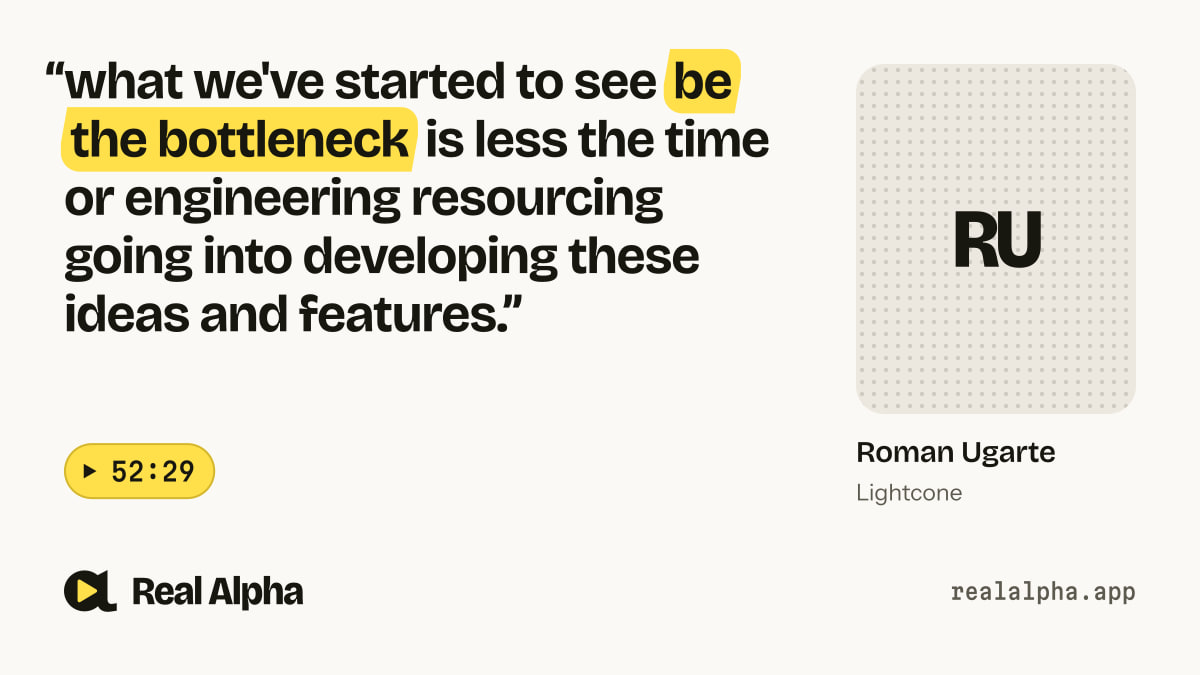
“what we've started to see be the bottleneck is less the time or engineering resourcing going into developing these ideas and features.”
Takeaways
- More engineering capacity makes product direction more important.
- Automate bug fixes that do not change the core experience.
- Keep a high bar for changes users see every day.
About this segment
Roman Ugarte says teams increasingly need alignment on what to build, not more engineering capacity. They automate small fixes but hold back changes to the core experience until they have internal buy-in.

Garry Tan, Host · President & CEO, Y Combinator
Co-founded Posterous and Initialized Capital, an early Coinbase backer.

Harj Taggar, Host · Managing partner, Y Combinator
Co-founded Auctomatic with the Collison brothers and later Triplebyte.

Diana Hu, Host · Managing partner, Y Combinator
CTO of Escher Reality; after Niantic bought it, ran AR for Pokémon GO.

Jared Friedman, Host · Managing partner, Y Combinator
Co-founded Scribd, which YC funded in 2006; has advised 20+ YC unicorns.
From “The Rise Of AI Coworkers”, Nov 14, 2026. Watch the full episode
Thanks. We'll look at and fix what's off.
Transcript
Transcribed by machine (Whisper) from the episode’s audio, so a word may be off here and there.
- 52:22
core team that works on GrokBot is, I mean, Lauren is putting up 4,000 PRs a month. And I think we're going to start to see more engineers do that. And I think what we've started to see be the bottleneck is less the time or engineering resourcing going into developing these ideas and features. And actually it's more alignment among us as a team of like, what do we want the product roadmap to be? What's our vision? What does good look like? What does great look like?
- 52:52
And I think we're seeing this where we've been in so many discussions, Lauren and I, where we're kind of talking about a future change to GrokBot and someone suggests something. And then someone else in the room says, oh, I have a PR for that if you're interested. Like I was working on this over the weekend, whatever. And that happens constantly. So the stuff is built, but we don't want to merge all of that because it's going to lead to a bit of a Frankenstein-y product with like random side projects.
- 53:15
Like we do need a consistent vision and philosophy of the product. And so I think we're shifting more of our time to that and those questions now that everybody is making thousands of micro decisions a day or a week, which I think was not the case in the past. Which, actually, I'm very curious. I mean, this is a bit of the trendy thing now with the thing that matters is taste, which means actually saying no to a bunch of stuff and having discernment.
- 53:41
What does that look like in practice for you guys? How do you make a decision, yes or no, on this? Yeah, for a certain category of things. So Lauren has set up one of my favorite parts of her factory is Sandy. which takes in thousands of pieces of customer feedback every day. We receive it through the product. We receive it through our support channels. We receive it through X. And a lot of times there are just small bugs.
- 54:04
And so in a lot of cases, Lauren's factory just fixes it. Like repros, fixes, merges. No one thinks about it. It goes out automatically at three in the morning. I wish all software would be made that way. I wish Apple, Apple, people who work at Apple, could you do this? Because, hey, I have, you know, calendar team in particular. I have some problems with you. There's a lot of GrokBot that should be self-healing in that way.
- 54:27
And it's cool that that finally works. I think there's another set of questions that should not operate that way at all. If you're changing the core pixels that a user is experiencing every day, it's like really frustrating as a user to wake up and you refresh your GrokBot and there's a whole new, the button moved and then it moved again the next day. And so the way we try to counteract that is a lot of dogfooding internally and sitting with a change for longer than feels comfortable before we ship it.
- 54:54
And the default is if something doesn't get internal product market fit, we don't ship it. Even if it gets like mixed internal product market fit, we don't ship it. And so as a team, we really try to keep a high bar. Yeah, I think that's actually one of my favorite parts of working on the GraphPod team is that, you know, despite the great velocity that we have, we still have a lot of intention and care for the user experience.
- 55:16
and you know even though you can go really fast it doesn't mean that you should just ship every feature you can think of and this is where human judgment and taste i think comes in i don't think that's gonna go out of style personally i think as long as we're building software for humans humans should really be thinking about the you know be an intentionally designed experience because we know each other the best right uh you know if you're building software for agents that's a different story that you know you can certainly probably go like as fast as possible but i think yeah for humans you do want to have uh put intentional care and thought uh into the stuff that you develop so even for my own factories i don't turn them towards like future development i turn them More towards the software maintenance side of things, because I care a lot about, you know, performance.
- 56:06
I care a lot about fixing bugs that our users encounter or quality of life complaints that they have. And I think that's actually such a great use of the agents, because that used to be like a full-time job or something. And now I've given that to a lot of agents, and that frees me up and other engineers up to think more intensely about the product experience.