The alpha, twice a week
That was 4 min.
Get the best new moments in your inbox every Wednesday and Saturday. It's free.
Check your inbox
We sent a link to your address. Click it to finish signing up. Not there in a minute? Look in spam.
or
Silicon Valley Girl · 4 min · Jun 12, 2026
Product-market fit shows up in usage and payment
 Grant Lee
 says organic sharing and willingness to pay are key signals for many consumer and prosumer products.
The episode’s best minutes
Full analysis- 19:33Product-market fit shows up in usage and payment4 min
- 16:48Choose ideas your team cannot stop exploring3 min
- 3 more moments in the full episode
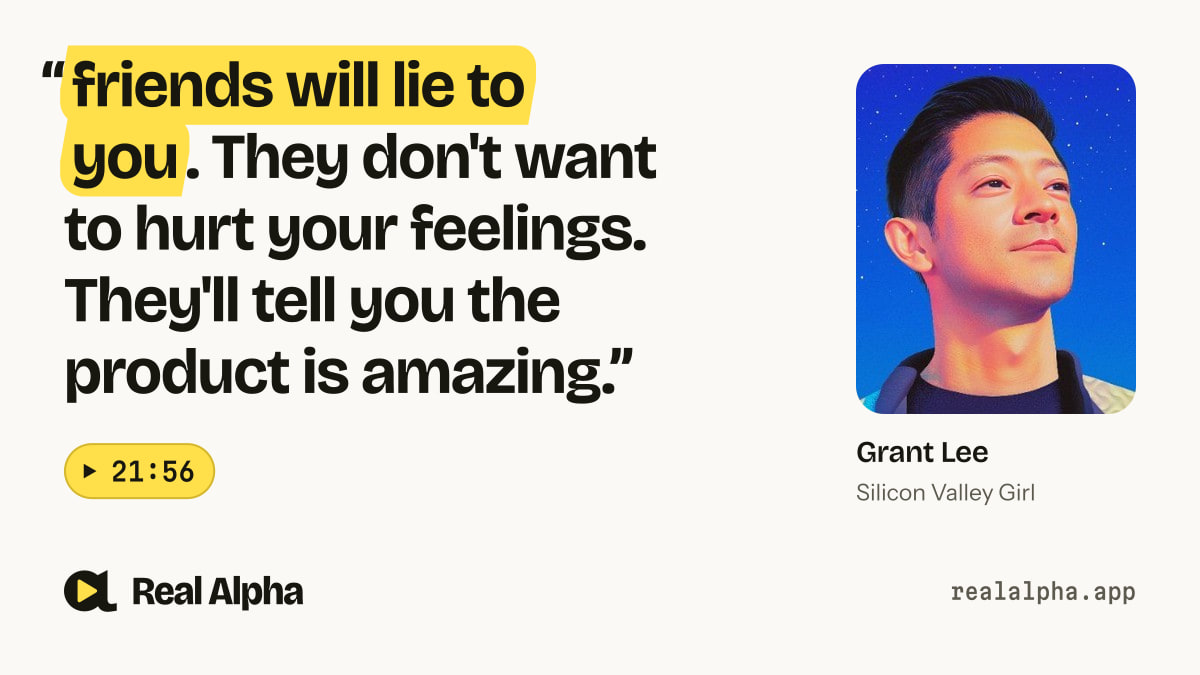
“friends will lie to you. They don't want to hurt your feelings. They'll tell you the product is amazing.”
 Grant Leeat 21:56 · Silicon Valley Girl
Takeaways
- Look for users who share the product organically.
- For paid tools, willingness to pay signals delivered value.
- Track actual usage to find the strongest early customer groups.
About this segment
Grant Lee says organic sharing and willingness to pay are key signals for many consumer and prosumer products. Gamma found its early users by tracking behavior, not relying on friends’ praise.

Grant Lee is co-founder and CEO of Gamma.
Built Gamma, an AI presentation and website tool serving 50 million customers; formerly COO of ClearBrain.

Marina Mogilko, Host · Host, Silicon Valley Girl
Co-founded LinguaTrip and built Linguamarina, an English-learning YouTube channel with almost 9M subscribers.
From “$2.1B AI CEO: The Beginner's Playbook to a Profitable AI Startup in 2026 | Grant Lee, CEO Gamma”, Jun 12, 2026. Watch the full episode
Thanks. We'll look at and fix what's off.
Transcript
Transcribed by machine (Whisper) from the episode’s audio, so a word may be off here and there.
- 19:46
to stop innovating today, especially given how fast things are moving. But when you're early on And sort of, you know, one question every founder will ask is, how do I know if I have product market fit? And I think the answer for many types of businesses, maybe not like infrastructure or B2B, but most like consumer or prosumer businesses, there's basically two things you're looking for. One is, does your product have organic growth?
- 20:10
Is it so good? people are telling all their friends, family, colleagues about. Because if it is, then you don't even need to spend any money in sales and marketing. You'll just have more and more users come to your door to actually try to use your product. So that's step one. If people are using your product, telling all their friends about it, you have organic growth. Step two is their willingness to pay. If you're a consumer product, maybe you can monetize via ads or different formats. But if you're a true sort of productivity or creative tool, people need to pay for your tool if it's really valuable and payment is always an exchange of value, right? If your product is valuable, they'll put their credit card down to pay their product. So if you have those two ingredients, I think then you'll know you have product market fit and you'll know you have
- 20:53
something where you can put more fuel on the fire by obviously investing in marketing and sales in different ways. But without that, any sort of sales and marketing is premature because the product itself isn't good enough for it to actually spread on its own. And you're always going to be fighting an uphill battle to kind of retain customers. Quick pause. My team and I are celebrating one year of the Silicon Valley Girl podcast. I know the channel has existed for a while, but a year ago, I made a decision to focus on amazing conversations with people who are building our future with AI. And for a whole year, we worked to bring you the biggest founders and builders in AI so you can keep up in this era and get inspired. If you love what we're doing, please subscribe and hit the notification bell. It's what helps us bring you the biggest minds
- 21:35
of our lifetime. Thank you so much for being here. Talk to me about getting those first thousand users. How did you get them? And is there any advice on getting them in 2026? Yeah. So when we first launched, maybe like many founders, we tried to recruit all of our friends to use the product, anybody that created a presentation. And we were able to get several thousand people just to sign up through our network, extended network. And of course, you ask your friends, like, how do you like the product? And one thing you'll learn is like, friends will lie to you. They don't want to hurt your feelings. They'll tell you the product is amazing. The real truth is that I'm going back and looking at the usage, right? Like, are people actually using the product? And so then we'd go in and, you know, many of the friends
- 22:20
that said they love the product weren't even coming back to the product, not using it. So then you start honing in, okay, where is the real usage of the product? What kind of use cases are people actually, you know, leaning into. And we saw early on a lot of, you know, freelancers, solopreneurs, small business owners that had to create a lot of content using Gamma as the way that they were presenting and sharing with their clients and customers. So that's where we understood, okay, there's a pocket of users here. We should be spending much more time with them, talking to them. And then of course, over time, then you can find out ways to like message to them specifically, whether it's on social media or, you know, if you're working with creators and influencers, like really tap into the personas where your product's the most useful
- 22:57
and start getting that flywheel going of they're finding the product, they're finding real value, they're sharing the product with their network,