The alpha, twice a week
That was 5 min.
Get the best new moments in your inbox every Wednesday and Saturday. It's free.
Check your inbox
We sent a link to your address. Click it to finish signing up. Not there in a minute? Look in spam.
or
Balance of Power · 5 min · Nov 6, 2026
Productivity growth can ease rate pressure despite strong hiring
Chris Phelan argues productivity is adding supply, so strong hiring need not push the Fed to raise rates.
In this episode
Full analysis- 36:11Data center backlash is part of a broader populist shiftPro pick 4 min
- 40:52Crypto groups missed their chance to pass market structure lawPro pick 3 min
- 19:56Productivity growth can ease rate pressure despite strong hiring5 min
- 25:02Data centers need local buy-in but serve U.S. jobs and security3 min
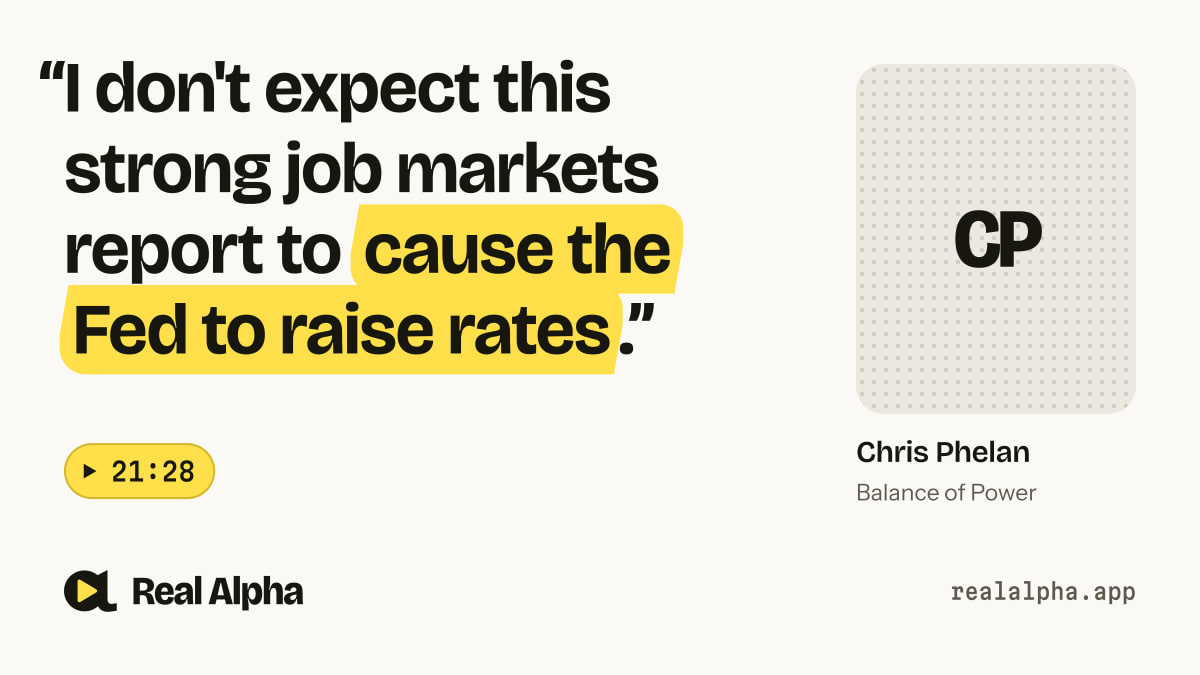
“I don't expect this strong job markets report to cause the Fed to raise rates.”
Takeaways
- About 40,000 monthly jobs are needed to keep unemployment steady.
- Phelan says productivity expands supply rather than fueling inflation.
- Prices remain about 25% above pre-COVID levels, he says.
About this segment
Chris Phelan argues productivity is adding supply, so strong hiring need not push the Fed to raise rates. He says prices remain about 25% above pre-COVID levels, a source of voter frustration.
Chairman, White House Council of Economic Advisers

Joe Mathieu, Host · Washington Correspondent, Bloomberg
Co-anchors Bloomberg’s Balance of Power and covers Washington; founded and hosted SiriusXM’s POTUS political news channel.

Kailey Leinz, Host · Washington Correspondent, Bloomberg
Co-anchors Bloomberg’s Balance of Power, interviewing presidential candidates, administration officials, lawmakers and regulators on policy.
From “Democrats Begin Outlining Priorities”, Nov 6, 2026. Watch the full episode
Thanks. We'll look at and fix what's off.
Transcript
From the transcript Balance of Power publishes with the episode.
- 20:09
Chairman, welcome back to Bloomberg TV and radio. As you look at this jobs report today, is this a labor market that to you would be capable of withstanding higher interest rates? Why should the Fed be worried about this side of its mandate at all and not just focused on inflation?
- 20:27
I think that Chairman Warsh in his Jackson Hole speech basically said that My decisions on what to do with interest rates will be based on what is happening to inflation, not what's happening to the labor market. So I think that. We're going to need to see what the next inflation numbers are to see what the Fed is going to do. We're not going to need to know that the labor, this is a great labor market. You can see it not just in the 165,000 jobs. Usually we have to create 40,000 a month just to stay even.
- 21:04
So this is a blowout month. 2026, we're still doing about double the 40,000 that we need for unemployment to stay constant. And that's why it went down. So it's a good labor market. There's no reason why that should cause inflation. And in fact, a lot of times inflation is called too much money chasing too few goods. Well, when you have a productivity boom like we're having, and basically that's alleviating the too few goods part.
- 21:38
So a supply shock is not inflationary. I don't expect this strong job markets report to cause the Fed to raise rates. Interesting.
- 21:49
Some have suggested that after skipping the last meeting, the Fed could go for 50 basis points, depending on what the next inflation reading brings us. What would the impact be on economic growth or on the job market if we saw a half point hike?
- 22:05
It's generally a good idea to. have rates no higher than they need to be. So yes, certain projects that make sense to do at this interest rate don't make sense to do at that interest rate. So it is always, that's why they try to raise it. When there's too much inflation, the rule is they raise interest rates as a way of trying to get inflation down. But again, I don't see why a strong labor market would cause that concern.
- 22:38
Well, and certainly you're seeing strength in the labor market in terms of hiring, as evidenced by the headline figures. But then you look at wages still not keeping pace with the rate of inflation. And perhaps it gives us a bit of an answer as to why what happened on Tuesday happened. When you think about the economic anxiety that Americans are experiencing, is there a way to find wages or boost to wages? Or do you simply have to wait for the inflation rate itself to come down?
- 23:08
What causes real wages to go up is productivity increases, usually with a lag. We've had good productivity increases. But what we really did have was a huge amount of inflation starting with COVID. Prices now are probably about 25% higher than at the beginning of COVID. And wages. Since the Trump administration started, the second Trump administration, wages have kept up with. Inflation, but not much.
- 23:38
And they've never made up for what was lost during 2019 to 2024. So if you want to know why people are unhappy, it's because prices are still much higher.
- 23:50
They're not going up as fast. Inflation now is in the threes. It's important. And they're not, I mean, people want inflation to be low.
- 24:03
But it's not the case, it's still the case that prices are much higher than they used to be. And that makes people unhappy.
- 24:11
Yeah, we saw it come out, obviously, in the election results, knowing that, I mean, inflation did get down to a two-handle, not 2% even months ago. But Democrats are looking at a pretty sizable majority here. And we heard from a lot of voters point to economic concerns. inflation being the number one that drove their votes. I know you've only been in place since summertime, Chris Phelan, but do you bear some of the responsibility as one of the caretakers of this economy and the administration for the electoral results this week?
- 24:45
It's not a good idea to argue with the American people. They made their decision. I think at this point, what's important is simply to institute policies, bipartisan if necessary, which most likely will be necessary now, that essentially grow the size of the pie. So I think we should just look forward to doing that over the. Next two years.