The alpha, twice a week
That was 5 min.
Get the best new moments in your inbox every Wednesday and Saturday. It's free.
Check your inbox
We sent a link to your address. Click it to finish signing up. Not there in a minute? Look in spam.
or
Bloomberg Daybreak: Europe Edition · 5 min · Nov 6, 2026
Professional investors are exiting AI risk faster than local buyers
Anthony Stevens explains why professional investors are selling while local Asian investors keep buying.
The episode’s best minutes
Full analysis- 13:01Professional investors are exiting AI risk faster than local buyersPro pick 5 min
- 2 more moments in the full episode
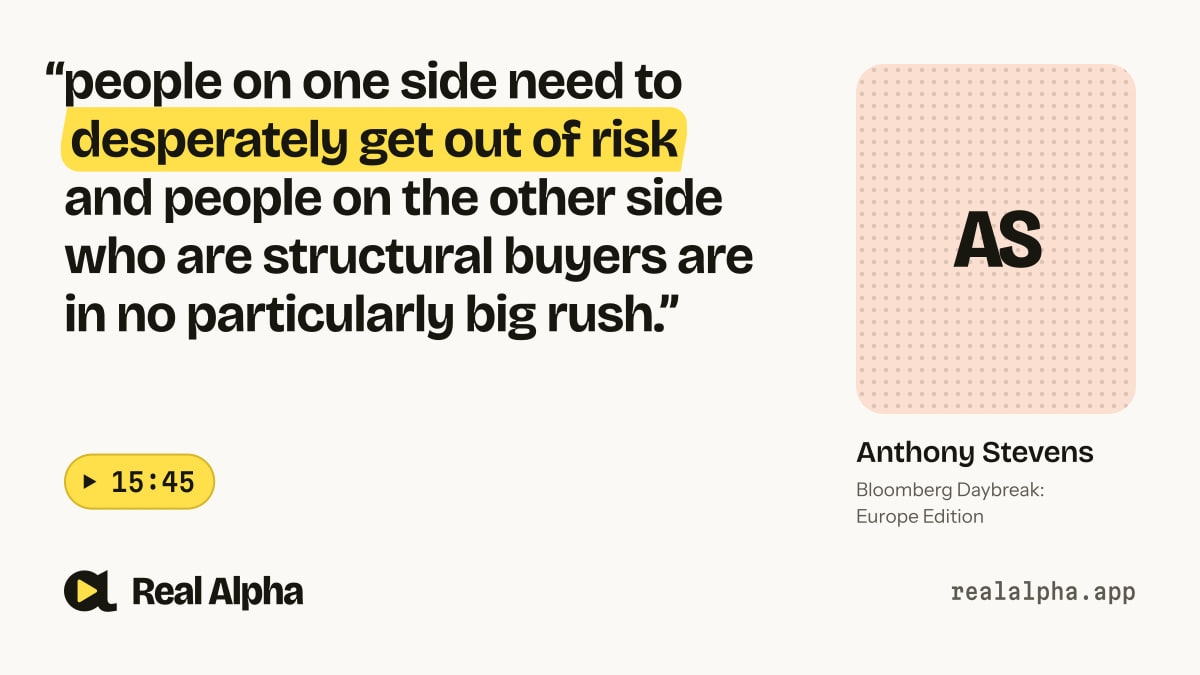
“people on one side need to desperately get out of risk and people on the other side who are structural buyers are in no particularly big rush.”
Takeaways Pro pick
- Institutions are deleveraging while local Asian investors buy the dip.
- China is less exposed after an earlier market reset and policy support.
- European consumer staples and banks could benefit from the rotation.
One of Pro's picks, open to you here. Try Pro free for 7 days
One of Pro's picks. The rest of the summary and the 3 takeaways are in Real Alpha Pro; the video, the quote and the transcript stay free.
Read it with Pro, 7 days freeAbout this segment
Anthony Stevens explains why professional investors are selling while local Asian investors keep buying. He points to regional differences and sectors that could benefit as money rotates out of US tech.
Anthony Stevens is a Bloomberg markets reporter.
From “Biggest Selloff Since 2020, $2.3 Trillion Erased, Aircraft Bomb Threats In Europe | Bloomberg...”, Nov 6, 2026. Watch the full episode
Thanks. We'll look at and fix what's off.
Transcript
From the transcript Bloomberg Daybreak: Europe Edition publishes with the episode.
- 13:03
Let's bring in Bloomberg's markets reporter, Anthony Stevens. Anthony, the big thought, is this the end of the AI rally?
- 13:13
Well, for professional investors, it probably is. In terms of the deleveraging that they need to do, that Goldman conversation was very interesting because that points to people asking for essentially institutional liquidity to get out, right? You call a sales trading desk with that level of panic, not for information, you have plenty of it, It's because you want liquidity to exit above and beyond what is in the market.
- 13:37
And clearly, they didn't find it because we saw volumes in the market in the US pick up materially into the sell-off. We saw volatility pick up materially into the sell-off. We saw implied correlation pick up any metric of equity risk that you look at. exploded overnight. And that continued into the Asian session. We have no respite from that at all. We saw markets do things that they're not supposed to do, like Korea was shut 20 minutes right after open. Almost the entire Taiwanese market opened down, limit down, right on open, including TSMC, which is an absolutely monster stock that could not care less whether data centers get built in the U.S., Australia, or Canada. There was a lot of illogical price action right on open in Asia that followed very illogical price action from a fundamental level
- 14:25
going by 2026 fundamentals in the US. And that points to people getting out of risk and having absolutely no clue what fundamentals look like in the 2028 and 2029 part of the AI trade where there was a lot of confidence just a couple of months ago.
- 14:42
I think that's extraordinary, isn't it? And also, you mentioned the cost beat. I mean, it has plunged more than 40% since June. But I think you really highlight the kind of volatile trading yesterday and today. Look, how widespread is that in Asia, though? If you look, you know, Japan, South Korea, China, how widespread is the action now in Asia?
- 15:04
So the consensus positions are getting lit up, right? So there is a lot of resistance from the local retail. I have to point that out. Local retail in Asia is very clued into AI. A lot of people have made a lot of money in the technology industry. So they are natives and they've been buying all the way down. Conviction is extremely high amongst the local retail and the local governments. They do not think that this is a bubble across the continent. But foreign professional investors, on the other hand, have risk to manage. They have careers to manage.
- 15:35
And if you see the hedge fund headlines coming out of the terminal, I count at least five headlines around hedge fund shutting down this morning. So, you have that kind of volatility mismatch, right, where people on one side need to desperately get out of risk and people on the other side who are structural buyers are in no particularly big rush. So you do see that intraday volatility. Now, to cut it up even further, China looks a lot more relaxed. China fell a lot harder than the US a lot earlier. The bubble came out of the Chinese ecosystem.
- 16:08
The frothiness came out a long time ago and valuations have kind of reset. And the government got started on a rescue much earlier than the governments in Taiwan and Korea, who are a little bit shell-shocked at the moment. Taiwan is hosting a press conference soon on market support. Korea rolled out a bunch of market support measures earlier today, but they are behind the ball compared to the Chinese.
- 16:30
So you are seeing that differentiation. Lastly, India is a complete port in the storm. You know, they got a lot of flack for missing out on the AI build out boom. And now they look like they'll be able to do it on their terms.
- 16:42
Yeah. So, lots of places then, people looking for places to hide. And I wonder, is Europe going to be that safe haven? I mean, the stock futures are not positive, but for investors fleeing AI, the UK has been a port.
- 16:57
Europe is a consensus underweight, and Europe is also potentially a winner from the rotation into consumers. That's been a massive underweight position that is a democratic priority, given the focus on income inequality and consumer confidence and affordability. So, there are European consumer staples, for example, that will benefit. The banking sector will be a hiding place, as they have been in Asia as well. You've seen banks outperform materially.
- 17:25
And then, U.S. versus Europe has been a spread that's been expanding pretty much my entire life. And it probably does look like that's going to pause for a little while. And it's a very heavy global spread trade that could keep Europe afloat as stock market allocations in the U.S. ebb away.