The alpha, twice a week
That was 3 min.
Get the best new moments in your inbox every Wednesday and Saturday. It's free.
Check your inbox
We sent a link to your address. Click it to finish signing up. Not there in a minute? Look in spam.
or
MTS · 3 min · Nov 12, 2026
Profitable memory stocks look safer than frontier labs to Erdil
 Ege Erdil
 sees memory makers as more attractive because they already earn high margins, while labs need a speculative path to profitability.
In this episode
Full analysis- 0:59Frontier labs may struggle to sustain high margins5 min
- 9:36Long-term compute commitments could put lab equity at risk3 min
- 16:20Compute and data constrain how fast AI research can acceleratePro pick 3 min
- 21:05AI timeline forecasts need measurable real-world outcomes5 min
- 12:43Profitable memory stocks look safer than frontier labs to Erdil3 min
- 6:09Low switching costs weaken AI labs’ pricing power3 min
- 25:34Erdil sees the METR report as weak evidence of AI acceleration2 min
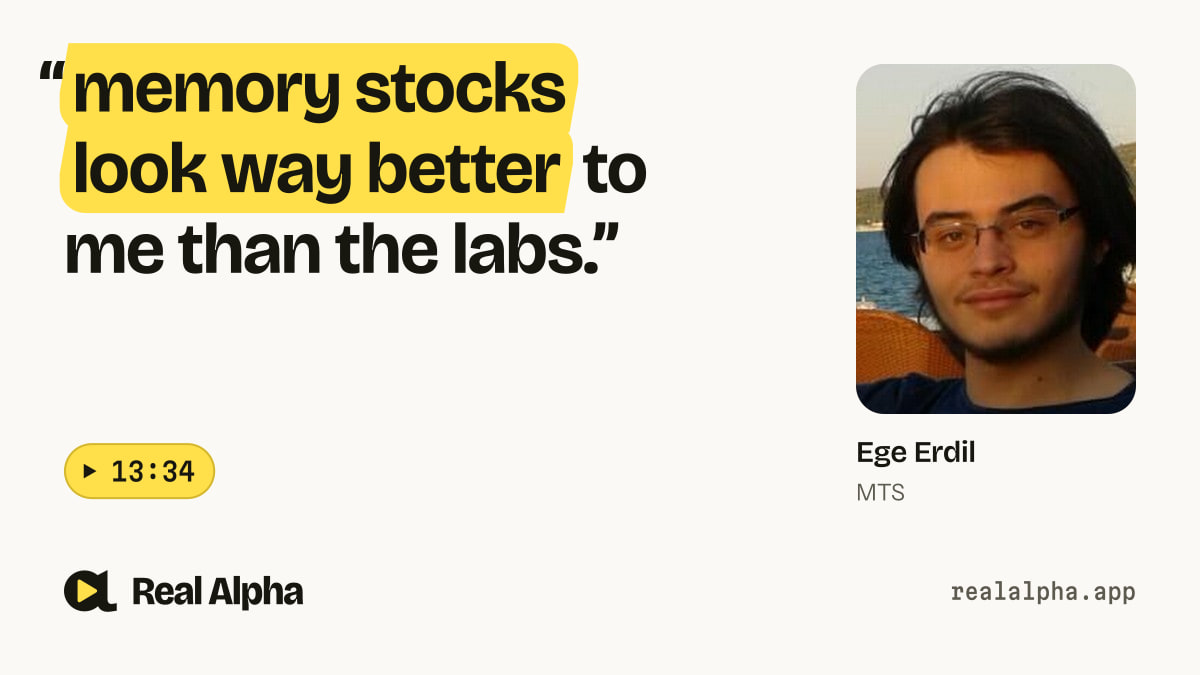
“memory stocks look way better to me than the labs.”
 Ege Erdilat 13:34 · MTS
Takeaways
- Memory makers already have high margins, unlike labs' future case.
- He considers OpenAI riskier than Anthropic, but both carry risk.
- For Nvidia, he focuses on earnings and continued revenue growth.
About this segment
Ege Erdil sees memory makers as more attractive because they already earn high margins, while labs need a speculative path to profitability. He also favors Nvidia’s earnings and growth prospects over reacting to market swings.

Ege Erdil is a research engineer at Google DeepMind; former Mechanize cofounder and Epoch researcher.
Co-authored research on algorithmic progress in language models and computer vision, and studies AI forecasting and automation.

Theo Jaffee, Host · Co-founder & host, MTS
One of the first members of a16z's new media team; earlier hosted the Emergent Ventures-backed Theo Jaffee Podcast.

Sophia Dew, Host · Host, MTS
From “Why Frontier AI Labs Could Go Bankrupt | Ege Erdil”, Nov 12, 2026. Watch the full episode
Answers “How does OpenAI make money, and is it profitable?” See all 14 answers
Answers “How do AI companies make money?” See all 72 answers
Thanks. We'll look at and fix what's off.
Transcript
Transcribed by machine (Whisper) from the episode’s audio, so a word may be off here and there.
- 12:47
for example. And so it's very risky. And I think they're aware that it's very risky. Right. Right. So what kinds of trades would you make on AI right now? Financial advice. Okay. Well, I mean, I can interpret that question in different ways. Because personally, I wouldn't really do very much. But that's due to my personal circumstances, which I don't necessarily want to go too much into. Basically, I have large positions that are correlated with AI that I can't necessarily get out of immediately.
- 13:21
So for me, I will think about it differently. But if I had just some amount of money and I had to allocate it, then I think the companies I would invest in are companies that are making a lot of money right now but that are not valued highly. So I think, like, if you want to make it better in my eye, like, memory stocks look way better to me than the labs. Like, I think memory stocks don't have to tell this weird galaxy brain story about how eventually, you know, they're going to become high margin.
- 13:48
Like, they're already high margin businesses right now. Like, they don't need to tell any story. Like, the entire hesitance is, like, whether they can sustain it. But if demand continues being very high, then they will sustain it. And then they're way safer, I think, as bets than the labs. Labs could way more easily just completely blow up. OpenAI more so than Anthropic, I think. OpenAI more risky than Anthropic.
- 14:10
But even Anthropic is very risky. Well, what about NVIDIA? You've tweeted about being an NVIDIA shareholder. You said the fair value of NVIDIA is $15 trillion, which would imply that it's substantially undervalued still. I think that's right. Why do you think that? I mean, I think just the revenue, I think, is just going to continue to grow. And I think the arguments, like, for example, the recent sell-off in NVIDIA, right?
- 14:32
I just don't see, I think that's just an overreaction. I think, like, often the market just overreacts to this kind of news, which don't really tell you very much about the long-term viable in the business. The same thing happened with, like, Google's recent early call, where I think there was a 10% drop in Google's share price or something. based on factors that I personally don't think have much relevance at all on the long-term profitability of business.
- 14:57
Like it's just like often these swings happen and like then my recommendation would be that if you think it's like unjustified, then you should just buy more and then in the long term you will do better. But like my argument is just like very simple. Like my argument is that if you can have a high margin business right now, like you already have a high margin business, then it is very strong evidence that it's possible for you to have a high margin business in the future as well.
- 15:22
You can tell some argument about, oh, how margins are going to go down in the future. They probably will if they're currently historically high. But, you know, like, you're not in the position of someone who has never been profitable, who is trying to make an argument for how in the long run they're going to have a high margin business. It's a much harder sell. So I would just anchor way more on that and sort of this objective evidence and less more about stories about, like, how the labs are going to be profitable in the future, which to me still seem quite speculative and quite vague.
- 15:52
Right. So one other thing that I want to talk about is timelines, right?