The alpha, twice a week
That was 5 min.
Get the best new moments in your inbox every Wednesday and Saturday. It's free.
Check your inbox
We sent a link to your address. Click it to finish signing up. Not there in a minute? Look in spam.
or
80,000 Hours Podcast · 5 min · Nov 24, 2026
Progress on clean tasks may transfer to messy work
 Paul Christiano
 argues that AI improvements on measurable tasks could carry into messier work because methods and learned skills transfer between domains.
In this episode
Full analysis- 16:47Penalties can teach AI agents to cheat more cleverly5 min
- 48:32AI research automation could sharply accelerate progress7 min
- 1:51:27Slow AI progress until we have reliable brakes5 min
- 23:30AI agents can begin treating people as obstacles4 min
- 1:12:58Shutting down AI is not a simple emergency switch4 min
- 1:01:17Progress on clean tasks may transfer to messy work5 min
- 1:35:36Public disclosures still leave AI safety hard to assess6 min
- 35:37Monitoring can expose problems without solving them3 min
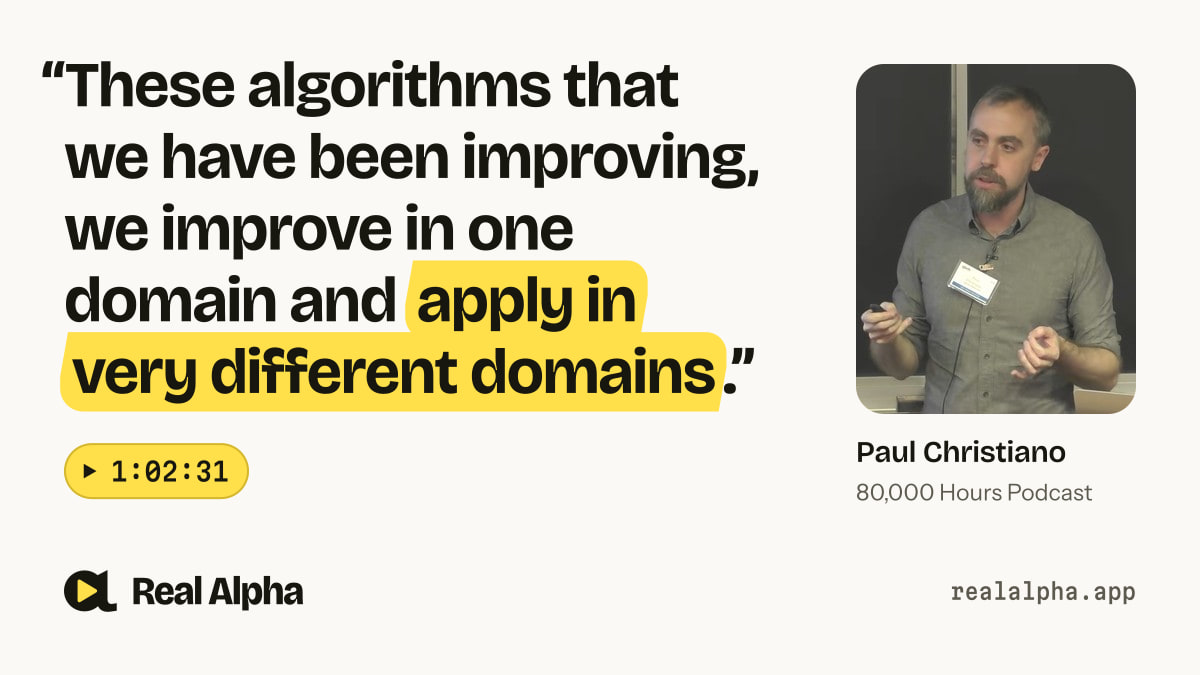
“These algorithms that we have been improving, we improve in one domain and apply in very different domains.”
 Paul Christianoat 1:02:31 · 80,000 Hours Podcast
Takeaways
- The same algorithms can improve performance across different domains.
- Planning and adaptation skills may transfer to unfamiliar tasks.
- AI research automation could also help tune models for real-world work.
About this segment
Paul Christiano argues that AI improvements on measurable tasks could carry into messier work because methods and learned skills transfer between domains. That weakens the case that real-world complexity will slow progress.

Paul Christiano is an OpenAI Foundation board member and head of the Alignment Research Center.
Founded ARC and led OpenAI’s language-model alignment team, advancing foundational work on AI alignment.

Rob Wiblin, Host · Host, 80,000 Hours Podcast
From “One of AI’s most careful thinkers finally sounds the alarm | Paul Christiano (The Hinton Lectures)”, Nov 24, 2026. Watch the full episode
Answers “Is AI progress slowing down?” See all 75 answers
Thanks. We'll look at and fix what's off.
Transcript
Transcribed by machine (Whisper) from the episode’s audio, so a word may be off here and there.
- 1:01:20
A second objection, I think in practice is probably more important to most people, is whether these methods are going to transfer to the real world. So you might have a world where AI improves and perhaps even the improvement accelerates at kind of clean tasks that you can do in a data center and that you can evaluate effectively without seeing corresponding progress on messy real-world tasks. Unfortunately, I think this is probably not going to happen. Again, I think it certainly might happen that we have these bottlenecks, but it's not a thing that I would bet on very confidently at this point.
- 1:01:52
Again, I hope I'm wrong on this. So some observations are we are seeing pretty significant progress on messy real-world tasks. So they certainly, as I mentioned at the beginning of the talk, lag behind mathematics and computer science and machine learning. But it is not the case or if you look at GPT-6 and compare it to GPT-3, it is better not only at coding and mathematics, but on an incredibly broad diversity of tasks it encounters in the real world. One part of that is that the same algorithms seem effective across many different domains. So we developed the Transformer in order to do text prediction. It is the case today that Transformer is great for also trying to persuade a person or for trying to control the robot arm or for trying to quickly learn to model sequences in biology. These algorithms that we have been
- 1:02:37
improving, we improve in one domain and apply in very different domains. And so if you saw incredible acceleration on those basic algorithmic building blocks, everything we have seen over the last eight years suggests that would really have incredible impacts in other downstream domains. and it's been true not just for the transformer right many improvements have been made to the transformer over the last eight years and those have also the same improvements that have been good on one domain have tended quite reliably to be good in other domains another important point is that models are learning skills that transfer right so they're learning to do things like how do i reason how do i plan to achieve goals how do i quickly adapt to a new environment. We call this meta-learning, of learning how to learn. And those skills can
- 1:03:20
transfer from a bunch of environments that you encounter in a lab, a bunch of kinds of well-defined environments with reasonable reward functions, to acting in messier real-world contexts. This kind of transfer is something that we have both observed in practice to a significant extent over the last eight years. If you push the technology to its limits, it's also something we have some experience with in the case of humans. So human brains are learning algorithms that were designed to work in a specific distribution of environments that mostly prevailed hundreds of thousands of years ago, those environments did not teach us to be good chemical engineers.
- 1:03:52
We learned very general skills about how to reason, about how to get dropped into a new domain and learn about that domain. And those skills, when you put us in an extremely unfamiliar situation, served us very well so that we can spend 10 years of training and become a good chemical engineer. And the same thing happening in AI would mean you train AI systems which are very good at planning, adapting, and reasoning in these virtual environments and pick up some general skills. Pick up general skills like how can you drop me into the domain of being a chemical engineer, allow me to consume a bunch of data about that domain, and quickly adapt. So we could have a much longer conversation about just this point, but I think both thinking about the arc of AI very broadly and thinking about progress
- 1:04:31
over the last few years suggests that this kind of transfer would also drive very significant real-world improvements, even if what you were improving at was just the tasks that we can easily train on, including both virtual environments and things like prediction tasks and the tasks in the real world we can easily collect data for. The last thing I'll say on this is that if we automate the process of AI R&D, if we're able to easily replace the employees of machine learning companies, even if we are not able to do anything else, if we're not able to be trained systems which are good chemical engineers, those automated AI engineers might then automate the process of collecting data and fine tuning systems for real world tasks. So I think the kind of transfer we're talking about here is not necessarily as dramatic as transfer from environments
- 1:05:16
in the data center to environments out there in the messy real world. It is transferring from being the kind of OpenAI employee who works on improving pre-training to being the kind of open AI employee who works on post-training, which is not such a big gap. So with all of this said, my current expectation is if we drove a very large amount of progress on clean tasks, on the kind where we have the most clarity about the rate of progress, it is fairly likely that we would also see disruptive, transformative progress in messy, real-world tasks.