The alpha, twice a week
That was 3 min.
Get the best new moments in your inbox every Wednesday and Saturday. It's free.
Check your inbox
We sent a link to your address. Click it to finish signing up. Not there in a minute? Look in spam.
or
Bloomberg Law · 3 min · Nov 19, 2026
Proposed green card rules could worsen health care shortages
 Leon Fresco
 describes proposed changes to employer green card recruitment, including longer hiring periods and limits after layoffs.
The episode’s best minutes
Full analysis- 9:56Pressure to win can push prosecutors below DOJ standardsPro pick 2 min
- 14:42Warrant rules could constrain ICE’s 3,000-arrests-a-day goal3 min
- 28:27Proposed green card rules could worsen health care shortages3 min
- 4 more moments in the full episode
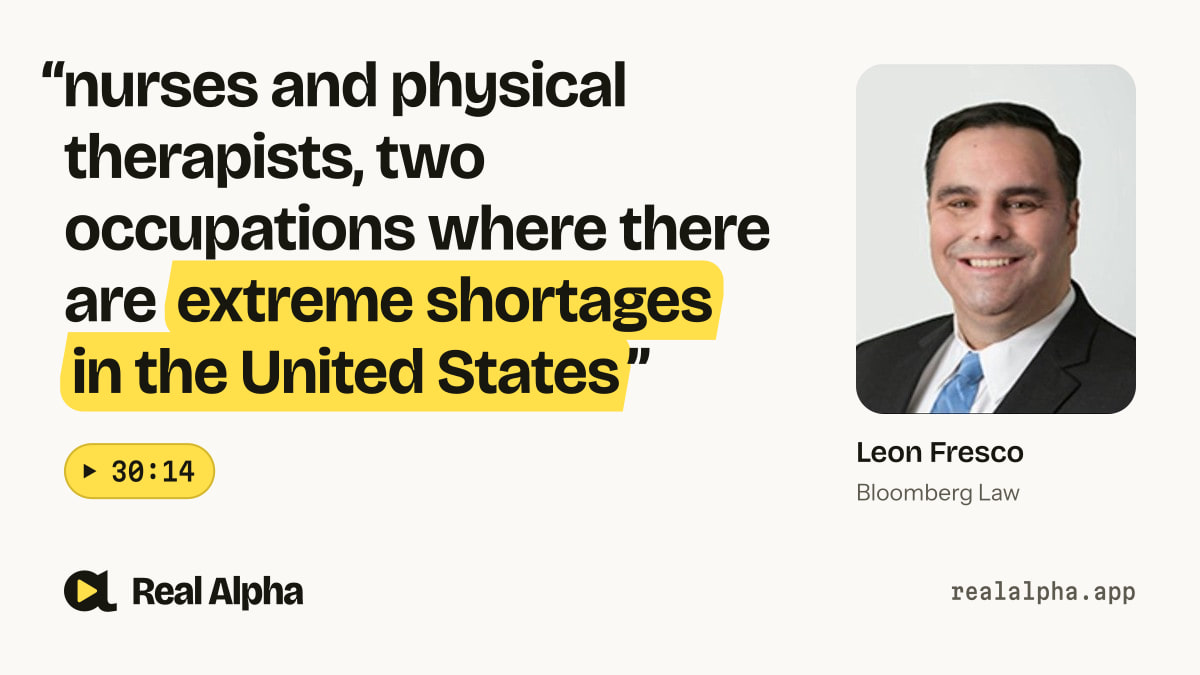
“nurses and physical therapists, two occupations where there are extreme shortages in the United States”
 Leon Frescoat 30:14 · Bloomberg Law
Takeaways
- Employers would have to recruit for 90 days, up from 60.
- Recent layoffs could bar green card applications for similar jobs.
- Nurses and physical therapists would lose shortage-occupation treatment.
About this segment
Leon Fresco describes proposed changes to employer green card recruitment, including longer hiring periods and limits after layoffs. Ending shortage treatment for nurses and therapists could deepen staffing gaps.

Partner, Holland & Knight
Drafted the Senate’s 2013 immigration reform bill and oversaw federal civil immigration litigation at DOJ.
- JG
June Grasso, Host
From “Crisis at Chicago US Attorney's Office & ICE Warrantless Arrests | Bloomberg Law”, Nov 19, 2026. Watch the full episode
Thanks. We'll look at and fix what's off.
Transcript
From the transcript Bloomberg Law publishes with the episode.
- 28:29
The Department of Labor this week has said, and we've already had these very interesting scenarios where they banned Microsoft and Adobe and a lot of Indian companies from petitioning for green cards for employers. And they've tried to have this theory that, look, we used to have these regulations that said, here's the way you have to show that an American worker isn't available in order for you to get your foreign worker a green card, meaning lawful permanent residence.
- 28:55
But what the companies have pushed back and what they've said is, yeah, but you wrote the regulation and we just follow it. So it's not our fault if we can't find American workers using the antiquated ways you told us to do it. And so that debate is happening on one side. But now what the Department of Labor is saying is, Moving forward, we're not going to allow that debate to continue. We're going to have a new regulation that says, however you recruit workers now for jobs, you have to do that for jobs where you're trying to, at the end of the rainbow, have a foreign worker get a green card. So if you use monster.com or if you use an internal ad or if you use a headhunter or whatever you do, you have to do the same thing for the job where you're not theoretically trying to find an American because you want the foreign
- 29:43
worker to get the job. In addition, they're going to make the employers now have to recruit Americans for 90 days, which is longer than the 60 days. And they're going to ban jobs. green cards if there's been a layoff of a US worker in the same or similar occupation in the last two years. And so a lot of tightening is going to happen where it's going to be very, very difficult for foreign workers to be able to stay here permanently and get a green card. One other very interesting thing is that for the longest period of time, nurses and physical therapists, two occupations where there are extreme shortages in the United States and where we import a lot of people from the Philippines and Nigeria and sometimes the Middle East, and you see all these people in hospitals, now they will not be presumptively viewed as as occupations
- 30:39
that are shortage occupations. So now, if a hospital wants to get a nurse, they have to go through the same very lengthy process that every other industry needed to go through. And that's going to be a dramatic change in the healthcare industry, which if there isn't more U.S. education for nurses and physical therapists, is going to lead to dramatic shortages.