The alpha, twice a week
That was 2 min.
Get the best new moments in your inbox every Wednesday and Saturday. It's free.
Check your inbox
We sent a link to your address. Click it to finish signing up. Not there in a minute? Look in spam.
or
Masters in Business · 2 min · Nov 18, 2026
Public backlash can make companies reverse pricing plans
 Lindsay Owens
 describes how consumer outrage forced Coca-Cola to retreat from a plan to raise vending-machine prices on hot days.
The episode’s best minutes
Full analysis- 2:44Compare prices across accounts before you buy2 min
- 18:38Public backlash can make companies reverse pricing plans2 min
- 5 more moments in the full episode
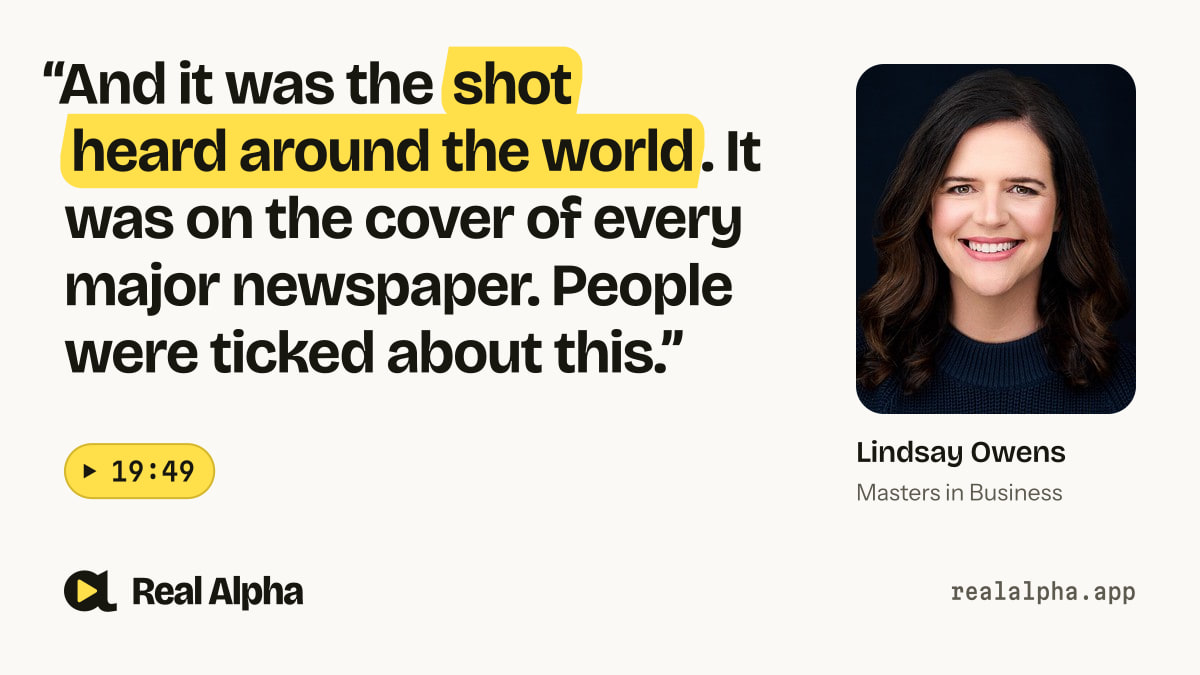
“And it was the shot heard around the world. It was on the cover of every major newspaper. People were ticked about this.”
 Lindsay Owensat 19:49 · Masters in Business
Takeaways
- The Coke vending-machine idea sparked widespread outrage.
- Pepsi used the controversy to its advantage.
- Consumer backlash helped prompt companies to walk back plans.
About this segment
Lindsay Owens describes how consumer outrage forced Coca-Cola to retreat from a plan to raise vending-machine prices on hot days. She says public pressure can be one of the fastest ways to change corporate behavior.

Lindsay Owens is CEO of Groundwork Collaborative and author.
Exposed corporate pricing power and profiteering, shaping debate on inflation, affordability and consumer protection.
- BR
Barry Ritholtz, Host
From “At The Money: Shopping in an Era of Surveillance Capitalism | At the Money”, Nov 18, 2026. Watch the full episode
Thanks. We'll look at and fix what's off.
Transcript
From the transcript Masters in Business publishes with the episode.
- 18:41
How significant is public backlash? Hugely, hugely significant. I mean, I really think one of the quickest ways that we can discipline companies who go too far with their pricing practices is to scream and yell and like and share and tweet, right? It is absolutely the case that consumer backlash is a powerful force in convincing companies to go in a different direction. Voting with your wallet is matters. And throughout history, we've seen so many examples of consumer backlash, really changing corporate behavior. One of the examples I love to talk about, which I include in the book is, you know, actually in the mid 1990s, the CEO of Coke said in an offhanded interview to a Brazilian magazine that Coke was piloting installing thermometers in their vending machines. Again, this was in the 90s. to
- 19:43
hike the price of a Coke on a hot day. And he said he thought it was reasonable. People would pay more on a hot day for an icy cold. Coke out of the vending machine. And it was the shot heard around the world. It was on the cover of every major newspaper. People were ticked about this. And they immediately had to walk it back. I mean, Pepsi really seized on the PR gaffe and everything. you know, saw their moment for an advantage and Coke walked it back.
- 20:14
And we saw that help in with Delta. Their partnership with Fetcher was revealed by my organization and, you know, Southwest and American jumped on it. And I think that was a big part of why Delta walked back some of their plans. Obviously with the Instacart study, my organization helped conduct, you know, consumer backlash was critical there. Two weeks later, you know, their, you know, corporate issued a letter saying they would not use these practices. So I actually do think the quickest way to immediate action by far is consumer backlash.