The alpha, twice a week
That was 5 min.
Get the best new moments in your inbox every Wednesday and Saturday. It's free.
Check your inbox
We sent a link to your address. Click it to finish signing up. Not there in a minute? Look in spam.
or
Prof G Markets · 5 min · Oct 26, 2026
Public markets price AI risk more cautiously than private markets
 Ed Elson
 argues that public-market investors are discounting AI companies for uncertain returns and rising spending.
The episode’s best minutes
Full analysis- 7:58The merger shifts attention from Tesla’s weakening car businessPro pick 8 min
- 18:43A SpaceX merger could dilute Tesla shareholders’ protectionsPro pick 5 min
- 55:55Public markets price AI risk more cautiously than private markets5 min
- 3 more moments in the full episode
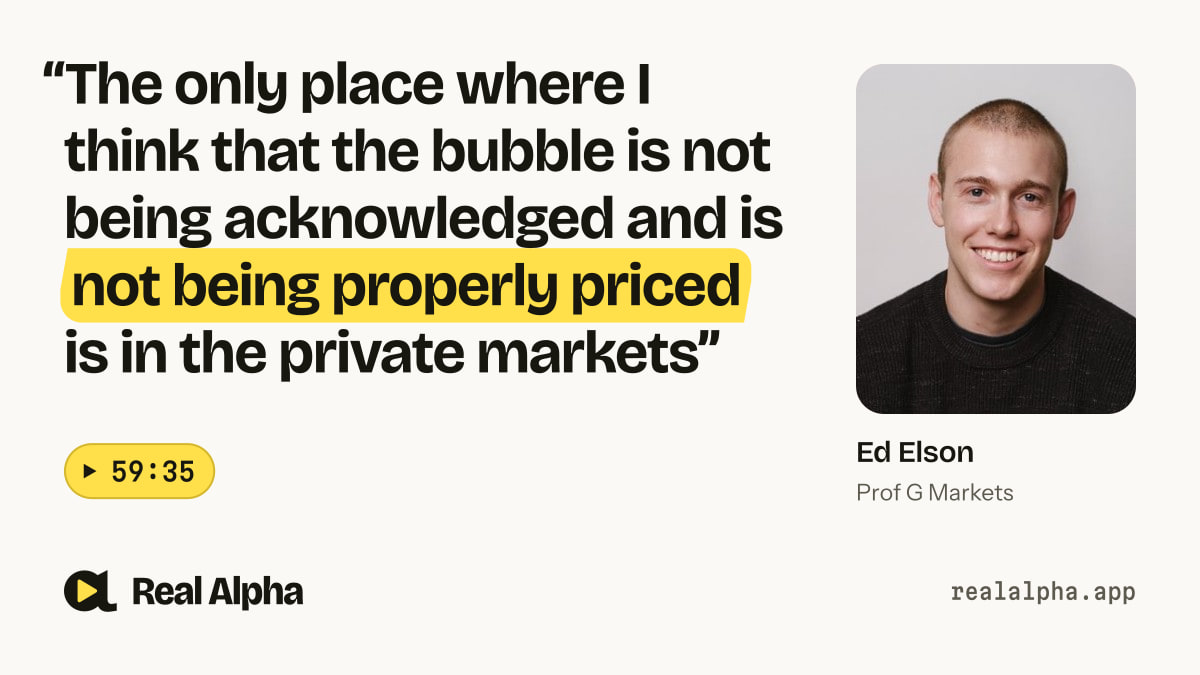
“The only place where I think that the bubble is not being acknowledged and is not being properly priced is in the private markets”
 Ed Elsonat 59:35 · Prof G Markets
Takeaways
- Rising capital spending is weighing on free cash flow.
- Public-market valuations have reflected concerns about future profits.
- Private-market AI valuations may not reflect the same risks.
About this segment
Ed Elson argues that public-market investors are discounting AI companies for uncertain returns and rising spending. He sees the bigger pricing gap in private markets, where risk may be overlooked.

Ed Elson, Host

Scott Galloway, Host
From “The $3.5T Bailout: Elon's Plan To Merge Tesla And SpaceX”, Oct 26, 2026. Watch the full episode
Answers “Is AI a bubble?” See all 30 answers
Thanks. We'll look at and fix what's off.
Transcript
Transcribed by machine (Whisper) from the episode’s audio, so a word may be off here and there.
- 56:07
this thing is going to be a disaster. I think when you look at a lot of the reporting, they're actually playing along with a lot of the accounting gymnastics that are making these businesses seem better than they are. I mean, the $80 billion loss, I don't think anyone took that seriously and was like, oh my God, they lost $80 billion. Like everyone knows that there is the giant caveat of the $72 billion write-off.
- 56:28
So I think what people are more focused on is the $8 billion or the- It's not a write-off. It's the way it's accounted for. Conversion, excuse me. Convertible debt, the conversion. Yes. Yeah, it turns to a loss. I think what they're focused on is the $8 billion, which is a lot of money. And you point out that, like, the margins are expanding on these cloud businesses. But yes, but also the free cash flows are getting obliterated and they're now going negative.
- 56:54
And the CapEx, you know, we're not seeing that in the margins because the CapEx has to get depreciated over time. But, you know, Amazon is negative free cash flow. Google, Meta just reported their earnings. negative free cash flow as well. And it's still up for debate, like, will the ROI appear? Will MetaMuse be enough to justify the $145 billion in capital expenditures that they're going to spend this year? And as they just told us this week, that might go up to $800 billion over the next few years. So they're going to spend hundreds of billions of dollars. And I think it is still an open question as to whether any of that will pay off.
- 57:36
I think it is a very big one. Where I would agree... with you is that when you look at the stock market right now all of that anxiety all of that risk i think is being priced in and and you look at the stock performances of some of the names that you just mentioned uh nebius which is another neocloud down 31 over the past month core weave down 52 over the past month the bigger names oracle negative 15 micron negative 18 the the semiconductor basket, the whole ETF is down 15% in just the past month. And then you look at the multiples on some of these names, like NVIDIA, where, you know, its stock has gone up, but its earnings have exploded even higher than the stock. And so essentially what's happened is that the forward earnings multiple has gotten cut in half over the past year. And to me,
- 58:27
that is investors saying like, yeah, we know that profits are rising, but we're anxious about the sustainability of these profits. So we're going to discount the future value of this company because we don't think that it's necessarily as reliable as we might have thought a year or two ago. And so that to me is the market saying like, no, we get the risks. We understand them. Like, I think investors are actually pricing this stuff in. And I don't think that was necessarily true for a lot of these AI names a year ago, but that's why a lot of them have kind of, you know, Some of them have lagged.
- 58:59
Some of them have come down in recent months. So I think that there is significant risk here. I think that there is, I mean, I think we're seeing all of the telltale signs of a boom and bust cycle where, similar to the railroads in 1873, you buy a lot of this stuff. There's a gold rush. Everyone's excited about it. We buy as many chips as we can. And then we learn, oh, hold on. Actually, it's going to take a long time to build the data centers.
- 59:27
it's going to take a long time to get the power generators and the power transformers connected to the data centers and connect this stuff to the grid. So actually, maybe we overbought because I know this because I'm looking at my warehouse and we've got billions of dollars of chips right now that are just sitting around collecting dust. So I think all of that stuff is happening, but investors are pricing it in. The only place where I think that the bubble is not being acknowledged and is not being properly priced is in the private markets where i think that their risk profile is totally different i think that vcs in silicon valley are basically just like we love the technology this guy's an awesome founder who cares one and a half trillion dollars two trillion dollars doesn't matter but i think that when anthropic and opening
- 1:00:14
i go public they're going to be entering into a different world where investors are going to be a lot more um discerning uh and i think that they're going to be in for a rude awakening because of that and we might have discussed that last week but to me the bubble in terms of where prices or or assets are not being correctly priced or risk is not being correctly priced it's in the private markets, whereas the public markets, you look at the valuations and they seem to be reflecting a cautious optimism about the whole thing. They seem to recognize that, yeah, CoreWeave might default. And that's why credit default swaps are skyrocketing right now. So I think the bubble's there, but it's priced. So when I was a sophomore at UCLA, I know you want more