The alpha, twice a week
That was 4 min.
Get the best new moments in your inbox every Wednesday and Saturday. It's free.
Check your inbox
We sent a link to your address. Click it to finish signing up. Not there in a minute? Look in spam.
or
MTS · 4 min · Nov 11, 2026
Real-world data does not show runaway AI self-improvement
 Ramez Naam
 argues that ECI gains and revenue growth don’t prove compounding self-improvement.
The episode’s best minutes
Full analysis- 4:48Real-world data does not show runaway AI self-improvement4 min
- 10:29AI task-horizon forecasts exceed observed performancePro pick 5 min
- 21:44Verifiable domains favor superintelligence more than messy onesPro pick 4 min
- 2 more moments in the full episode
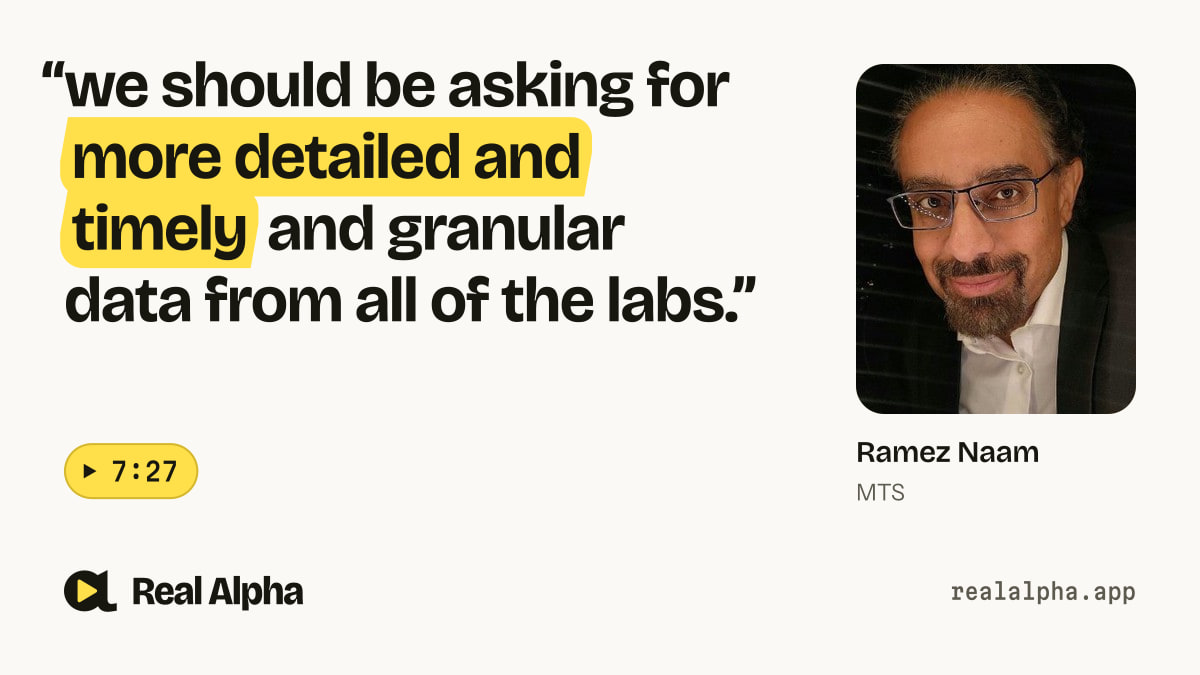
“we should be asking for more detailed and timely and granular data from all of the labs.”
 Ramez Naamat 7:27 · MTS
Takeaways
- More capability can raise revenue without proving recursive improvement.
- Observed task-horizon growth is sublinear or linear at best.
- Naam wants granular, timely data from AI labs.
About this segment
Ramez Naam argues that ECI gains and revenue growth don’t prove compounding self-improvement. He says measured task horizons and lab data show much weaker feedback loops than theory predicts.

Ramez Naam is an investor at Planetary VC.
Invests in AI, climate, and energy; previously led Microsoft teams in AI, search, email, and browsing.

Theo Jaffee, Host · Co-founder & host, MTS
One of the first members of a16z's new media team; earlier hosted the Emergent Ventures-backed Theo Jaffee Podcast.

Sophia Dew, Host · Host, MTS
From “Why Recursive Self-Improvement Hits a Wall | Ramez Naam”, Nov 11, 2026. Watch the full episode
Answers “Is AI progress slowing down?” See all 75 answers
Thanks. We'll look at and fix what's off.
Transcript
Transcribed by machine (Whisper) from the episode’s audio, so a word may be off here and there.
- 4:52
Claude from 80,000 hours countered your post by pointing out that higher levels of ECI are exponentially more valuable because Claude with lower ECI could earn, you know, very small amounts of revenue. Claude with higher ECI, in other words, more capable Claude, is capable of earning a lot more revenue. Yes, there's, you know, some confounding factor here in that, like, there's also, like, a lag in terms of how quickly Claude can grow revenue.
- 5:20
So, presumably, if Claude had not progressed in fundamental capability, its revenue would have still grown just through diffusion. However, I think that the rate of revenue growth from Claude is probably pretty clear that this is largely due to capabilities growth. And if we only had Claude 1 from 2023, it wouldn't be earning tens of billions, high tens of billions of revenue. um so basically it's not about uh dollars in versus capabilities out it's dollars in versus dollars out and so if anthropic can continue exponentially growing its revenue then it can continue exponentially growing its capabilities i broadly agree and i have deep respect for benjamin i love 80 000 hours i point people there who are concerned about ai safety all the time for ways to get involved and i have a lot of respect for everybody that's built these models
- 6:16
But, you know, all models should be subject to being checked against reality. And while the theory of ECI, the way that it's constructed, is that every ECI point is like a little bit of an exponential increase in capabilities, that is not matched by real-world data. It is true that the current cloud models are just qualitatively head and shoulders above the very early AI models that we had even a few years ago.
- 6:47
So there are threshold effects. But if you want to measure, say, does each additional point of ECI get you a compounding effect on AI progress? Does it give you a compounding effect on the number of experiments per researcher that you run, for instance? Does it give you a compounding effect on the task horizon in real-world data, which we only have from OpenAI and Google? Mind you, we don't have it from Anthropoc.
- 7:14
The answer is no. The best fit is like steeply sublinear or linear at best. Now, we don't have enough data. And so I can give you my priors. But actually, the most important point I'm going to make in this whole segment, however long it goes, is we should be asking for more detailed and timely and granular data from all of the labs. Anthropic has done a great job in model cards, but OpenAI actually set the standard because OpenAI put out this report in late August, I think, that had month by month, what was the length of task that the models they were using internally could accomplish at what success.
- 8:00
And that allowed us, that was the first time we had really a real-world data set about AI research itself that allowed us to chart the progress, and that progress was not exponential. Now, it's too short a time frame. It was January to August. It's from one lab. We don't know exactly which model is being used at which point, but it's more granular data than anyone else has put out. DeepMind followed that in the Gemini 4 Argonne report with a single month period.
- 8:30
And we should be asking all the labs to give us that data because I want to emphasize again, all of these runaway RSI models are based on theory. They're based on math people have written down. We need to actually calibrate that against what actually happens in the real world. And with the data that we have, when you do calibrate it, the real-world effect of AI on improvement of itself is much, much slower and has a much harder slope, much more diminishing returns, than you get in the theoretical models that people have written down.