The alpha, twice a week
That was 3 min.
Get the best new moments in your inbox every Wednesday and Saturday. It's free.
Check your inbox
We sent a link to your address. Click it to finish signing up. Not there in a minute? Look in spam.
or
Unsupervised Learning · 3 min · Jun 12, 2026
Recursive self-improvement may advance without a takeoff
 Ari Morcos
 says models are showing promise at improving parts of AI research, but compute and human limits constrain the pace.
The episode’s best minutes
Full analysis- 3:24Near-frontier open-weight models may disappear4 min
- 32:27Compute shortages could restrict access to model APIs3 min
- 49:15Recursive self-improvement may advance without a takeoff3 min
- 5 more moments in the full episode
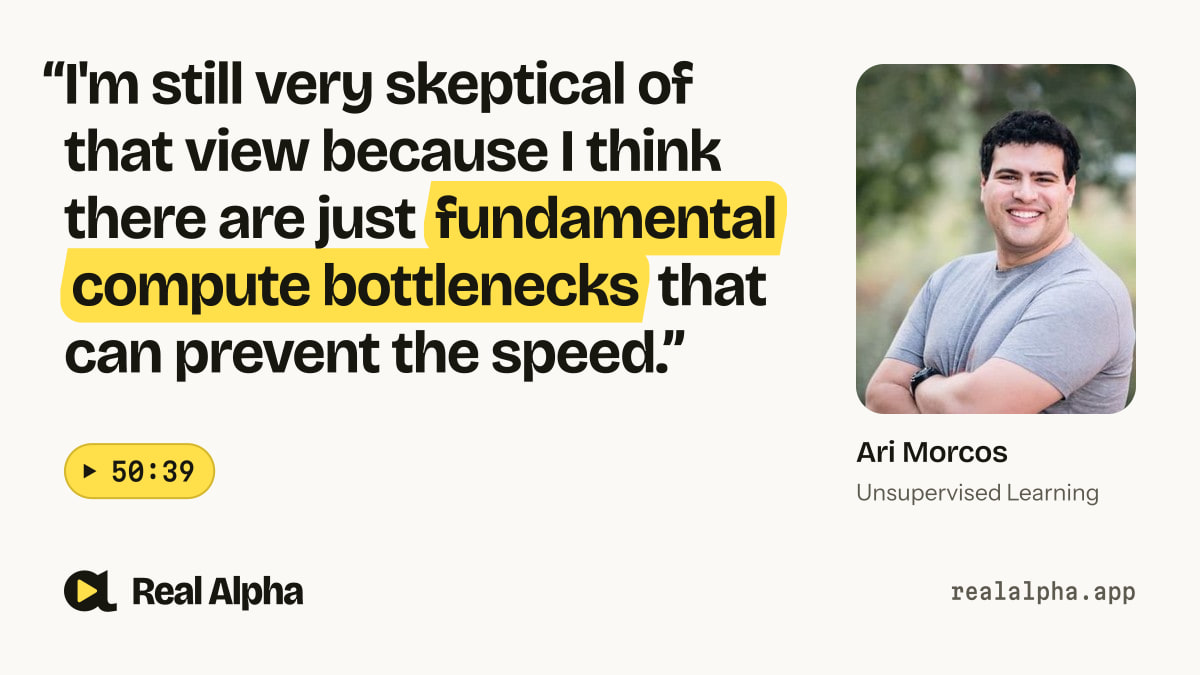
“I'm still very skeptical of that view because I think there are just fundamental compute bottlenecks that can prevent the speed.”
 Ari Morcosat 50:39 · Unsupervised Learning
Takeaways
- Ari is more bullish on RSI than six months ago.
- Compute bottlenecks could slow any rapid takeoff.
- Several well-funded labs can pursue the same work.
About this segment
Ari Morcos says models are showing promise at improving parts of AI research, but compute and human limits constrain the pace. He sees progress toward recursive self-improvement without a runaway winner.

CEO, Datology AI
Co-founded DatologyAI's data curation platform; former Meta FAIR and DeepMind researcher with NeurIPS and ICLR best papers.

Jacob Effron, Host · Managing Director, Redpoint
Growth investor in Abridge, Ramp and Physical Intelligence; ex-Flatiron Health.
From “AI Vibe Check: Lab Wars, Why APIs Might Vanish & Future Predictions”, Jun 12, 2026. Watch the full episode
Answers “What will AI look like in the next few years?” See all 395 answers
Thanks. We'll look at and fix what's off.
Transcript
Transcribed by machine (Whisper) from the episode’s audio, so a word may be off here and there.
- 49:19
How close do you guys think we actually are? And, like, you know, is Andre deciding it's time to go back in? Like, how much of a signal is that? I think we're closer. My estimate is that we're much closer now than we were six months ago, I would say. So I do think this is something that has changed and that I've become one of the places where my mind has changed a little bit, where, you know, I've become more bullish on this direction.
- 49:39
I do still think that the bottlenecks are in compute, fundamentally. I think we talked about this in maybe the last episode, that, like, ideas are not necessarily the challenge. Even execution is not necessarily the challenge. um it's you have to actually then go and run the experiments um and that takes compute um so i i do think there's going to be some bottleneck on the pace of improvement um but we are we are clearly getting to the point where models can improve themselves you know we've started to do a number of experiments here around you know just having agents uh do the curation itself uh in various ways with various amounts of guidance and like seeing far more promising results out of that than I would have expected.
- 50:22
So there's a lot in this direction. I think there is a lot of reason to be very excited about it. I do think, though, that lots of people will be able to do the same thing. So I think the flip side of this is there's this view of RSI where it's like, okay, now there's one player that's going to go super-duper fast and run away, and then nobody can compete with it. I'm still very skeptical of that view because I think there are just fundamental compute bottlenecks that can prevent the speed.
- 50:51
And also like there are 10 companies at least at this point that have the funding, the talent and the know-how to work on this. It's not something that I think is gonna be like fundamentally limited to a small group of people. I was expecting you to be more skeptical, Ari, on the whole notion of recursive self-improvement, but it's interesting that you are a believer in it and yet you don't buy into this kind of like takeoff narrative.
- 51:18
Like, what would that look like for a lab to, like, crack true RSI and yet not have this sort of exponential takeoff? Is it just the compute as a limiter, basically? I think that's where a lot of it, like, compute is a fundamental limiting factor with respect to this. And also, like, getting, having just, like, more humans only makes you go faster to a certain point. And I think there is a question of, like, how much better than humans is it going to be?
- 51:44
It's clearly coming to the point where it can be comparable to a junior AI researcher. Having just an army of junior AI researchers get you so far, so will it continue past that? And then I think there will be some speed limitations. But I will say, like, I was a lot more skeptical of it, you know, six months ago. And I think, you know, we have seen some clear progress here. I think also you look at some of the actions that some of the labs are taking, Anthropic is slowing down on hiring a lot of junior folks.
- 52:14
That starts to drive, you know, more confidence that this is possible. But I think it's going to be a lot slower than people say.