The alpha, twice a week
That was 5 min.
Get the best new moments in your inbox every Wednesday and Saturday. It's free.
Check your inbox
We sent a link to your address. Click it to finish signing up. Not there in a minute? Look in spam.
or
How I Invest · 5 min · Nov 18, 2026
Regulated workflows and organized data can defend against AI
Todd Abbrecht argues that customer relationships alone may weaken as preferences shift, while regulated, deterministic work and protected data may remain defensible.
In this episode
Full analysis- 22:14AI may erase the margins of white-collar services firms3 min
- 26:03AI-resistant investments need defensibility and a tailwindPro pick 3 min
- 47:58Pre-auction relationships can reduce the price of a deal3 min
- 51:39THL underwrites against IPO dependence as an exit3 min
- 41:02THL brings its operating team into sourcing, not just diligence6 min
- 31:07Regulated workflows and organized data can defend against AI5 min
- 1:00Private equity shifted from deal execution to value creation3 min
- 6:59THL lines up co-investors well before an auction4 min
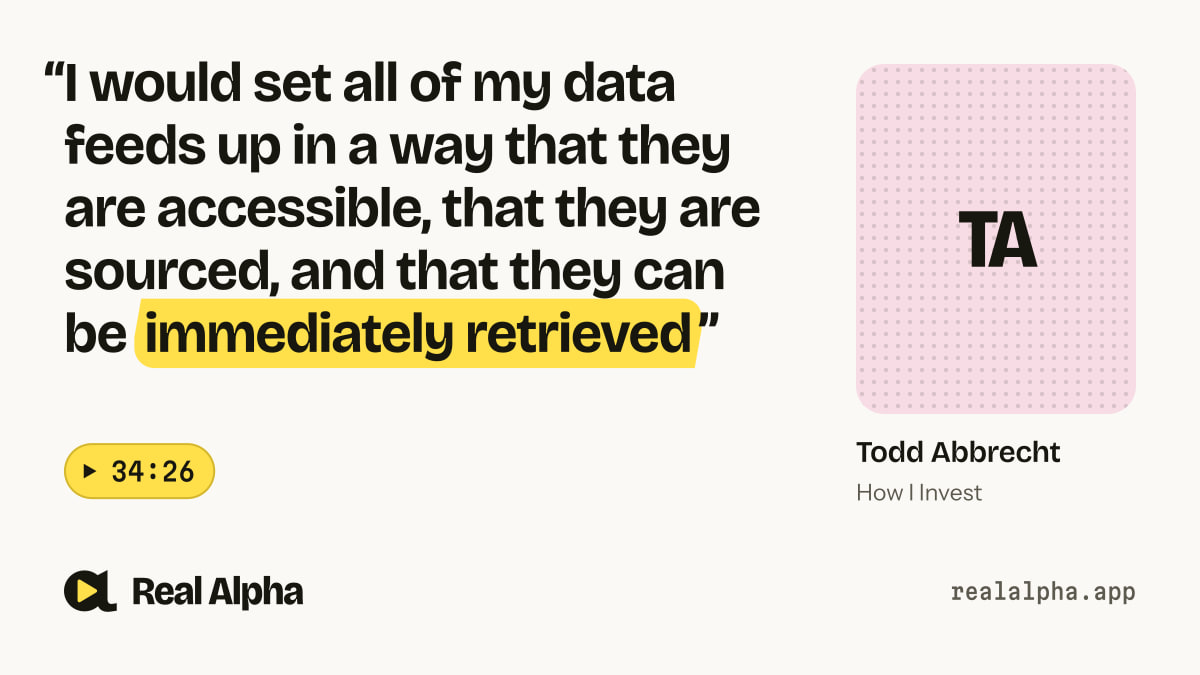
“I would set all of my data feeds up in a way that they are accessible, that they are sourced, and that they can be immediately retrieved”
Takeaways
- Customer relationships can fade as customers prefer screen interfaces.
- Regulated, deterministic work may still require humans or automation.
- Proprietary data needs protection, organization and ready access.
About this segment
Todd Abbrecht argues that customer relationships alone may weaken as preferences shift, while regulated, deterministic work and protected data may remain defensible. He stresses making proprietary data accessible and organized.
Todd Abbrecht is Co-CEO of THL Partners.
Led investments across THL’s sectors since 1992, with particular expertise in healthcare and service on numerous portfolio boards.

David Weisburd, Host
From “THL Partners’ Todd Abrecht: Private Equity’s AI Reckoning, Building Moats, and the Art of the Buyout”, Nov 18, 2026. Watch the full episode
Thanks. We'll look at and fix what's off.
Transcript
From the transcript How I Invest publishes with the episode.
- 31:19
So I've been on a treasure hunt the last six months trying to collect as many moats post AI because I think six months ago, people were still... You referenced it, sitting around thinking, well, what is AI gonna do? Is it real? Is it not? Are are these pilots turning into real real customers? And now pretty much everybody has resigned to the fact that AI is here, and it's here to stay. So I've been collecting these post AI moats.
- 31:44
So you you referenced one of them, the customer moat. I think it's probably one of the most underrated, the relationship with the customer. Why? Because human beings are still emotional beings. They have trust. All these things are not gonna go away until AI is basically running everything. I love that moat As a long only five year investor who needs someone to believe in another five years, it is really hard for me to rely on it on its own.
- 32:10
I need something more durable for the the very last thing you said until, you know, bots are running the world. I have watched human behavior change pretty dramatically over the last ten years. I used to invest in some interesting consumer businesses, Dunkin' Donuts, Aramark, Phobo de Chao. And one of the things we saw from 2005 to 2015, particularly at something like a a quick service restaurant, customers don't wanna talk to a person.
- 32:39
The the So not negative? Yes. They wanted to interface with a screen where their order is perfect. They don't want a conversation for that particular engagement, and they don't want mistakes. So I think that relying entirely on that human engagement can be something that over a period of time gets foggier and foggier. So that's a harder one, I think. Yeah. So there goes that moat. So It's not... Maybe it's not a moat.
- 33:07
Maybe it's a a moat with a sandbar. I don't know. So the other the other moat, you didn't reference it, but I think it was implicit in your thesis, is the regulatory moat. Yep. I think it's also very underrated moat. Yes. It's a very good one. Laws don't change. There's all sorts of lobbying. The... What I might call corruption, but regulatory capture. Yes. What do you think about that one? I agree with that one.
- 33:29
I would bill it as the need for a deterministic activity. So... Which is something that AI can't do, particularly in a regulated environment, filling out a profile for a life insurance contract and illustrating a life insurance contract. That is something that is regulated, is very deterministic, and is not perfect for AI. AI can be part of it, but you're still gonna need either a human or workload automation involved to make sure that you're achieving that.
- 33:55
So deterministic for sure. That's okay. That's one. I like that one for now. This is fun. I like this new Next one. It's a new segment. Yeah. It's called it's called Name your moat? Name your moat. Next one, data moat. Yes. Real. Is that... Does that survive AGI? I believe so as long as people are very careful careful about protecting, corralling, and and organizing their data so they can access it.
- 34:25
You know, sometimes I'm asked the question, if you were to start an a a a new... A private equity firm from scratch, what would be one of the things that you would do in an AI world? Or what do you think to AI it? What what would you do? I I would set all of my data feeds up in a way that they are accessible, that they are sourced, and that they can be immediately retrieved and can interact with each other.
- 34:49
It's it's a huge, huge wealth of knowledge. It's true for private equity firm too, but we're still digging through memos from 2010 that I wrote that we have data in them, but we can't validate the data right now because what sources aren't in that. So that data is a is a very big one. Keep it proprietary, protect it, organize it, and make sure you can access it. And I think it's a real moment. Previous guest, David Friedberg, talked about this, which is he had some pretty novel...
- 35:18
He has a company called Hollow, and he has some pretty novel biotech, for for lack of a better word, in that business, and he was advancing it with ChatGPT. ChatGPT even confirmed that was novel. And then three months later, he was just querying it from another ChatGPT and asking about it, and it was basically revealing his secrets. Yeah. Now there... There's a question on intentionality whether ChatGPT is purposely doing that or whether the the the LM is just learning or or metacognition.
- 35:48
Ultimately, it doesn't matter because the IP is out of the bag. So I think this is something that probably every chief information officer, every CIO is really thinking about that. And that's probably where we have nightmares about.