The alpha, twice a week
That was 5 min.
Get the best new moments in your inbox every Wednesday and Saturday. It's free.
Check your inbox
We sent a link to your address. Click it to finish signing up. Not there in a minute? Look in spam.
or
Bloomberg Law · 5 min · Nov 9, 2026
Religious schools seek a broader exemption than race law allows
 Caroline Mala Corbin
 explains how the schools’ argument could make religious discrimination easier to prove than racial discrimination.
The episode’s best minutes
Full analysis- 15:19Religious schools seek a broader exemption than race law allows5 min
- 27:24A Democratic win could shift the court back toward the middle5 min
- 39:02Kroger’s CEO should have led the merger defense3 min
- 5 more moments in the full episode
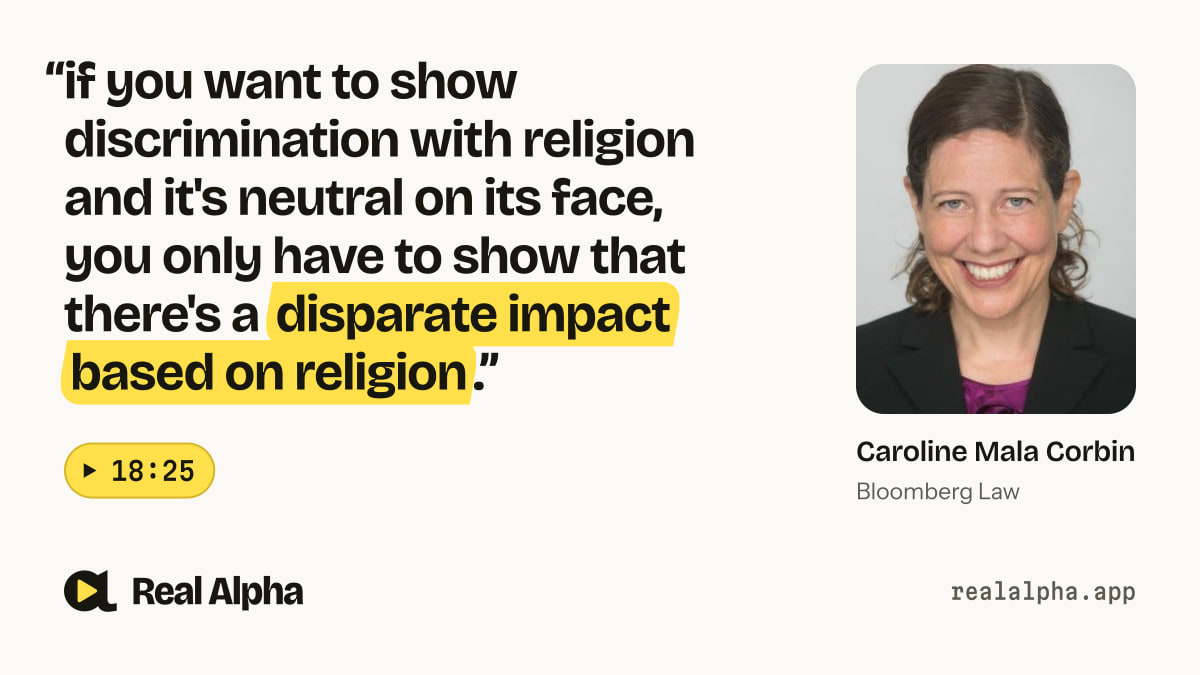
“if you want to show discrimination with religion and it's neutral on its face, you only have to show that there's a disparate impact based on religion.”
 Caroline Mala Corbinat 18:25 · Bloomberg Law
Takeaways
- The schools argue disparate impact alone can show religious discrimination.
- Race claims generally require proof of discriminatory intent as well as impact.
- The schools seek strict scrutiny when a law substantially burdens their faith.
About this segment
Caroline Mala Corbin explains how the schools’ argument could make religious discrimination easier to prove than racial discrimination. That distinction could give religious claimants unusually broad protection from neutral laws.

Professor, University of Miami Law School
Focuses scholarship on First Amendment speech and religion clauses, especially their intersection with equality issues.
- JG
June Grasso, Host
From “SCOTUS Leans Toward Catholic Schools at Expense of LGBTQ Rights | Bloomberg Law”, Nov 9, 2026. Watch the full episode
Thanks. We'll look at and fix what's off.
Transcript
From the transcript Bloomberg Law publishes with the episode.
- 15:22
Both Justice Sonia Sotomayor and Katonji Brown Jackson asked whether the Catholic preschools could discriminate based on race then.
- 15:31
But the bottom line is that the religious entity does not want to have to commit to discrimination. opening its schools to students, children of LGBTQ couples. Couldn't that same logic support a religious entity who says we don't want to open our schools to students of races that we disagree with or ethnicities that we disagree with? Why wouldn't the same logic from the standpoint of the First Amendment claim be the same?
- 16:02
Her argument is, listen, if they want to discriminate based on race, they're going to get money. And they're like, no, no, no, no, no, because we're not going to say that not ending discrimination against racial minorities is compelling government interest. So that's how they would distinguish it. But that does not acknowledge the importance of and the centrality of anti-discrimination law in the government's provision of education, especially when they're funding it. So just to be clear, This is not a rule that says Catholic schools can't discriminate. They can, right? The government is not banning them from discriminating. The government is saying, we're not going to give you our money to discriminate, right?
- 16:47
If you want our money, and if you want to participate in our pre-K education program, you have to follow our rules. And the court is like, not if you're a religious school. If you're a religious school, we have special rules, right? When I say special rules, I really mean apart from the new doctrinal rule they create, which is they claim that, well, if it's benefits, you go directly to substantial burden, which is not at all what the doctrine says. But the protection that religious organizations get from religious discrimination, what they're seeking is very different than the kind of protection the court currently offers against race discrimination and sex discrimination. So again, if a law discriminates against religion on its face, that law is not neutrally and generally applicable. That gets subject to strict scrutiny. Same
- 17:41
thing with race. If you discriminate based on race on the face of the statue and like in the language, it says we are going to treat black people differently than white people. That triggers strict scrutiny. But if the law is neutral on its face. If a law doesn't specifically mention race of people, but it has a really disparate impact based on race. So, for example, if you redistrict something so that you exclude all the black people and none of the white people, but you don't mention race anywhere in it, that is not going to be considered discrimination anymore. Unless there is both a disparate impact and a discriminatory intent, you have to show both under equal protection law. And the rule that they're seeking is that if you want to show discrimination with religion and it's neutral on its face, you only have to show
- 18:35
that there's a disparate impact based on religion. You don't need to show that there's discriminatory intent. So they're saying it is discrimination just because there are more religious schools than secular schools affected by this law. And that is enough for it to be considered discrimination and trigger strict scrutiny. Again, that is not the regime that we provide for race. If you have a law that is neutral on its face with regard to race and it has a racially disparate impact, that is not considered discrimination. under existing equal protection law. So basically, they want two levels of special treatment, right?
- 19:19
They want special treatment and they alone are allowed to discriminate on the government's dime. But even more broadly, they want to recognize disparate impact against religion as religious discrimination, even when disparate impact on race is not recognized as racial discrimination. They want special rules that for what counts as discrimination for religion. They want to make it very easy to say that there's religious discrimination while they've made it very hard to say that there's racial discrimination. So the level of privileging of religion is astounding if they're actually going to rule in favor of the schools and if they're going to adopt the rule that the schools are seeking, which is If there's a substantial burden, we get strict scrutiny.