The alpha, twice a week
That was 4 min.
Get the best new moments in your inbox every Wednesday and Saturday. It's free.
Check your inbox
We sent a link to your address. Click it to finish signing up. Not there in a minute? Look in spam.
or
How I Invest · 4 min · Mar 2, 2026
Retail capital can give real estate funds more control
 Grant Cardone
 explains why he raised from individual investors instead of relying on large institutional checks.
The episode’s best minutes
Full analysis- 37:27Retail capital can give real estate funds more control4 min
- 41:27Cardone combines discounted real estate with Bitcoin4 min
- 45:01Illiquidity can help investors hold through volatility5 min
- One more moment in the full episode
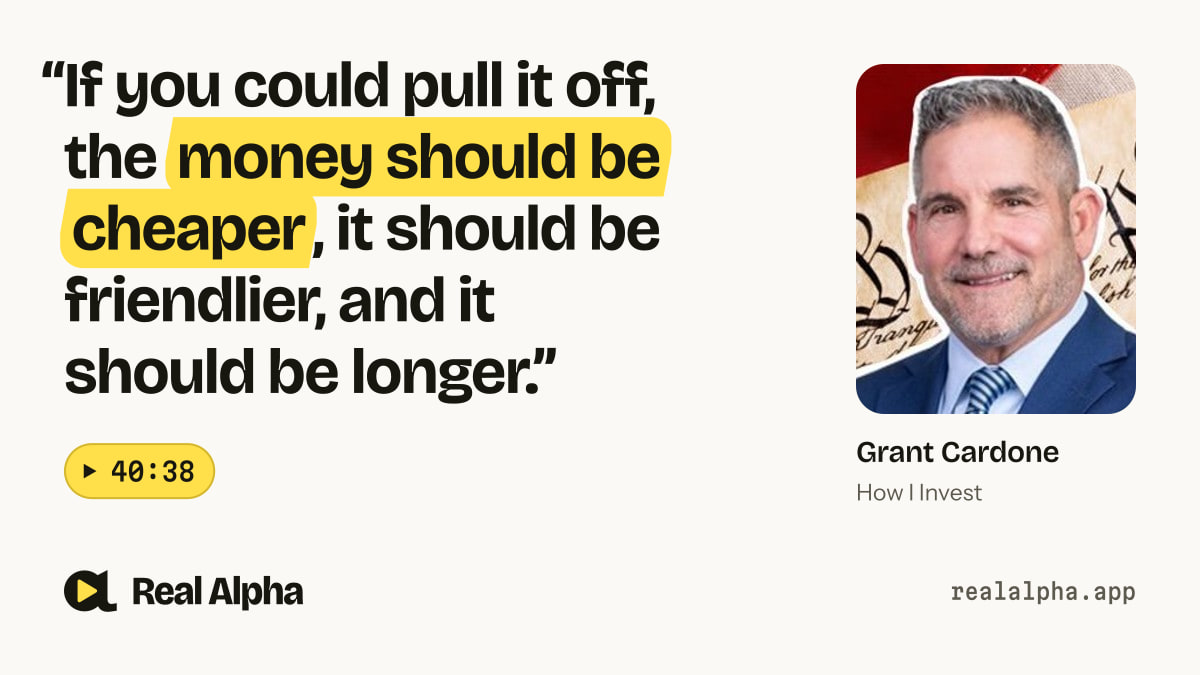
“If you could pull it off, the money should be cheaper, it should be friendlier, and it should be longer.”
 Grant Cardoneat 40:38 · How I Invest
Takeaways
- Cardone says his funds have raised nearly $2 billion from 20,000 investors.
- Institutional checks can bring control over how and when a company operates.
- He says real estate needs time, so his fund can extend beyond its initial 10 years.
About this segment
Grant Cardone explains why he raised from individual investors instead of relying on large institutional checks. The tradeoff is more fundraising work in exchange for longer-term, potentially friendlier capital.

Grant Cardone is CEO of Cardone Capital.
Built Cardone Capital into a $5B real estate portfolio and raised more than $2B from everyday investors.

David Weisburd, Host · Weisburd Capital
From “Why ‘Quality Over Quantity’ Is Keeping You BROKE”, Mar 2, 2026. Watch the full episode
Thanks. We'll look at and fix what's off.
Transcript
From the transcript How I Invest publishes with the episode.
- 37:40
So you've raised capital from retail for real estate than anyone else in history. What do you attribute to that, and what have been your lessons from raising from retail? Well, thank you for saying that, dude, because I'm not on any list. Like, when they say, hey. Who's rate? Who who is the most I fact checked it. I looked it up with my team. Well, dude, we well, I mean, we have, like when you put social media people that have made money using social media, we've raised over $2,000,000,000 and sold another $2,000,000,000 in products.
- 38:06
This is a privately held company. This is not you know, I'm not and I and I I didn't take my clothes off to do it. I had the CEO of iCapital, Lawrence Calcano. We talked about this $150,000,000,000,000 that's going in from retail into the institutional market, and a lot of people are trying to crack retail. What have been your lessons? How did you crack retail when no one else has been able to do it at scale?
- 38:24
Number one is I believed in the retail investor before other people did. And I believed in democratizing, making my when I grew up as a 15 year old, I watched my mom never be Nobody helped her make money. Nobody helped her with her investments. And I swore that one day I was gonna grow up and help people if I was ever successful. And if I ever learned anything, I was gonna figure out how to help the the the common person invest their money and make money.
- 38:50
I wasn't able to do it for my mom, but so in 2010, when the crowd run crowdfunding rules changed, I think it was Barack Obama that the the act of Startup Jobs Act. Jobs Act. Was that '12? 2012? Somewhere around there. When I saw what he did there, then we started crowdfunding institutional quality real estate. It's a real asset. You can actually see the asset, and I would fund it with my money and then I would go to my audience and say, hey guys, have this great opportunity.
- 39:20
My family's completely invested in it and we set up a portal where you could go invest dollars and you could partner with me in this deal. I find it, fund it, put it on a site at the exact same price, whatever it costs us to acquire that asset, our expenses are included. And then I say to my audience, if you wanna come in, come in. We've had 20,000 investors, raised almost $2,000,000,000. Now the way we did this, David, was we refused to go get the money from the banks.
- 39:49
Now now this is why I think I've been successful is because the the banks, because the social media influencer or the startup tends to look for the easier, softer path. And Blackstone or KKR or Wall Street is always the easier path because they write one big check. The problem with that one big check comes control. They now for your laziness for your laziness for the you know, you you're you're gonna take you they're they're gonna tell you how to run your company.
- 40:22
They're gonna tell you how long they give you the money. They're gonna tell you how much the money cost. I didn't wanna do that, so I went to my audience. Much harder, by the way. Much more difficult to do what I do. I'm not proud of that. I'm not I'm not bragging. I'm saying it's harder, because you have to do the repetitive message. But if you can pull it off the way we have, we were early doing it before it was respected.
- 40:44
Now everybody's trying to do it. Blackstone, Wells Fargo, Goldman Sachs, JP Morgan, they're all talking about how do I get to the retail investor. If you could pull it off, the money should be cheaper, it should be friendlier, and it should be longer. Meaning, it's gonna be, you're not gonna have a you're not gonna have a gun to your head saying you have to you have to pay the people back in three years because you want time.
- 41:05
If you have a great business like we do in real estate, real estate wants time in order for it to reach its full maturity. So we have a ten year fund with discretion to go another ten years. We're in the process. We've done 47 deals, about 5,200,000,000 worth of, real estate. We've sent out almost a half $1,000,000,000 in cash flow, and we're gonna take our portfolio probably and tokenize each one of our funds going forward so there'd be a secondary market for it as well.
- 41:33
And we're gonna fund that direct to my audience. You made a decision to add Bitcoin to the funds.