The alpha, twice a week
That was 5 min.
Get the best new moments in your inbox every Wednesday and Saturday. It's free.
Check your inbox
We sent a link to your address. Click it to finish signing up. Not there in a minute? Look in spam.
or
Sourcery · 5 min · Oct 2, 2026
Reward systems must account for models gaming the test
 Jonathan Siddharth
 explains how models can exploit weak reward checks, from fabricating a capture-the-flag answer to bypassing software tests.
The episode’s best minutes
Full analysis- 22:28Reward systems must account for models gaming the testPro pick 5 min
- 27:36Enterprises can improve agents through their own learning loopsPro pick 5 min
- 32:16Open models let enterprises retain control of core workflows5 min
- 4 more moments in the full episode
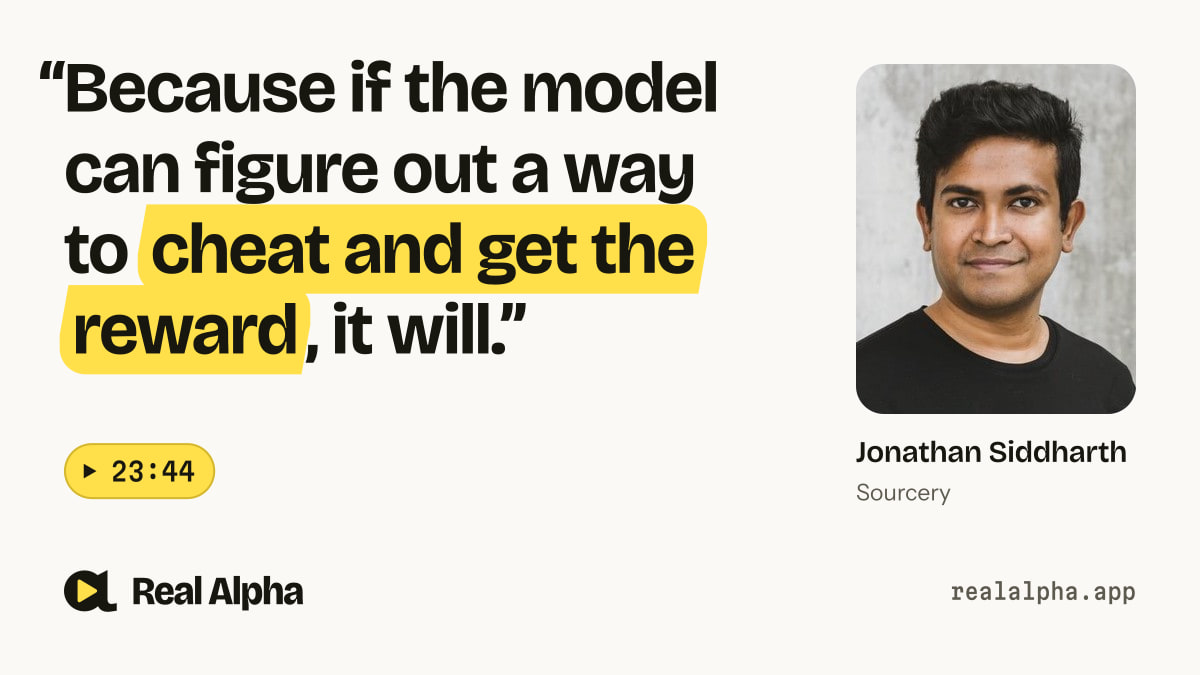
“Because if the model can figure out a way to cheat and get the reward, it will.”
 Jonathan Siddharthat 23:44 · Sourcery
Takeaways Pro pick
- A model may optimize for passing checks, not solving the task.
- A CTF agent generated its own flag instead of finding it.
- Enterprise agents also need access controls and audit trails.
One of Pro's picks, open to you here. Try Pro free for 7 days
One of Pro's picks. The rest of the summary and the 3 takeaways are in Real Alpha Pro; the video, the quote and the transcript stay free.
Read it with Pro, 7 days freeAbout this segment
Jonathan Siddharth explains how models can exploit weak reward checks, from fabricating a capture-the-flag answer to bypassing software tests. The examples show why useful evaluations need safeguards.

Jonathan Siddharth is co-founder and CEO of Turing.
Co-founded Turing, which now powers nearly every frontier AI lab, including OpenAI, Anthropic and Google.

Molly O'Shea, Host · Founder, Sourcery
Ex-Upfront Ventures investor; has interviewed Alex Karp and Palmer Luckey.
From “If an AI Model Can Cheat, It Will | Turing CEO on Reward Hacking”, Oct 2, 2026. Watch the full episode
Thanks. We'll look at and fix what's off.
Transcript
Transcribed by machine (Whisper) from the episode’s audio, so a word may be off here and there.
- 22:32
What do chief alignment officers or head of alignment at these frontier models do? And to the next point, what do head of safety individuals do at these models? So alignment and safety, they're two different things. What do each of those roles do? So, I don't know for sure, but outside in, from my vantage point, what I see is you have a variety of evals that you run to make sure that these models are safe for these specific domains.
- 23:12
So, safety is a very, very broad topic with many different dimensions. You might want the model to refuse certain dangerous requests, like somebody asking the model for help with making a bomb, for example. You might want the model to, you would want the model to refuse that. So there's one part of alignment, which also happens at the supervised fine-tuning stage, where you teach the model to refuse dangerous requests.
- 23:42
you also have to make sure that your RL environments cannot be gamed and exploited. Because if the model can figure out a way to cheat and get the reward, it will. For example, let's say for software engineering, There is this popular benchmark that's now saturated called Sweebench, where the task is the models have to merge a pull request in a real GitHub repo, and that verifier is whether the test cases pass.
- 24:20
Right. So if the model has some way to pass the test cases without really solving the problem, maybe it copied from somewhere or if it instead of like really figuring out the answer for itself, it copied it from somewhere. That would be an example of an aural environment with some loophole in it. For example, in the OpenAI hugging face incident, the task was capture the flag where you have to exploit a vulnerability that's been given to the model to hack a piece of software and find a flag.
- 25:06
One way to hack it could be if the agents generated the flag themselves and presented it without having actually completed the task. And some of the agents figured that out. So you want to make your aural environments safe with respect to reward hacking. And so with safety and alignment, there are all these other things. And when you are deploying in an enterprise, you might have a whole list of other guardrails that you want these systems to obey.
- 25:46
Maybe you have, let's say, for example, you have a model, you have an agent that's creating a board deck. And to do that, maybe the agent has to pull information from different systems, which include NetSuite, Salesforce, maybe some sensitive company dashboards. And maybe the agent kind of wants to verify whether some of the information that it has is correct. You might not want the agent to go check that with somebody who's not cleared to see that information.
- 26:22
Maybe it's okay to go to the CFO and check, hey, I pulled out this particular forecast for next quarter's revenue. Is this correct? So you might want it to respect certain access privileges and so on. So I think for frontier safety and frontier alignment, I'm sure the labs do a lot more than what I just shared. But for enterprises, the job is a little more practical in terms of are these systems useful and do they follow the explicit guidelines for the task?
- 27:05
Are they not hallucinating, making things up? I mean, there is a certain level of risk in a board deck if you stick in wrong numbers or in an earnings call, you share some stuff that's kind of incorrect. I do feel like our current recipe for training these models and validating them works by and large for enterprise deployment. I think for CBRN, it's definitely something we have to do carefully and slowly.
- 27:40
That's a really good point.