The alpha, twice a week
That was 7 min.
Get the best new moments in your inbox every Wednesday and Saturday. It's free.
Check your inbox
We sent a link to your address. Click it to finish signing up. Not there in a minute? Look in spam.
or
Big Take · 7 min · Nov 6, 2026
Richter says AI music needs royalties for its source artists
 Max Richter
 argues generative music solves no unmet creative need, while training used artists’ work without consent.
The episode’s best minutes
Full analysis- 31:30Richter says AI music needs royalties for its source artists7 min
- 28:14Richter stripped back his music to speak directly to listeners3 min
- 18:14A Richter track gave Hamnet its final scenePro pick 3 min
- 3 more moments in the full episode
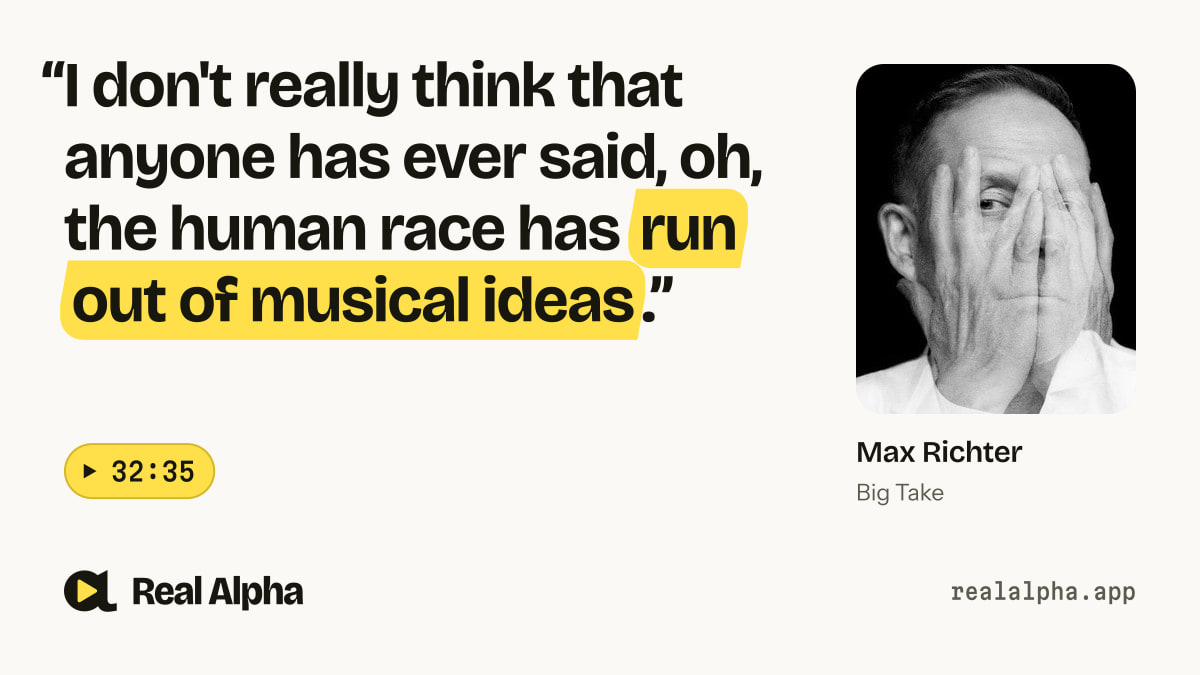
“I don't really think that anyone has ever said, oh, the human race has run out of musical ideas.”
 Max Richterat 32:35 · Big Take
Takeaways
- He sees little creative need for automated music generation.
- He wants royalties for artists whose work informs AI tracks.
- AI uploads dilute payouts and threaten new artists’ livelihoods.
About this segment
Max Richter argues generative music solves no unmet creative need, while training used artists’ work without consent. He proposes built-in source royalties and warns AI uploads could price working musicians out.

Max Richter is a classical composer.
Composed music for over 50 film and TV projects and acclaimed albums including The Blue Notebooks and SLEEP.

Mishal Husain, Host · Host, The Mishal Husain Show
From “Composer Max Richter on AI, Artist Pay and Music’s Future | The Mishal Husain Show”, Nov 6, 2026. Watch the full episode
Answers “Which jobs will AI replace, and which are safe?” See all 241 answers
Thanks. We'll look at and fix what's off.
Transcript
From the transcript Big Take publishes with the episode.
- 31:43
Yeah, I mean, I think AI in music is problematic. It's an interesting one because I think musicians and artists have always embraced technology and in a sense sort of furthered it.
- 31:57
You did at an early age with building your own synthesizer. And, you know, the orchestra starts out a certain size in this sort of 18th century, and it just grows all the time. More and more sophistication, more and bigger instruments, different brass instruments, more bigger wind section, the strings change. And that's all driven by the wants and needs of composers to have a bigger palette, a more diverse palette of colors. So in a way, it's natural. I see AI in creative works as... kind of a solution looking for a problem. Within medical research or scientific research or mathematics, all kinds of large systems, then obviously AI systems are extraordinary.
- 32:38
You only have to look at the AlphaFold project that DeepMind did. I mean, that's really transformative on a global level. But I don't really think that anyone has ever said, oh, the human race has run out of musical ideas. We need to outsource our creativity to an automated system. I just don't see the utility. Um, there are also, uh, issues to do with how the AI system was built. AI systems were built on data, which is stolen. That's not an exaggeration. It just was.
- 33:17
Work like yours and many others. Yeah. You know, the sum total of musical output of humanity has been hoovered up. Uh, and it's, uh, an extraordinary sort of large-scale transfer of commonly owned material. It's an act of enclosure, essentially, something like that. Do you think there is a way to stop it?
- 33:37
Would you like, even at this stage, to put some kind of guardrails around music and say, this is not material that AI should scrape?
- 33:46
I mean, I think it's too late for that because all of this happened three, four, five years ago. And, okay, in the last couple of years, people have started to talk about it, but, you know, it's too late. What I would say I think should happen at this point is that, okay, so these systems exist. People are using them. I think there should be a royalty mechanism. So if somebody uses an AR system and they make a track which is derived from a source work, an existing work, that composer of the existing work should get a royalty.
- 34:24
It's completely possible to do it. And I think that should just be baked in to the AI system.
- 34:29
But instead, what's really happening right now is that record labels are making deals with AI music companies, but the artists are not. Part of that.
- 34:39
Well, the artists aren't part of this conversation. There have been some attempts to include artists in the conversation, but not on equitable terms. So at the moment, there's a sort of holding pattern going on where no one quite knows what to do. And yeah, a lot of the large sort of stakeholders, DSPs, record labels, these kinds of things are trying to figure out how to make deals which work. But artists aren't part of the conversation fundamentally.
- 35:11
How does that make you feel? Well, in a way, it feels eerily similar to what happened when the legitimate Streaming platforms were set up. First of all, you had the Wild West of Pirate Bay and the early Napster and all of that. Napster, yeah, I remember. And then you got the advent of Spotify and Apple Music and all of these things. And again, the majors, the labels, made deals with the DSPs, essentially without any input from the artists. And a similar thing is happening right now.
- 35:45
And what's at stake if that mechanism isn't found and implemented right now before it's too late? What happens to, not to you because you're successful enough, but what happens to the next Max Richter?
- 35:56
That is really the big thing. And that because you've got a diluting of the royalty pool with, and without exaggeration, millions of AI generated tracks are being uploaded to the DSPs. You know, the overall royalty pool is being diluted so that human artists aren't able to participate as much as they formerly could. So for somebody trying to find their way and to make their way from start now is extraordinarily difficult. And really what it means is that in the future, it's very likely that the only people who can afford to make music, be artists, are people with other incomes, people who have got family backing. It's going to be very difficult for somebody without resources to do this stuff.
- 36:53
So composing, making music will be a hobby? Well, it'll be a hobby or it'll be something which rich people can do. Which is very bleak.
- 37:02
I mean, the other thing is, what kind of music do we get from those millions of AI-generated tracks.
- 37:09
Yeah, that is in a way one issue is that we're getting a sort of, because AI music generally, these systems are predictive, aren't they? And they're based only on existing data. So you're sort of putting existing works into a blender and then taking them out in the combination requested. I mean, people call it slop. It tends to be very undistinguished and it sort of meanders around and mimics existing things. In other words, it's going to have a sort of degrading effect on taste. You know, people will get used to it. People won't, in a way, they won't mind it. They'll think it's okay, which I think is a problem in itself. You know, we'll get used to this kind of level of non-innovation, non-imagination. And it does kind of sound like music, kind of, but it isn't really in a meaningful sense.