The alpha, twice a week
That was 3 min.
Get the best new moments in your inbox every Wednesday and Saturday. It's free.
Check your inbox
We sent a link to your address. Click it to finish signing up. Not there in a minute? Look in spam.
or
Bloomberg Surveillance · 3 min · Oct 27, 2026
Rising debt can undermine Treasuries as a safe haven
Robert Kaplan links high government debt and weak workforce growth to mounting pressure on the long end of the curve.
The episode’s best minutes
Full analysis- 17:52AI markets are overfunding the boom and hiding debt risks3 min
- 9:18Rising debt can undermine Treasuries as a safe haven3 min
- 41:49Nominal growth must cover a country's interest costs2 min
- 5 more moments in the full episode
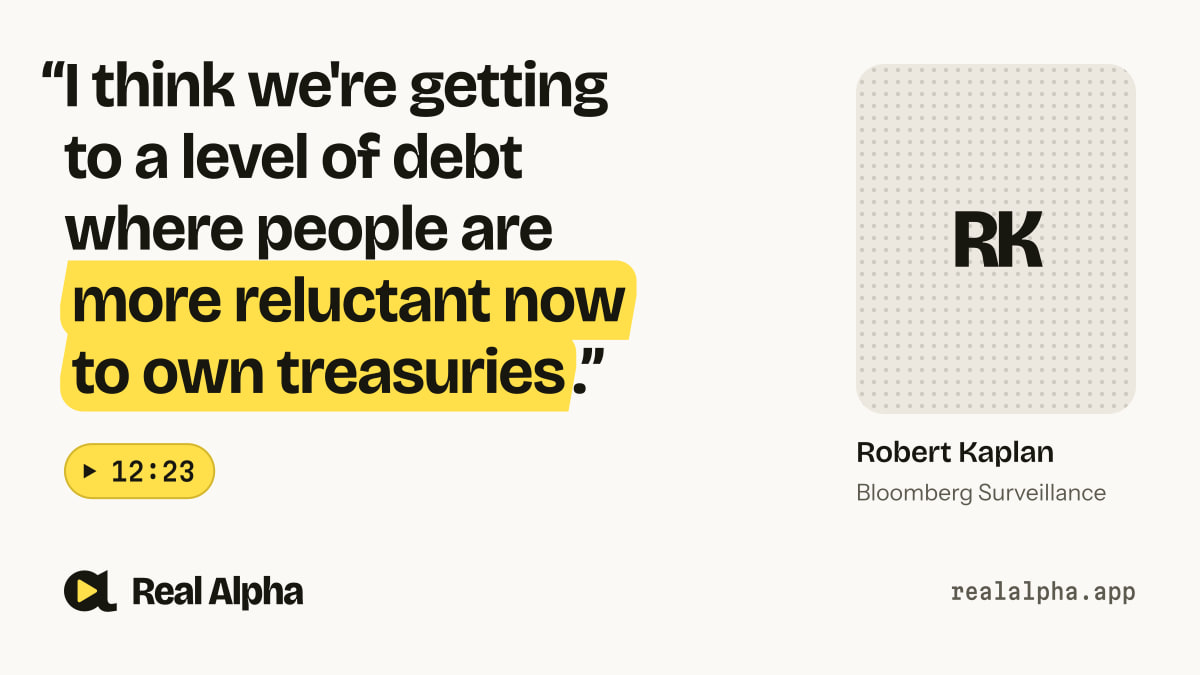
“I think we're getting to a level of debt where people are more reluctant now to own treasuries.”
Takeaways
- Debt is rising while workforce growth remains weak.
- Higher long-term rates are squeezing housing and businesses.
- Kaplan calls for a plan to bend deficits as a share of GDP.
About this segment
Robert Kaplan links high government debt and weak workforce growth to mounting pressure on the long end of the curve. He says investors' growing reluctance to own Treasuries is a warning to address deficits.
Vice Chairman, Goldman Sachs
- TK
Tom Keene, Host
- PS
Paul Sweeney, Host
From “Previewing the Fed Meeting and AI IPOs | Bloomberg Surveillance”, Oct 27, 2026. Watch the full episode
Thanks. We'll look at and fix what's off.
Transcript
From the transcript Bloomberg Surveillance publishes with the episode.
- 9:21
bad things happen. And usually we don't see them coming, think the SNL crisis and the roll-up. What do you worry about at night? What do you worry about in class when some mouthy person.
- 9:32
Is— Well, now I'm out with clients, but I would say the biggest tail risk I see still starts with— governments around the world and witness what's going on in France. Governments historically highly leveraged. And in the aftermath of COVID, we got a lot more leverage and we don't have workforce growth. So that means we're putting all our chips on productivity growth. And I do worry that we've got to come up around the world, including here with a fiscal approach that at least shows how we're going to bend these deficits as a percentage of GDP because I worry about the long end of the curve that it keeps backing up. And that's squeezing housing. It's squeezing a lot of businesses.
- 10:16
I've got to get this in quickly because Paul's got a series of questions. So then do you advocate that we should get our blended tax rate back up to where it was. That's what's coming down the pike from, say, 17% or 18% of budget up to 19% or 20% halfway there.
- 10:31
I'm not smart enough to know it. But I think there's 15 things you need to do. So what do you need? You need to grow faster. I would argue we need to relook at immigration. We need $ 1 million to $ 2 million a year in immigration. There are a lot of open jobs that are not getting filled. And it's slowing growth. I think you're going to have to continue to keep balanced regulation to help spur growth. Yeah, we need a plan to use all the– every company we've just heard is using AI to control costs. Governments should be doing the same. So reinstitute AI. embedded cost management in all the government entities. And entitlement reform is going to be on the menu, also has to be, because it's such a big part of the budget. And you notice the big miss on the budget deficit in 2026, I think $ 250 billion of it was entitlement surprise heading north. Another
- 11:25
$ 100 billion, I believe, was interest expense. So we're going to have to look at entitlement reform. So you need a menu of things. And we can do it, but we've got to start.
- 11:35
These are the conversations that we as a society have been having for 40 plus years that I've been on Global Wall Street. We just haven't had the political will to engage. Do you sense there's something that's going to accelerate this? Is it people looking across the pond to France and saying, you don't want to be in that position?
- 11:55
So people say all the time, we've been talking about this my whole life, it's never mattered why now. I think we're getting to a level of debt to GDP now. And you're seeing this in Europe, you're seeing this around the world, you're seeing in Japan, where I think the treasury curve is not acting right now like a cyclical diversifier.
- 12:15
There was a flight to quality the last two weeks. I think it was refreshing. But for the last two years, the theory is when the economy slows, markets go down, treasuries rally. We're not seeing that. I think we're getting to a level of debt where people are more reluctant now to own treasuries. That's a dangerous thing. I think that should be the red warning light that gets us to address this.