The alpha, twice a week
That was 3 min.
Get the best new moments in your inbox every Wednesday and Saturday. It's free.
Check your inbox
We sent a link to your address. Click it to finish signing up. Not there in a minute? Look in spam.
or
The Peterman Pod · 3 min · Aug 24, 2026
Robots need more reliability than interactive AI tools
 Sergey Levine
 says robots only deliver their full value when they act autonomously, unlike tools people can correct through repeated prompts.
The episode’s best minutes
Full analysis- 17:01Robotics needs to prove it can improve through experience4 min
- 25:59Robot experience can help models learn from human videoPro pick 5 min
- 37:14Robots need more reliability than interactive AI tools3 min
- 5 more moments in the full episode
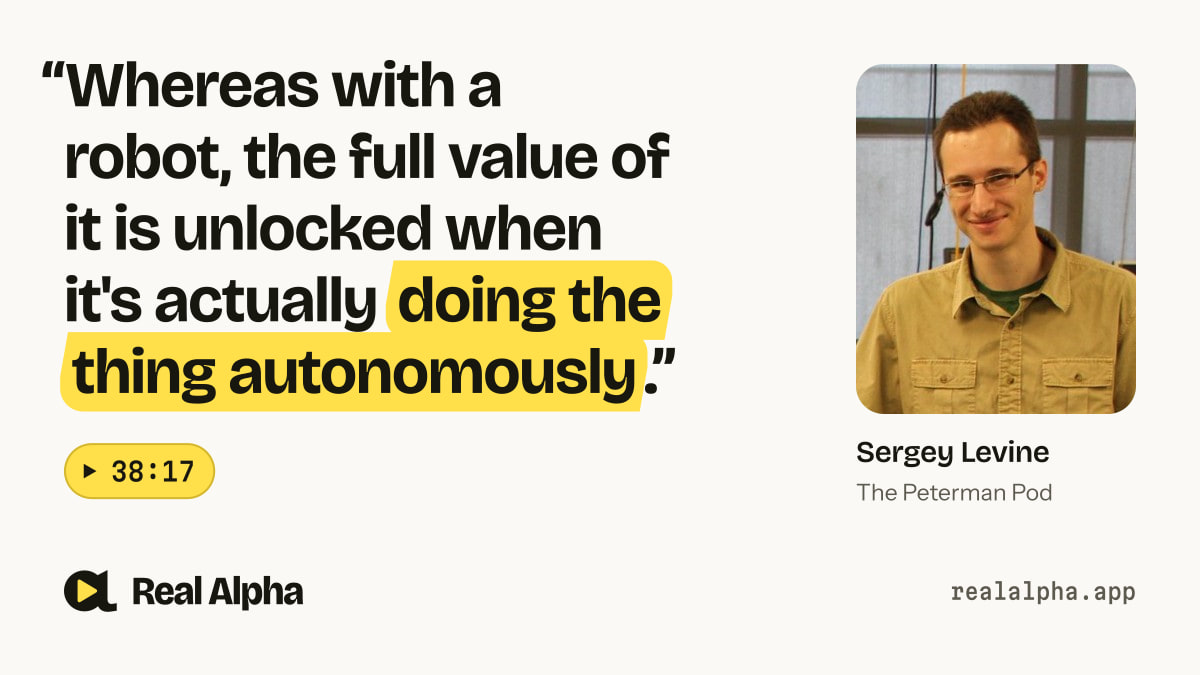
“Whereas with a robot, the full value of it is unlocked when it's actually doing the thing autonomously.”
 Sergey Levineat 38:17 · The Peterman Pod
Takeaways
- People can iterate with an LLM; robots must act autonomously.
- A polished demo does not establish practical robustness.
- Reinforcement learning may help close the reliability gap.
About this segment
Sergey Levine says robots only deliver their full value when they act autonomously, unlike tools people can correct through repeated prompts. He sees reliability and the final stretch of robustness as major risks.

Sergey Levine is cofounder of Physical Intelligence and robotics researcher.
Co-founded Physical Intelligence, building a foundation model to bring general-purpose AI into the physical world.

Ryan Peterman, Host · Host, The Peterman Pod
Went from new grad to staff engineer at Instagram in three years.
From “Sergey Levine: Humanoid Robotics Results, Chinese Labs & Future Timelines”, Aug 24, 2026. Watch the full episode
Thanks. We'll look at and fix what's off.
Transcript
Transcribed by machine (Whisper) from the episode’s audio, so a word may be off here and there.
- 37:17
But in this case, I'm curious, what would you say to a pre-mortem? And in the sense of if humanoid robotics did not succeed in single-digit years, what do you think would be the most likely reason why humanoid robotics failed? Ultimately, for these things to be truly useful, they do need to reach a level of reliability and robustness and generalization that is higher than we typically expect from LLMs, for example, or, you know, generative AI for like images and video.
- 37:49
Because typically, like these tools, they are very much human interactive tools. Like you get an LLM to do something and it doesn't do quite what you want. So you sort of revise your prompt and you basically like you iterate with it. And that's why like even the earlier LLM tools, like the first version of ChatGPT, even though they were much more primitive than what we have now, they were still already useful because somebody could just like keep hammering at it until it basically solves their problem.
- 38:14
You know, just like if you're using a search engine, like you type something in the search and you don't get quite what you want. You've revised your query and then you get what you want. Whereas with a robot, the full value of it is unlocked when it's actually doing the thing autonomously. So having to have somebody constantly iterate for every single task is almost like antithetical to the benefit that you're getting.
- 38:33
So I think a lot of the risk has to do with how easy is it to get that level of reliability and robustness. And that's, again, where some of the demos might be a little bit misleading because if someone shows a demo of their robot doing something cool, I mean, obviously, if everything is presented in a forthright way, that could still be a very good indicator of progress, but it doesn't make it obvious how far or how close it is to reaching that practically relevant level of robustness.
- 39:00
So I'm personally a big believer in using techniques like reinforcement learning that can actually benefit from autonomous experience to kind of fine-tune that last few percentage points to make it go from like 95% to actually like 100%. But that's really important and it's not yet a solved problem. If it did take longer than expected, it's because the bar is higher. Because the bar is higher and in particular, like those last few, the kind of the last inch so to speak, is something that requires not just really good models, but also new innovations in technology.
- 39:35
I mean, I don't think that, you know, I'm not the kind of person that would say like, oh, we should like throw out everything that we know about foundation models to start over. I don't think it's that at all. I think that roughly the puzzle pieces that we have are actually very good puzzle pieces. But still, we should acknowledge that right now, the methods and the models need more work to cross that level of robustness.