The alpha, twice a week
That was 4 min.
Get the best new moments in your inbox every Wednesday and Saturday. It's free.
Check your inbox
We sent a link to your address. Click it to finish signing up. Not there in a minute? Look in spam.
or
Founders · 4 min · Nov 15, 2026
Rubin was hours from a margin call before eBay bought his company
 Michael Rubin
During the 2009 crisis, Michael Rubin’s stock-backed borrowing collapsed and he struggled to repay the final $3 million.
The episode’s best minutes
Full analysis- 8:10A failed ski season led Rubin into the closeout business2 min
- 11:38Rubin was hours from a margin call before eBay bought his company4 min
- 38:57Fanatics grew collectibles by guaranteeing league revenue and innovating cards8 min
- 5 more moments in the full episode
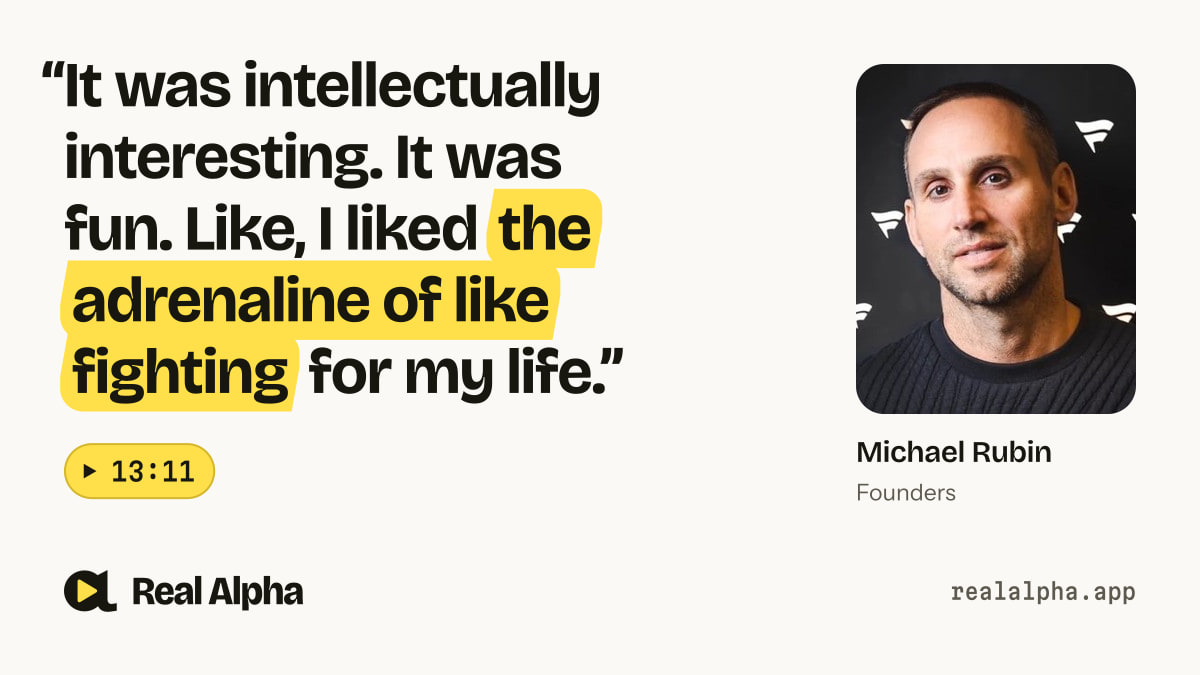
“It was intellectually interesting. It was fun. Like, I liked the adrenaline of like fighting for my life.”
 Michael Rubinat 13:11 · Founders
Takeaways
- His $250 million in stock value fell by 90%.
- He got the final $3 million back with hours to spare.
- eBay bought the company for $2.4 billion in 2011.
About this segment
During the 2009 crisis, Michael Rubin’s stock-backed borrowing collapsed and he struggled to repay the final $3 million. He describes why the near-loss energized him rather than rattling him.

Michael Rubin is founder and CEO of Fanatics.
Built GSI Commerce, sold to eBay for $2.4 billion, then grew Fanatics into a global sports platform.

David Senra, Host · Host, Founders
Has read an entrepreneur's biography every week for Founders since 2016.
From “What It Means to Be a “Real” Entrepreneur | Michael Rubin, Fanatics”, Nov 15, 2026. Watch the full episode
Thanks. We'll look at and fix what's off.
Transcript
Transcribed by machine (Whisper) from the episode’s audio, so a word may be off here and there.
- 11:43
you had a couple experiences like this where you were um i heard you tell the story it was like you need like something like 50 million dollars or something and you had to call like one of your bankers or something like, I don't know, 50 times or the 51st time he finally picks up. He's like, God damn it. I'll give you the money. You were much older then though. This was during- That was only 17 years ago. 2009 financial crisis. We were a public company. The stock that I personally owned was worth about $250 million in 2007. I was borrowing money from one of the big banks against that $250 million in stock. And I was investing that money in the market because that's kind of how I was living. And that worked from 1999 until 2007. And then when the financial crisis happened, stock went down by 90%, my $250 million.
- 12:30
Stock's now worth 25 million. The advance ratios went from 40% to 15%. And now I'm able to borrow $4 million instead of the 50 million I was able to borrow before. Well, I did a great job getting most of the money back because it was all my money was invested in different hedge funds, mutual funds. So I got the money back. I got down to $3 million. Couldn't get another penny out. And there was one guy who gave $5 million to start his hedge fund.
- 12:54
I called the guy, I think 50 times is an understatement. I probably called him 100 times. He's like, I can't give you the money back. I can't give you the money back. And finally, it's like, just stop fucking calling me. Take the money back. And by the way, I was like not days or weeks or months from being margined out of my company. I was hours. And the crazy thing about it, I loved every bit of the experience.
- 13:15
It wasn't scary to me. It was intellectually interesting. It was fun. Like, I liked the adrenaline of like fighting for my life. Say more about this. I mean, what do you say? Like, if it's the same shit every day, that's boring. Like, you know, business is a roller coaster. our business is an adventure. And, you know, if you're a real entrepreneur, you like that, you thrive on that, you know, you know, look at what the changes that happened in the marketplace, you know, two years ago, I mean, you know, you could have a red hot company one day and three years later that completely changed. I like having to be on top of your game all the time.
- 13:46
This is the same company where it's like close, you were close to like losing it. And then like, is this the one that 18 months later you sold for like $2 billion? Yeah. Yeah. What was the time frame there? So spring 09, I was going down. I owed $50 million to one of the big banks, which I got down to $3 million personally. Didn't think I could get the last $3 million paid back, which seems crazy, but I couldn't get the last $3 million. Again, 2009.
- 14:20
they were going to start selling the shares to pay the margin loan off and got that last $3 billion back with hours to spare, not days. Hours. Hours. And then March of 2011, eBay bought the company for $2.4 billion. How has that happened in just such a short amount of time? Like, what did eBay see that was so valuable? Well, financial crisis was over. Yeah. And eBay really wanted to offer all the e-commerce services that we offered to big retailers and big brands that they could then get into their marketplace.
- 14:53
So they had a sound strategy for wanting to do it. But the thing that was interesting for me was seeing, you know. some of the darkest days of my business, but I was never frazzled. I was never nervous. I just kept working. Like to me, if you keep working a problem and working a problem and working a problem, you can generally get to the right place. A lot of people give up too easy. I agree with that. That leads me to like the next question where you just mentioned,