The alpha, twice a week
That was 5 min.
Get the best new moments in your inbox every Wednesday and Saturday. It's free.
Check your inbox
We sent a link to your address. Click it to finish signing up. Not there in a minute? Look in spam.
or
Upstarts · 5 min · May 1, 2026
Runway kept going when investors said generative AI was not a market
 Cristóbal Valenzuela
 recalls top investors rejecting Runway because they saw no market for generative AI.
The episode’s best minutes
Full analysis- 20:02Runway kept going when investors said generative AI was not a market5 min
- 25:19Build for changing models, not today’s limitations5 min
- 6:11Runway’s founders treated early AI as a creative medium7 min
- 5 more moments in the full episode
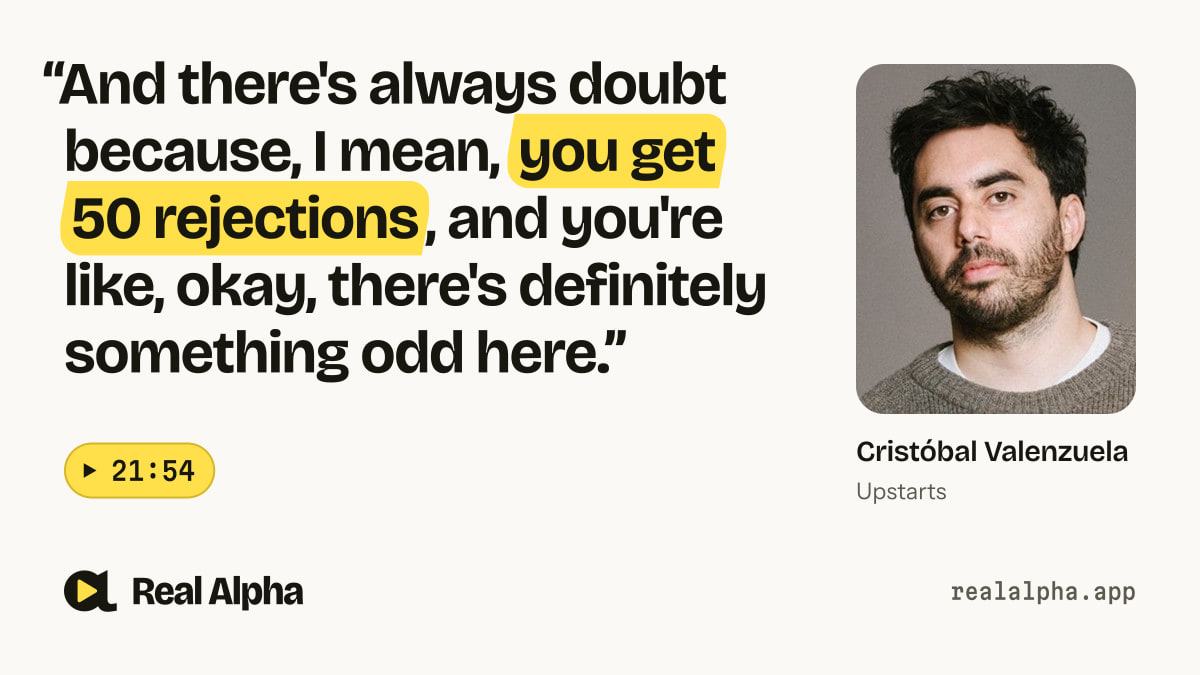
“And there's always doubt because, I mean, you get 50 rejections, and you're like, okay, there's definitely something odd here.”
 Cristóbal Valenzuelaat 21:54 · Upstarts
Takeaways
- Runway faced repeated investor rejection before generative AI took off.
- Rejection can be a signal to question consensus, not just your idea.
- The team still revisits those early rejection emails.
About this segment
Cristóbal Valenzuela recalls top investors rejecting Runway because they saw no market for generative AI. The experience taught him to stay non-consensus when building something unproven.

Cristóbal Valenzuela is co-founder and CEO of Runway.
Co-founded Runway, an applied AI research company whose creative suite has more than 30 AI-powered tools.

Alex Konrad, Host · Founder & editor, Upstarts Media
Ran Forbes' Midas List for ten years and co-created its Cloud 100 list; founded Upstarts in 2025.
From “Runway’s Cris Valenzuela: Building The Hollywood-Friendly Video AI That OpenAI Couldn’t”, May 1, 2026. Watch the full episode
Thanks. We'll look at and fix what's off.
Transcript
Transcribed by machine (Whisper) from the episode’s audio, so a word may be off here and there.
- 20:12
We've had CEOs on the show talk about the technology being the hardest part or just finding the first customers or raising funding from VCs who didn't believe in the product until it was obvious. When you think back on the journey so far, what has been the biggest challenge Or on the show, we call it an upstart moment where maybe you felt like you were punching above your weight the most or, you know, facing a very high stakes challenge.
- 20:35
There are a lot. I mean, I think building a startup is about like overcoming those moments over and over again and they never end. You need to start getting used to it. Maybe one that comes to mind and maybe feels like counterintuitive just given where we are and like how everyone feels and knows that this is what models are able to do and how the economy is changing. And basically, AI is in everyone's mind.
- 20:57
a lot of the hardest things we had to do back then was to convince people investors and like talent that ai had legs and that it could have it works and again it sounds contrary to it because like now of course it works it like works pretty well but back then it wasn't as obvious i have a presentation i've shown to our team and i think we we do a version of it every almost every on site where I show screenshots of emails I've gotten over time.
- 21:26
And some of them are from some of the best investors you can imagine, like the top, top 1% of the top 1%. And it's funny because the emails are like, you know, Chris, we're not going to invest in your Series A or your seed. And the reason is that we don't think Genitive AI is yet like a market or like there's no opportunity yet, like define, in quote, and I have this perfect email, Genitive AI is not like a thing, you know?
- 21:49
When you're trying to build something that hasn't been proven, that's counterintuitive, and you get an email like that, you're like, oh, maybe, either maybe I'm wrong, maybe they're right, or maybe they're wrong, and I'm right. At that time, you're not sure. And there's always doubt because, I mean, you get 50 rejections, and you're like, okay, there's definitely something odd here. But I think I've realized that in some cases, a really interesting thing about like building something as special, I think, as Runway is, is you have to be able and willing to be like non-consensus driven, you know, like I think there was consensus at the time that something didn't work until they work.
- 22:29
And now, of course. And now it's consensus that this is the thing everyone should be investing. But at the time, that was a very hard time for us, for the company, because we had to convince people that this is worth spending time on. I find that interesting because in a way, it might be a little bit liberating if it's not you specifically that is maybe what they're doubting. It's the whole technology. And so to your point, if you believe in the technology, then yeah, of course, you have a chance to win.
- 22:55
And now it is the opposite where I could imagine people questioning, well, actually, this is so obvious now that aren't a million people going to do this or, you know, aren't they going to force you to do it at a way that can't be sustainable because you have to spend more money than you can you can make from it. Do you feel those doubts now? Does that feel different than maybe the doubts of like, does this work?
- 23:16
You know, now it's maybe can you be unique or is this viable? yeah um of course now you have more doubts and more questions and more ideas and more more competition and everyone's thinking about the same but but i think again i like i like to think about it more from a this lateral thinking perspective which is like okay what's the non consensus thing here and what is maybe going back to what you just mentioned is like what is the things that you what are the things that we believe are true regardless of whatever else thinks about and that actually is a very hard position or like it's extremely expensive or heart to be in a position where you can afford yourself to think long-term because in day-to-day you're like it's a battle and it's a fierce like competition and you're everyone is looking at
- 23:58
each other you know and long-term long-term thinking is a strategy if you're able to we had it back then like we're thinking about this 10 years ago and and we had we were able to flesh out some sort of strategy over time and improve it and modify it but it was there and i think for For us now, there's something that feels something similar with some of the things that we are building that we're getting some of the same like perspectives on like, oh, it's not going to work or it's not there yet.
- 24:23
Or like, yeah, well, that's what everyone else thinks. But I think we're pretty convinced that we have something here that might be as important as with the things we've done in the past. And so being kind of obsessed with the things that you believe to be true and working towards making those things happen really matters a lot.