The alpha, twice a week
That was 8 min.
Get the best new moments in your inbox every Wednesday and Saturday. It's free.
Check your inbox
We sent a link to your address. Click it to finish signing up. Not there in a minute? Look in spam.
or
Into the Impossible With Brian Keating · 8 min · Dec 29, 2024
Safe AI needs objectives and engineered guardrails
 Yann LeCun
 rejects the idea that intelligence inherently creates a drive to dominate.
The episode’s best minutes
Full analysis- 17:13JEPA predicts useful representations instead of pixels7 min
- 46:59Safe AI needs objectives and engineered guardrails8 min
- 1:03:31AI glasses can answer practical questions for farmers3 min
- 5 more moments in the full episode
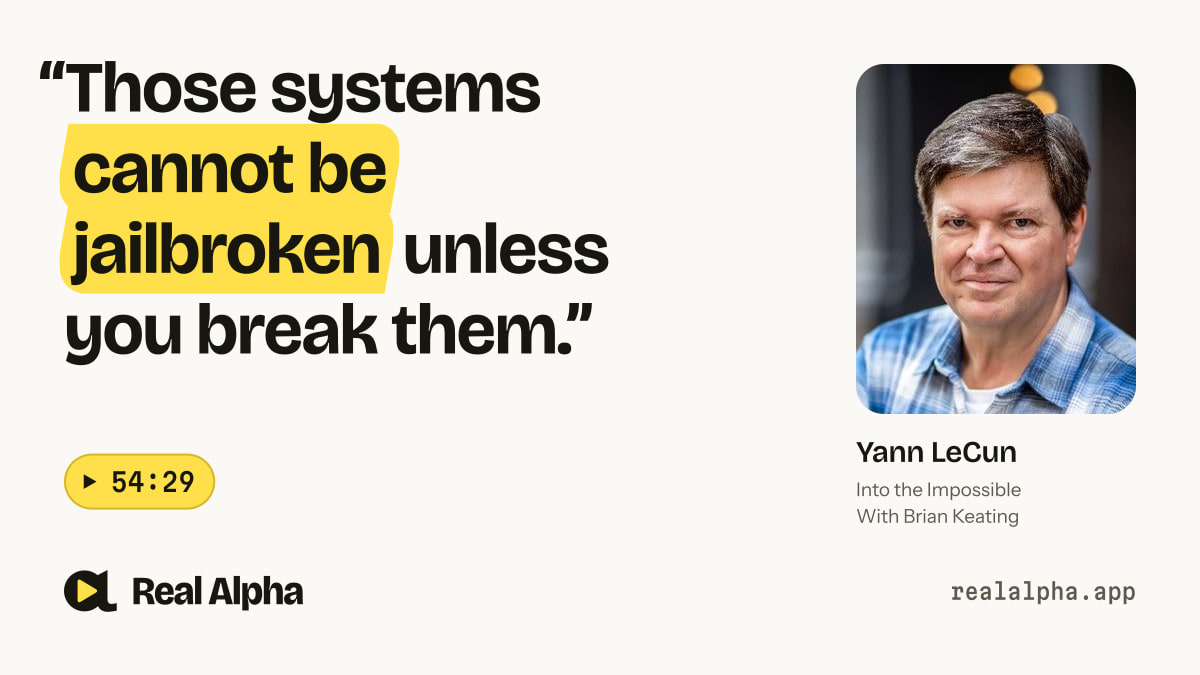
“Those systems cannot be jailbroken unless you break them.”
 Yann LeCunat 54:29 · Into the Impossible With Brian Keating
Takeaways
- Intelligence does not automatically create a desire to dominate.
- Objective-driven AI can check actions against guardrails.
- Safety depends on accurate models and well-designed objectives.
About this segment
Yann LeCun rejects the idea that intelligence inherently creates a drive to dominate. He argues that objective-driven systems can be engineered with guardrails, though accurate world models remain crucial.

Yann LeCun is chief AI scientist at Meta and professor at NYU.
Founded world-model lab AMI Labs after leaving Meta, where he was chief AI scientist and founded FAIR.

Brian Keating, Host · Host, Into the Impossible With Brian Keating
From “Yann LeCun: AI Doomsday Fears Are Overblown [Ep. 473]”, Dec 29, 2024. Watch the full episode
Answers “Is AI dangerous?” See all 224 answers
Thanks. We'll look at and fix what's off.
Transcript
Transcribed by machine (Whisper) from the episode’s audio, so a word may be off here and there.
- 47:05
of machine learning, but we're still not, nowhere near where we need to be. Max asked second question. You can probably guess this, Jan. What is your plan for preventing loss of control over even smarter AGI? Okay. So Max and I disagree on this, right? We've been on various panels discussing this issue. I also disagree with Jeff Finton on this, right? We're good friends, but we disagree on that question.
- 47:29
So first of all, There is the sort of implied idea that if a system is intelligent, it wants to somehow take over or dominate. And that's just completely false. Not only is it false, it's not even true within the human species. You know, it is not the smartest among us who want to be the chief, right? We have examples on the political scene. That's right. We won't talk politics. The idea somehow that intelligence is necessarily associated with a desire to dominate is just false.
- 48:04
To have a desire to dominate, or not a desire, but just even dominate by accident, there has to be some hardwire drive into the entity for competition, for resources, for example, or for influencing other entities to be able to profit from it or whatever. And this is a characteristic, the desire to dominate is a unique characteristic of social species within biology, right? So you have domination, submission behavior in baboons, you have them in chimpanzees, you have them in wolves and dogs, You have them in humans, although in humans, there is another way to acquire status in human society, which is prestige, right?
- 48:55
And you and I are both academics, so we're not influencing others by force, right? We're doing it by prestige, or at least we hope we do. But then take orangutans. Orangutans are not social. They are solitary. They're territorial, as a matter of fact. And they don't have any desire to dominate anybody because, like, you know, they don't need to. so this idea that there is an intrinsic desire to dominate that is linked with intelligence is just false it's just false okay so now there is the question as to how do you make sure that the drives of an AI system are going to be the objectives are going to be aligned with human values and those systems are not going to destroy us by deliberate action, but also not by accident.
- 49:47
If you project, if you extrapolate the capabilities of LLM, then you might be entitled to be scared because LLMs, to some extent, are intrinsically unsafe. Now, they're not very smart, so it doesn't matter, but they're not controllable in the sense that... the way they produce an output is not by optimizing an objective, is not by trying to figure out the sequence of actions that will satisfy an objective.
- 50:09
They just produce one token after the other autoregressively without thinking very much. Right, but why do you say that's not safe? I mean, my toddler does the same thing, but has no power, right? There's no embodiment. There's no controllability network that could allow her to actually do something to me, even though she might be stochastically crazy, right? I mean, by an adult standard. She could be like, you know, sitting on your lap and in front of your computer and then sort of randomly slap on the keyboard and destroy your entire file system.
- 50:40
Right, but not launch nuclear war. Right. She's not going to... No, because, you know, she won't have that power, but like people don't have that power either. And the AI system will not have that power either, unless we're very stupid with, you know, in the way we build it. What your daughter has is a set of drives that were hardwired into her by evolution, some of which have to do with just, you know, exploring the world and things like that to learn, you know, how the world works, basically. But some of them are very specific. So there is a drive for, you know, kids around one-year-old to want to stand up because that's the way you learn to walk, right?
- 51:12
So they're happy when they stand up. That's hardwired. There are, you know, hardwired objectives. So I'm not talking about hardwired behavior. I'm talking about like, you know, the fact that, you know, you touch the lips of a baby and the baby will start sucking, right? That's just hardwired behavior directly. that is like a neural circuit that just does that. I'm talking about hardwired objectives.
- 51:34
So things that you're driven to do, but nature doesn't tell you how to do that. Like eating, right? I mean, nature doesn't tell you how you find food. You have to hear that by yourself. I mean, with the help of your parents. Max's fellow Swede, Nick Bostrom, was on the podcast, and he's famous for this paperclip problem. But I pointed out to him, you know, you can't produce infinite paperclips because there's only so much iron inside of the core of the Earth or on any asteroid or on any solar system.
- 52:02
So it's kind of preposterous. They first have to have the agency, the desire, the target teleology, the purpose built. And I don't want to say it's impossible because that's one of my rules. I don't say anything's impossible. But it seems like Max is obsessed with perhaps proving something which can't be proven. He's asking you provably safe, but what if that's proving a negative? I don't believe.
- 52:25
I mean, also, Stuart Russell also wants to, is looking for, you know, proof. I think that's just as impossible as a provably safe turbojet. You can't prove that a turbojet will be safe. Yet, we can build incredibly reliable turbojets, right? They can fly you halfway around the world in complete safety with only a two-engine airplane, right? That's my bargain in terms of technology. But we can build those things.
- 52:54
AI is going to be the same. There's not going to be a magic bullet. There's not going to be a proof that we can build safe systems, but we're going to engineer safe systems. And the way we're going to engineer them, I think, that's the way I think things are going to go, is that we're going to build systems that are objective-driven. I call this objective-driven AI. And it's the fact that the output that is produced by the AI system is not the result of just producing a token after the other.
- 53:24
It's the result of optimizing an objective, with respect to a set of actions you take. So you have some mental model in your head, in your mind, in the mind of the system. The system has a mental model of the situation it wants to, or the environment it wants to act into. It's imagining a sequence of actions it's going to accomplish. And through the sequence of action in this mental model, it can predict what the outcome is going to be.
- 53:49
And now you can check whether this outcome satisfies a set of objectives. So one of them is, did I accomplish the task that I set out to accomplish? okay but making a thousand paper clips but then there might be other objectives that are more like cost trades and they would be guardrails okay so you know you pay a high price for killing someone or hurting someone for example right or maybe for you know taking certain actions that will consume to rush energy or whatever right so you can imagine having a series of those objectives some of which are guardrails some of which are task objectives and then the way the system produces its output is that it through optimization, it searches through the space of action sequences for one that minimizes all of those objectives and guardrails.
- 54:34
Now that's objective driven. Those systems cannot be jailbroken unless you break them. But you can't jailbreak them like you can jailbreak an LL by giving it a real prompt which will go outside of its conditioning if you want. So those systems cannot be jailbroken. The only outputs they can produce are outputs that satisfy the guardrails according to their internal mental model. the situation and now the game to make a safe ai is going to be how accurate can those mental