The alpha, twice a week
That was 4 min.
Get the best new moments in your inbox every Wednesday and Saturday. It's free.
Check your inbox
We sent a link to your address. Click it to finish signing up. Not there in a minute? Look in spam.
or
Sources · 4 min · Sep 22, 2026
Salesforce saw Slack as an agent for business
 Marc Benioff
 says Salesforce bought Slack with the idea it could become a business agent.
The episode’s best minutes
Full analysis- 21:04Customer reality is a better guide than SaaS panicPro pick 5 min
- 29:30Salesforce saw Slack as an agent for business4 min
- 44:25AI will make computer interfaces dynamic and adaptive4 min
- 5 more moments in the full episode
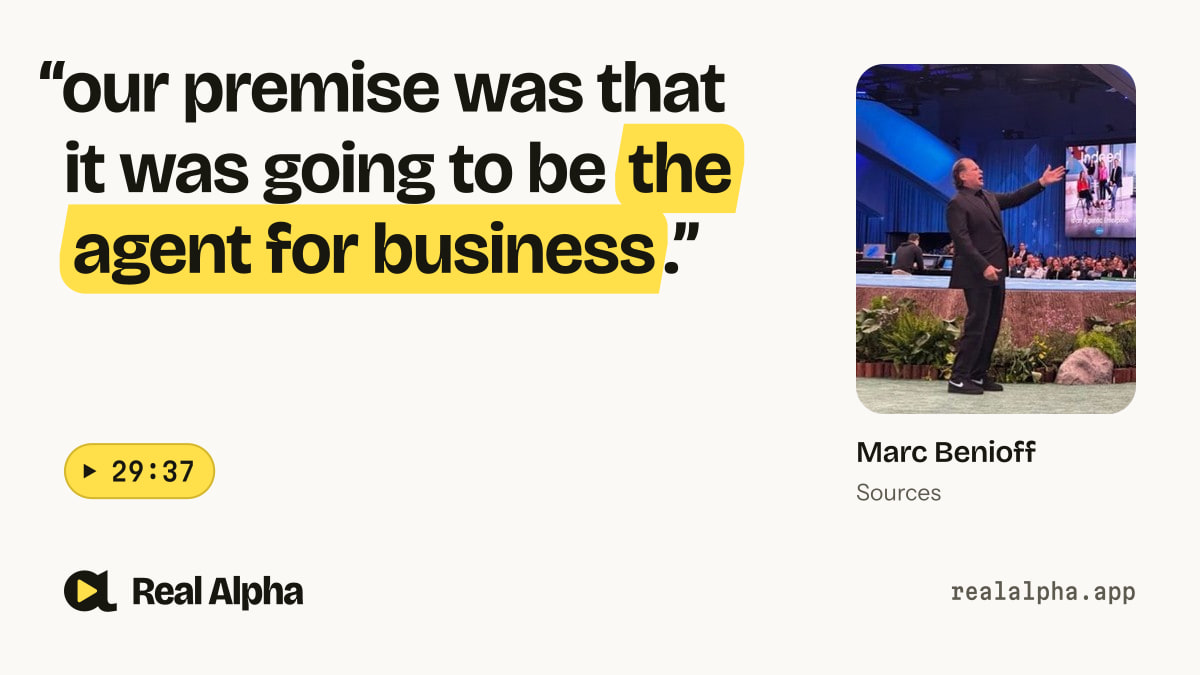
“our premise was that it was going to be the agent for business.”
 Marc Benioffat 29:37 · Sources
Takeaways
- Salesforce paid about $25 billion for Slack at roughly $900 million in revenue.
- Slack now connects business workflows with agents and applications.
- Benioff sees Slack as an operating system for companies.
About this segment
Marc Benioff says Salesforce bought Slack with the idea it could become a business agent. He describes how Slack’s integrations and customizable interfaces could make it an operating system for companies.

Marc Benioff is CEO of Salesforce.
Founded Salesforce in 1999, pioneering cloud computing and building one of the world's leading enterprise software companies.

Alex Heath, Host · Founder & host, Sources
Left The Verge to start Sources in 2025; it has made over $1M since, mostly from sponsors.
From “Marc Benioff on Dreamforce memes and the AI SaaSpocalypse”, Sep 22, 2026. Watch the full episode
Thanks. We'll look at and fix what's off.
Transcript
From the transcript Sources publishes with the episode.
- 29:34
We always knew that we wanted to own Slack. And we knew we wanted to own it because our premise was that it was going to be the agent for business. No way. Six years ago? I have the paper. I can show it to you. Wow. So this was important to us. We paid a pretty high price for the company at the time. Yeah, you did. About $25 billion. It was controversial. It was about $900 million in revenue, so you can think it was about 25 times revenue, and we got a lot of slack for buying slack, if you will, because we paid a high price, but it was going to trade once, and we felt that we needed to step up.
- 30:15
Everybody says it was the greatest acquisition of all time. And we've innovated aggressively on the platform. We've introduced Slack code so that you can code in channels. We have Slack CRM so you can operate Salesforce directly from Slack. Or even if you're a small business, you can use Slack as your CRM. And now we have also Slack Force so you can build a highly customized surface across your whole enterprise on Slack that's dynamic and intelligent and composite.
- 30:45
And has zero data retention, so none of your data goes into the model. And it's been a great platform, but the ecosystem and the success, and like you said, these large customers like not just Facebook, but or, you know, Meta. It's also Nike has gone to Slack. I just spent some time with the COO there, who's the big power user there. General Motors just moved from Teams onto Slack. And I think this is the moment where more companies Need to look at Slack as their operating system.
- 31:16
Huge boost of productivity for our company, I'm sure for every large company. Well, the way it works with AI,
- 31:22
I mean, where you can send stuff from AI in there, back out, super flexible. It's amazing, isn't it? Yeah, it is. And it's just so interesting to hear you say that you were thinking about agents six years ago. Yeah, we were. We're very fortunate. I'll give a nod to our chief futurist, Peter Schwartz,
- 31:38
who worked very closely with me on the Slack acquisition because he actually was the one Now you may know Peter Schwartz because he was involved in writing the movie Minority Report. That's right. And also War Games and Deep Impact and a few other things. And he is remarkably prescient and has tremendous vision. Just turned 80 years old. Lives very close to me. And we spent a lot of time together.
- 32:06
And he's been an incredible influence on the whole company. And in Slack, I had felt very closely it was about Slack. I didn't think that They would ever sell to us, you know? And then Peter kept pushing, pushing, pushing, saying, you've got to do more with Slack.
- 32:21
Do you and Stuart ever catch up and just marvel at the state of Slack now? Probably not as aggressively as we should. Yeah. You know, I'm sure he has some mixed feelings about selling the company, realizing that today it is the operating system for the whole AI industry. We mentioned great companies like NVIDIA. OpenAI. OpenAI. Guess what platform they all use to run their operations? Slack. Yeah, it's pretty remarkable.
- 32:46
It is. When you think about the future of Slack, what is it? I mean, I would venture to say there's maybe more agents already on Slack than humans, maybe, but certainly in the future. And I'm curious, you know, when you're thinking about the roadmap for Slack, what is it?
- 33:01
Well, when we talk about the data for the company, when we talk about the application and analytics and semantic layers, and we talk about the agentic layer and the interface layer, Slack is very much three of those. So it's not holding all the data for the company, but it's holding your DMs, it's holding the channels. It has a lot of the application functionality over. And it has the agentic framework that's integrated with the top agents in the industry, like Vercel and Linear and all the major agent platforms.
- 33:34
And then now it can build these highly customized interfaces. It's a really cool product.