The alpha, twice a week
That was 5 min.
Get the best new moments in your inbox every Wednesday and Saturday. It's free.
Check your inbox
We sent a link to your address. Click it to finish signing up. Not there in a minute? Look in spam.
or
Moonshots · 5 min · Aug 4, 2026
Scientific research is slowed by bureaucracy and outdated rules
 Michael Kratsios
 argues that research productivity is falling because the system rewards familiar processes over experimentation.
The episode’s best minutes
Full analysis- 31:09Scientific research is slowed by bureaucracy and outdated rulesPro pick 5 min
- 36:54Funding science requires grants that reward risk-taking6 min
- 1:00:32Autonomous labs could make experiments easier to access4 min
- 4 more moments in the full episode
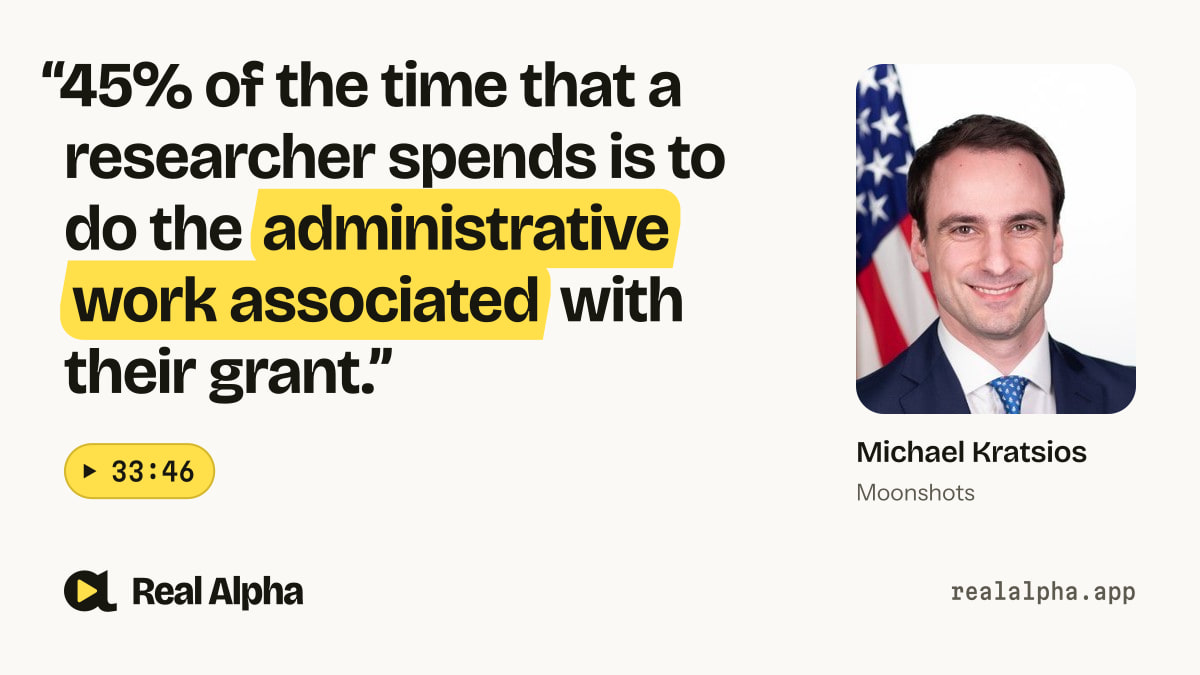
“45% of the time that a researcher spends is to do the administrative work associated with their grant.”
 Michael Kratsiosat 33:46 · Moonshots
Takeaways Pro pick
- Researchers spend too much time on grant administration.
- Funding more of the same may not improve results.
- Rules can prevent testing technologies like supersonic flight.
One of Pro's picks, open to you here. Try Pro free for 7 days
One of Pro's picks. The rest of the summary and the 3 takeaways are in Real Alpha Pro; the video, the quote and the transcript stay free.
Read it with Pro, 7 days freeAbout this segment
Michael Kratsios argues that research productivity is falling because the system rewards familiar processes over experimentation. He points to grant paperwork and flight rules as examples of barriers worth changing.

Michael Kratsios is a White House science policy director and Assistant to the President for Science and Technology.
Led the American AI Initiative as U.S. CTO and now directs the White House science and technology agenda.

Peter Diamandis, Host · Founder, XPRIZE
Co-founded Singularity University and founded Zero-G; co-wrote the books Abundance and Bold.
From “How the White House Plans to 10x Scientific Productivity | Michael Kratsios | EP #276”, Aug 4, 2026. Watch the full episode
Thanks. We'll look at and fix what's off.
Transcript
Transcribed by machine (Whisper) from the episode’s audio, so a word may be off here and there.
- 31:22
it was like you went much further than I expected is sort of naming ideas and we'll get to those so the first point you make is that scientific productivity has been declining despite larger budgets I you rooms a lot right Moore's law spelled backwards that's sort of like the discovery per unit dollar has has dropped why what's going on here and we got better tools yeah I to me For me, I think we have been unable to or just unable to change the way that we conduct science.
- 32:06
And I think this goes back to kind of one of the main sort of reasons why we wrote this report. The president wrote me a letter after I was confirmed and essentially kind of like charged us with how do we revitalize the science enterprise. eyes and we went back and kind of thought about it and kind of the data that you talked about kind of this declining productivity was kind of one of the one of the first things that we looked at and we asked ourselves you know like what why like what Why is it? Like we have better technology than we ever have. Our budgets are more than we ever have.
- 32:34
And I think it's most probably relevant in the biomedical field where the NIH budget now has ballooned to almost like $45 billion, yet the cost of drugs is more expensive than ever, kind of the list goes on. And I think one conclusion we had was like, we just are not experimenting enough in the way that we conduct science. We're doing the same thing over and over again and just putting more money towards it and believing that the outcomes are going to get better. And I think one of the main core theses of the whole Golden Age report is we have to be more experimental and more ambitious about testing out new ideas. And why I found it so particularly relevant and shocking in the world of science is you would think that in science, those people would be the most interested and the most excited to try different ways of doing
- 33:19
science. Yet, funny enough, that community doesn't want anything to change. They want the system to be exactly the way it was 30 years ago. The way I say it, if you're an expert in something and there's a revolutionary breakthrough, you're no longer the expert at it. So there's a disincentive for doing that. Could it be regulatory bloat? Could it be legal bloat? Could it be just the paperwork that's developed over time?
- 33:45
It is. I think it's all of the above. So some things that we talk about in the report are around research burdens. So I think there was a very well-known study that the National Academies put out a few years ago that essentially said something like 45% of the time that a researcher spends is to do the administrative work associated with their grant. And that is one of the most depressing statistics I can think of.
- 34:06
These scientists are the crown jewels of our country. We want them to be doing their work 100% of the time. Same thing in healthcare. Yes. Physicians are spending all their time filling out paperwork. Yeah. And I think that the regulatory stuff does kind of matter too. And I think one example that's very close to my heart and it's been one of my pet projects for a long time is how do we bring back supersonic flight to America?
- 34:26
And an example of that is it's kind of a kind of a regulatory issue where in the U.S. There has essentially been a speed limit for flights over land. So essentially there was if you're flying over Mach 1, it's just not allowed anymore. Because the sonic boom is concerned, right? And the reality is, I think research has shown, and I think Boom Supersonic, a company, showed that they're able to fly over Mach 1 without creating a sonic boom.
- 34:53
So our regulations, the way it stands, disincentivize them for ever trying to fly over Mach 1 because they'll never be able to fly over Mach 1. to so um again due to the president and executive order that he signed you know we are now changing that rule to create a noise limit rather than a speed limit yeah if you can keep it if you can keep it quiet fly just fly i love that i mean the breakthrough you know the policy changes on both supersonic flight and on e-vtols uh just to i mean the aviation industry had been stuck yeah for 50 years and so unleashing in that way one of the second uh challenges you note here is young talent waiting too long before they're given a chance to implement their bold ideas.