The alpha, twice a week
That was 8 min.
Get the best new moments in your inbox every Wednesday and Saturday. It's free.
Check your inbox
We sent a link to your address. Click it to finish signing up. Not there in a minute? Look in spam.
or
My First Million · 8 min · Nov 18, 2026
Screens and AI are increasing demand for effortful offline activities
 Shaan Puri
They connect a screen-free year and demand for humanities courses to a backlash against easy digital rewards.
In this episode
Full analysis- 0:43Mahjong sells a social experience, not just a gamePro pick 7 min
- 8:45A difficult entry can make a community more valuablePro pick 4 min
- 38:17Creator sponsorships move from underpriced to overpriced6 min
- 19:22Screens and AI are increasing demand for effortful offline activities8 min
- 49:17Platforms must win screen time from one another to keep growing3 min
- 46:33Instagram's long-form format could support another business-news brand3 min
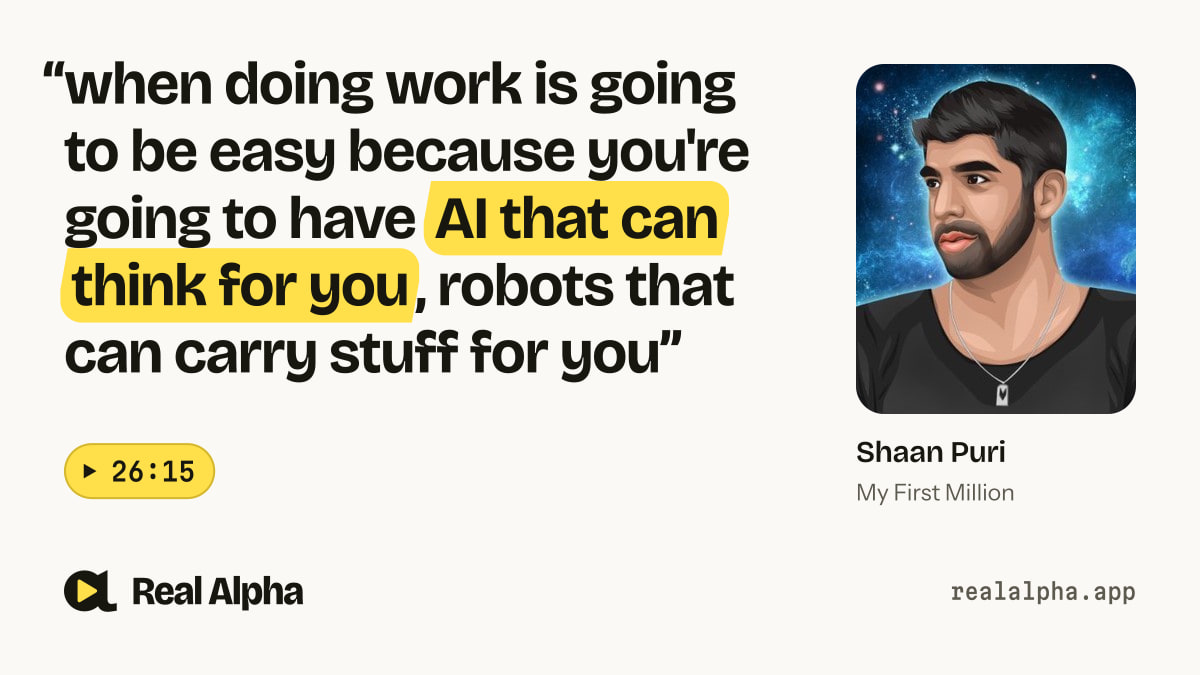
“when doing work is going to be easy because you're going to have AI that can think for you, robots that can carry stuff for you”
 Shaan Puriat 26:15 · My First Million
Takeaways
- Harvard's Humanities 101 drew hundreds of applications for 90 seats.
- The speakers see growing interest in doing hard things without shortcuts.
- AI may make effort and offline experiences more valuable.
About this segment
They connect a screen-free year and demand for humanities courses to a backlash against easy digital rewards. As AI makes work easier, effortful offline activities may become more valuable.

Shaan Puri, Host
Co-host, My First Million
Sold Bebo to Twitch in 2019; co-founded the crypto newsletter Milk Road.

Sam Parr, Host · Co-founder, Hampton
Founded the business newsletter The Hustle and sold it to HubSpot.
From “Proof you don’t need a clever idea to make crazy money”, Nov 18, 2026. Watch the full episode
Answers “What will AI look like in the next few years?” See all 395 answers
Thanks. We'll look at and fix what's off.
Transcript
Transcribed by machine (Whisper) from the episode’s audio, so a word may be off here and there.
- 19:35
Check out HubSpot.com, the agentic customer platform for growing businesses. Have you seen this guy named David do a year on plug.com? Oh, I love this guy. He started it now, right? Oh my gosh. Yeah, he's the... Explain what this guy's doing. Because I actually haven't followed it the last month, but I think I just saw a photo of that, like it started. Tell me what's going on. Go to yearunplugged.com. This guy's basically what Bryan Johnson was to not dying. This guy is to not using screens. So his name's David.
- 20:06
I think he just worked in tech. He was a normal guy. He looks like he's only 25 or 26 years old. For the last six months, he's been tweeting this stuff out where he's been saying like, I'm going to go a year without screens. And he's been setting up his life so he could do it in a somewhat practical way. Because with screens, screens aren't like cigarettes. With cigarettes, so you could just quit and you just don't have nicotine with screens.
- 20:26
It's sort of impossible. It's like quitting sugar. It's really challenging when it's everywhere. He's not just saying less screen time. He's saying, I will not see a screen with my eyes, meaning my own phone, a television that I see somewhere if I'm out and about. He's trying to be hardcore about no screens. He's trying to. And if you go to his FAQs, he says, what does no screens mean? He's like, I won't have any screens in my home.
- 20:50
He's like, I can't control when I'm out to eat and there is a screen. Here's what he said. Exactly. No phone, laptop, TV, tablet, no Kindle, no movies. Everyday screens don't count like a menu board, a thermostat, a checkout screen, or if I'm at a concert. The only exceptions are tests that need one. So for example, when I get my brain test, my blood pressure test, there'll be a screen or a camera present.
- 21:12
But I'm cutting out the worst of it. And it's really fascinating because here's what he's doing now. One, if you go to yearonplug.com, you see a daily score with his Oura ring and it shows you how he's sleeping that night and he logs his mood and he explains how he's doing this. So he, for the last six months leading up to this, he's been talking about it. He's like, I created this thing where I can write tweets out by hand and it will upload to the scanner and it automatically tweets.
- 21:37
And then now he's like, if you see this tweet, you know that the scanner worked. I have no idea if it didn't work though. And so like, it's pretty interesting. And you can see his daily biomarkers. He's also doing cognitive tests. He's 10 days into the one year right now. Yeah, he just started with the one year, but he's been talking about how he was going to do it. Sweep duration, low, brain scan, mildly impaired.
- 21:59
It's not doing so hot right off the bat. Well, he's like, he's like my addiction. He's like, I think I'm, he's like, I'm having withdrawals. Like I feel horrible. And he talks about that on his feed. And he got a sponsor. I think it was like Function Health. And he's like interviewing experts as he's going along the way. This is great. It's great. It's awesome. This is going to, I think this is going to blow up.
- 22:20
Deserves to blow up. Yeah, yeah, absolutely. we talked about it before when he first announced he was going to do it immediately it's like you know sometimes you just have the right story and it's like I just need to hear I need to hear it once in one sentence and I'm in you know that's it and this guy he got it down to that killer story and I'm envious of it this is like an awesome experiment this is awesome I don't know if he'll make it 365 days I've had lunch with him by the way I messaged him I'm saying this is great he's like yeah we had lunch in Boise I'm like oh shit yes I do remember this so I've like met this guy years ago and I never would have thought he'd be doing this.
- 22:55
I think there's a world where you're seeing this constantly, right? Like with the midterms, one of the issues was data centers, which comes from the anger of AI. And I did a few things that was interesting. I got to give a shout out to Cal Newport because he did a video on this. But the Wall Street Journal had this really cool article about Harvard. Basically, there's this new class called Humanities 101 and they had only 90 seats for it, but they got hundreds of applications.
- 23:23
And this class, you know, humanities, are different from science. Science is like how shit was made. Humanities is like the art of like what's important and how do we think. So you're looking at art, you're looking at literature, philosophy, things like that. And they opened up this new class at Harvard and it got flooded with applications. And they made it exactly like you said, really hard to get in. You had to write an essay on how, why it's important to you. They track attendance every single day. And it's become part of the culture where you get made fun of for not doing the work. Because with this class, you have to read a book a week.
- 23:53
They say no AI is allowed and all the students are sticking to it. Like it's part of the culture. And you're seeing this massive shift, I think, of young people where it's going to be sort of like obesity, I think. There's going to be like a small group of people that really care about health and wellness and are anal and like ideological about it. And then there's going to be like most everyone else.
- 24:14
But this is like a pretty big niche and you're seeing it with this. And the concept here is that Cal was like, There's this thing called reward shortcutting, which basically means like when Facebook came along, it was this idea that if I click like on someone's photo or comment on it, that somehow means that I'm shortcutting the social connection. I clicked like, that was easy. See, I connected with someone, but it's not real.
- 24:37
Like you don't get the real reward for it. And I think what you're seeing with people is that they want to get rid of that and they want to do the hard work to get the reward. No screens, read books, do the work. There's another thing that I just read about. It's really interesting. Have you heard of Ralston College? No. It's a college just for a humanities master's. I think it's in Georgia. They got $25 million in funding from a billionaire.
- 25:01
One billionaire just kind of gave them the money, right? Wait, wasn't this one teaching like stoicism? Or no, that's something else. Yeah, yeah, yeah, yeah. They're studying Greek philosophy. The idea is that like, so it's called Ralston College. It's in Savannah, Georgia. There's a cool article about them in the Wall Street Journal. It was called The Navy Seals of Western Values because this class, it's the idea of what are Western values and how did they get created?
- 25:26
So they actually take trips to Greece and they study Greek philosophy to understand how we got democracy and all this stuff, humanity shit. And it's blown up. It's blown up. They're getting a ton of applicants. I think they only accept 25 or 50 people a year and I think it's free. But Wall Street Journal has been talking about this stuff for a while now. It's actually becoming quite prevalent. like this like anti-shortcutting.
- 25:49
Right. Yeah, I think I've always talked about this. Whenever, you know, it's whatever that third law is or whatever, you know, for every action, there's an equal and opposite reaction. And when the world gets, swings too far in one direction, it creates the demand for the opposite. And so when the world is full of screens, it creates the demand for someone to do a radical experiment. We all want to watch and see how it happens and we want to be inspired by it.
- 26:15
When 40, 50% of the country is obese, it creates the demand for the opposite. You get Bryan Johnson and you get GLP-1s and you get the health and wellness craze. Like you get all these things. And similarly, when the world is going to be, when doing work is going to be easy because you're going to have AI that can think for you, robots that can carry stuff for you, cars that can drive you. Well, what's going to become cool?
- 26:39
Some good old fashioned effort. And again, it's not going to become what the masses do. The masses will always, you know, the pop charts always use, you know, the four chord songs. It's great. That works. But there is going to be these segments of the population that really start to respond to things that sound counterintuitive at first. But it's not counterintuitive once you realize like, oh, the thing that became rare in rare supply and was high effort, was high, you know, low digital, right?
- 27:10
And so those are going to obviously be new areas of opportunity, new areas of growth that didn't exist before. I got to read this cool headline. I read about this the other day.