The alpha, twice a week
That was 6 min.
Get the best new moments in your inbox every Wednesday and Saturday. It's free.
Check your inbox
We sent a link to your address. Click it to finish signing up. Not there in a minute? Look in spam.
or
Bloomberg Businessweek · 6 min · Oct 29, 2026
Search monetization and cash flow explain Alphabet’s selloff
 Ed Ludlow
 says the search miss doesn’t prove AI is cannibalizing Google, but monetization remains unclear.
The episode’s best minutes
Full analysis- 10:41Search monetization and cash flow explain Alphabet’s selloff6 min
- 25:11AI investment needs to prove its returns5 min
- 3 more moments in the full episode
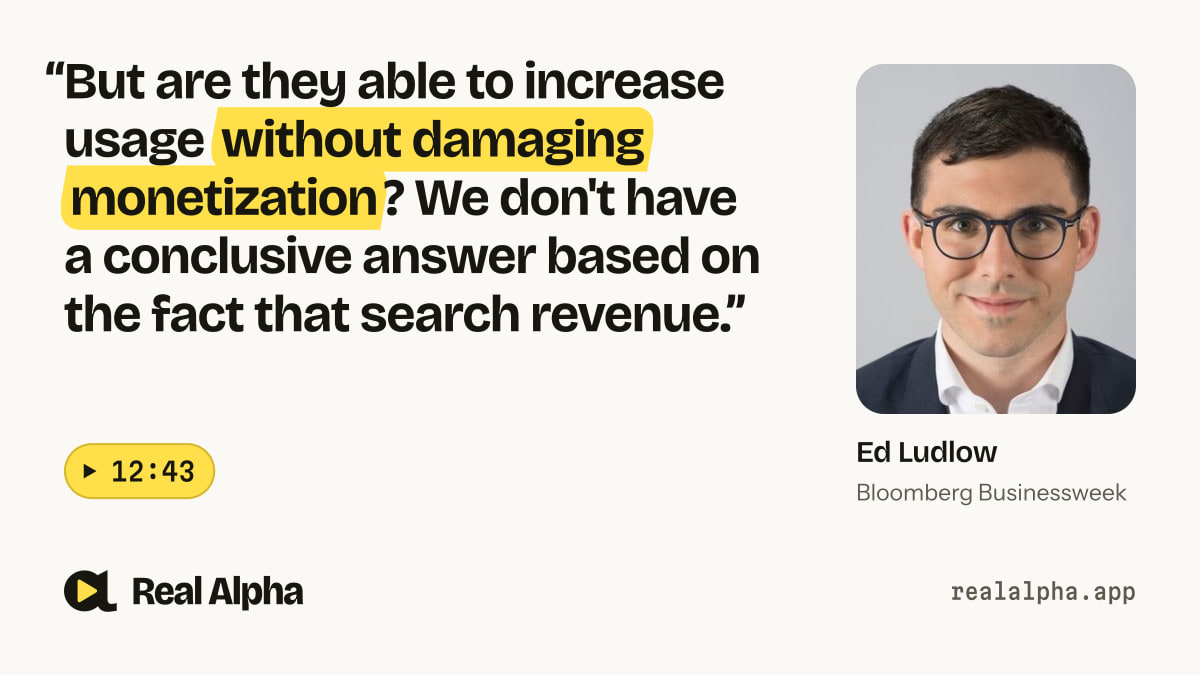
“But are they able to increase usage without damaging monetization? We don't have a conclusive answer based on the fact that search revenue.”
 Ed Ludlowat 12:43 · Bloomberg Businessweek
Takeaways
- AI may be driving more search use without lifting revenue as expected.
- Alphabet’s search miss alone doesn’t settle the cannibalization question.
- Investors are comparing Alphabet’s negative cash flow with Microsoft’s positive cash flow.
About this segment
Ed Ludlow says the search miss doesn’t prove AI is cannibalizing Google, but monetization remains unclear. He points to negative free cash flow as a reason investors are scrutinizing Alphabet’s spending.

Tech Host, Bloomberg
Hosts Bloomberg Tech and reports on technology, supply chains, deals and finance for Bloomberg News.
- CM
Carol Massar, Host

Tim Stenovec, Host · Co-host, Bloomberg
Interviewed leaders including Reed Hastings, Stephen Schwarzman and Mary Barra as a Bloomberg Businessweek co-host.
From “Alphabet Disappoints, Microsoft's Cloud Sales Grow: Earnings Live from Schwab IMPACT | Bloomberg...”, Oct 29, 2026. Watch the full episode
Thanks. We'll look at and fix what's off.
Transcript
From the transcript Bloomberg Businessweek publishes with the episode.
- 10:44
you that search... is being cannibalized a little bit by these LLMs finally. Yeah, I mean, the data doesn't answer your question. So like Google search is really mixed. Overall search revenue missed by about $ 1. 5 billion, which is a significant miss, right, in this environment against Wall Street consensus, but informed by what they were talking about last quarter. But, you know, Google says very explicitly that AI is driving growth in search queries, right? So the use, like, people going to search is getting a benefit from AI. But in terms of revenue, like, the monetizable amount, you know, it's not in line with expectations. It's growing 12%. You know, it's hard.
- 11:36
I don't know the answer. Sorry. So where's the disconnect? But, Ed, this is the golden goose. This is what Larry and Sergey invented, you know, decades ago. A better way to give us information... and then sell it next to companies that want to reach you. And I would argue that out of Silicon Valley, the only company that's perhaps done a better job doing that is Mark Zuckerberg's company. But for search, Alphabet owns it. This is their business. And the concern a year ago or 18 months ago was that the LLMs would eat into that.
- 12:12
And we got over the last few quarters an indication that that wasn't happening. Everyone was like, oh, don't freak out. We're going to be fine. does it seem like it's going to be fine? Because if people are still getting the answer they want, but Alphabet's not monetizing it the way that they're. Used to, then that could be an issue.
- 12:28
So search is still the golden goose, and from a scale perspective, like in the quarter, it's more than half of revenue. So the AI question matters. is the action that this company's taken, which is putting AI overviews or AI mode in search, they're saying that it is increased use of search. But are they able to increase usage without damaging monetization? We don't have a conclusive answer based on the fact that search revenue.
- 12:55
Is overall missed. But you'd bet, wouldn't you, that the analysts will ask exactly that question on the call. Okay, Google or Alphabet Management searches up But the financials of this are changing. Explain that to us. Right.
- 13:13
And it goes to that bigger question, right? We still think about this company as a search engine company. And how is AI changing it? Is it giving it increased ROI to some extent, right, on its main business? Like whether or not they're seeing the payoff from all this investment. It kind of is as simple as that.
- 13:32
Yeah, I would say search grew 12%, but search revenues did not grow 12%. What's up with that? Pretty simple. I would also say, there's another part of the business, which is advertising, right? And advertising also missed by well above $ 1. 5 billion as well. So something's going on there in the advertising broadly. Yeah, sorry. Yeah.
- 13:57
Those two businesses inextricably linked. I mean, I think the challenge here is like, to me, this seems existential. I mean, where was a business we cover about this a year ago? And Julia Love worked on this story. And it was all about how Alphabet was trying to adapt Google and search for the next generation. We spoke to a small business owner last week who has had to completely change her business. And it's getting killed as a result of the changes that Google has made. She's now trying to optimize for the LLMs. Christina Stembel of Farm Girl Flowers.
- 14:31
That's right, because there's search queries. Because the search queries are not leading to her business. So I'm just wondering if there's a link there, Carol.
- 14:37
Yeah, I think it's a good question. Investors are certainly weighing in. We continue to see Alphabet down more than 7.5%. Just to recap, we're talking with our Ed Ludlow, host of Bloomberg Tech, as he continues to pour over the results. alphabet the headline reporting quarterly sales and profit that fell short of expectations a sign that the company is failing to generate enough return to justify its massive investments in ai i mean still a lot 111.2 billion uh were sales ex-partner payouts for the three months ending september 30th but it was still below or just below the 111.3 billion that alice had projected um.
- 15:19
It's costing a lot. Again, the narrative that has changed in the last three years about where's the payoff on all of this. And let's just remind everybody on Microsoft, continuing to watch that one as well, it's up about 4.3%. Microsoft reported better. Than expected cloud revenue, suggesting the company continues to reap the benefits of its massive investment in AI. What's the difference? None of these companies are exactly the same here, Ed.
- 15:44
I mean, but we tend to kind of put them all in the same bucket, these hyperscalers, but they all have different core businesses.
- 15:50
Okay, free cash flow. I mean, going into these earnings print, that is the comparison that you make. So in the quarter, Alphabet had negative free cash flow of $ 9. 1 billion, which actually shows worsening free cash flow from last quarter, where it was just under $ 6 billion. Compare and contrast, kind of fun. Microsoft had free cash flow of almost $ 19 billion. And if you just take those hyperscaler names, or the Mag7, and you look at the stock, their performance since last quarter's earnings, or year to date, the best performers are those throwing off cash.
- 16:26
NVIDIA, Apple. The worst performers in the stock market are those with negative free cash flow. And so you can't take the search myths in isolation with Alphabet. You have to look at all of it. And so the cloud growth is amazing, astonishing. The spending we know about, but now Wall Street has this high bar where it's looking at the negative free cash flows and that also is a factor in this reaction.
- 16:51
Microsoft has good free cash flow.