The alpha, twice a week
That was 3 min.
Get the best new moments in your inbox every Wednesday and Saturday. It's free.
Check your inbox
We sent a link to your address. Click it to finish signing up. Not there in a minute? Look in spam.
or
Bloomberg Surveillance · 3 min · Nov 24, 2026
Selectivity and broader market breadth support a long-term equity view
 Brian Belski
 says investors need not own every AI stock, citing his firm’s tech-neutral stance and performance.
The episode’s best minutes
Full analysis- 11:14Frontier AI chips carry serious national-security stakesPro pick 5 min
- 33:10Stay invested while targeting selective credit opportunitiesPro pick 3 min
- 2:33Selectivity and broader market breadth support a long-term equity view3 min
- 5 more moments in the full episode
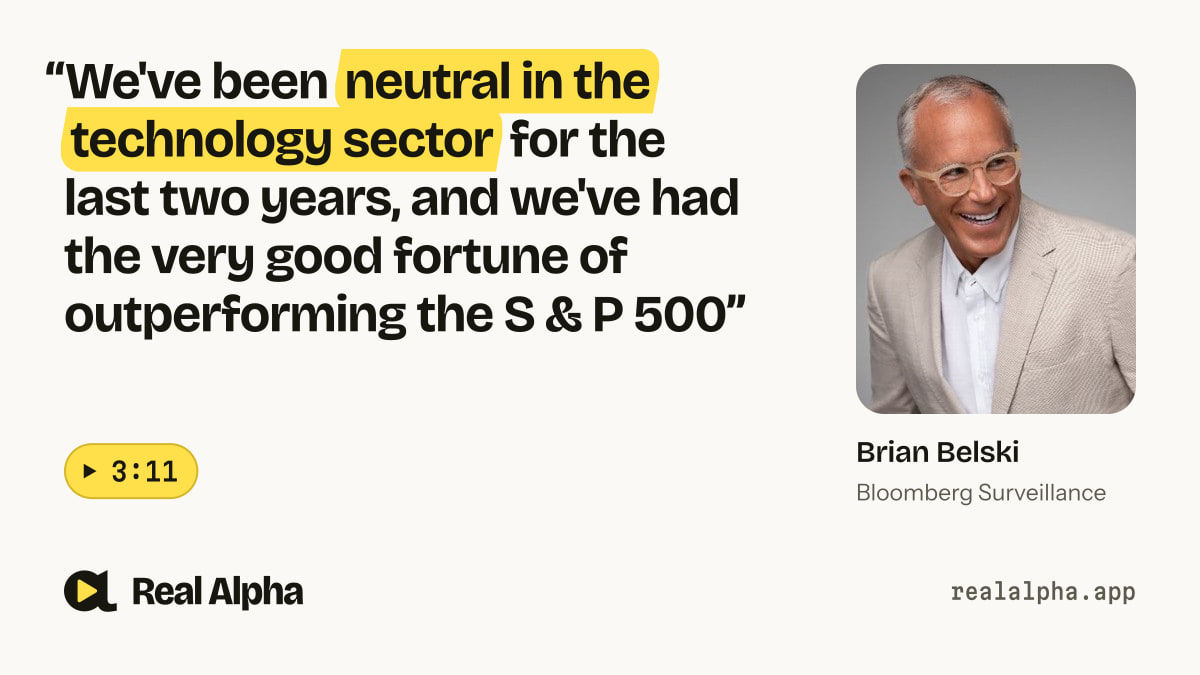
“We've been neutral in the technology sector for the last two years, and we've had the very good fortune of outperforming the S & P 500”
 Brian Belskiat 3:11 · Bloomberg Surveillance
Takeaways
- His firm stayed neutral on technology for two years.
- He sees fear around AI as evidence the trade is not a clear bubble.
- Broader participation favors value, dividend growth and sector diversification.
About this segment
Brian Belski says investors need not own every AI stock, citing his firm’s tech-neutral stance and performance. He sees broader market participation as a sign of more fundamental investing.

CEO, Humilis Investments
Led BMO Capital Markets' Investment Strategy Group before founding Humilis after a 36-year Wall Street investment career.
- TK
Tom Keene, Host
- PS
Paul Sweeney, Host
From “Nvidia Resets the Market | Bloomberg Surveillance”, Nov 24, 2026. Watch the full episode
Answers “Is AI a bubble?” See all 99 answers
Thanks. We'll look at and fix what's off.
Transcript
From the transcript Bloomberg Surveillance publishes with the episode.
- 2:36
So what is, Brian, your kind of view of the AI trade broadly defined? Because it means different things to different people. And, you know, it's a fluid situation all around how you want to play it. How do you guys just think broadly about getting exposure to properly to AI?
- 2:56
It's a great question and it really adds perspective with respect to what's going on, Paul. So thanks for asking that. I think a lot of people think they have to own everything. So we're believers that you don't have to own everything. You have to be very, very select in terms of how you're looking at this. For instance, We've been neutral in the technology sector for the last two years, and we've had the very good fortune of outperforming the S & P 500 in our flagship product.
- 3:22
That's kind of number one. Number two, from a sentiment perspective, we love the fact that people are scared. We love the. Fact that people are scared about AI and worried about it because that means the bubble is nowhere near. And some would argue that the bubble burst here with all this volatility. We would say that that was more driven through technology. a perfect way about what happened in Washington and what's going on with data centers and what's going on with the technology valuations and is that I think the market's going to be transitioning, Paul, to worrying about the slowdown in earnings and relative to where earnings are and valuations are. Valuations on the technology sector is as cheap as they've been since 2016. I think people are missing that. And earnings growth has become increasingly stable. And
- 4:09
I think as we go on with the AI trade in general, you have to think about where are the most stable earners, What part of the ecosystem are there? Where's the money coming from and how that fits into the overall investing habit in terms of the United States? And we still think the U.S. is going to be the leader as everyone. Most people are coming out their year ahead pieces for 2027. Everyone's going to be negative.
- 4:32
Everyone's going to be blah. Everyone's going to talk about investing in emerging markets in Europe once again. And so that we think is a contrarian positive for U.S. Stocks.
- 4:41
I love, Brian, that you brought up valuations for tech, because I think that is sort of the big underreported story at the moment, or one of them at least. But when you look ahead to 2027, what is, are we going to see a continuation of this market broadening or the breadth getting wider?
- 4:59
We are, you know what I think, but people have missed and we wrote about it in a one pager yesterday just to kind of get something out in terms of what's happening in the broadening out is that we haven't seen this type of unweighted S & P 500 outperformance relative to the weighted when the market's been going down. We haven't seen that and it's been outperforming on the way up. This is a sign that we believe investors are becoming more fundamentally driven. That means that strategies like value, like dividend growth and like having, ownership in every sector makes a lot of sense. We actually think that is a healthy thing for longer term investors. Remember, we don't look at a week or a month. We look at annual periods. And if you take two steps back and you look at the S & P 500 and you look at rolling 20 year returns since 1970, there's never
- 5:47
been a negative period. And so the average is nine point six percent or something like that. So if you're a longer term investor, you don't try to pick the bottoms like we've seen the last couple of days.