The alpha, twice a week
That was 7 min.
Get the best new moments in your inbox every Wednesday and Saturday. It's free.
Check your inbox
We sent a link to your address. Click it to finish signing up. Not there in a minute? Look in spam.
or
The Diary Of A CEO · 7 min · Nov 2, 2026
Self-driving vehicles should keep human supervisors
 James Talarico
 argues that autonomous vehicles can improve road safety without removing every driver, comparing oversight to pilots on automated planes.
In this episode
Full analysis- 16:00Corporate influence helped shrink the middle class7 min
- 43:18AI rules should protect workers, children and democracyPro pick 6 min
- 57:33Affordability helped drive voters toward Trump3 min
- 24:47A Texas donor gave the governor $12 million for voucher policy3 min
- 31:32Collecting taxes already owed could raise $172 billion a year4 min
- 38:02One firm can control insurance, hospitals and pharmacies2 min
- 49:21Self-driving vehicles should keep human supervisors7 min
- 1:06:42Congress should withhold war funding without clear objectives4 min
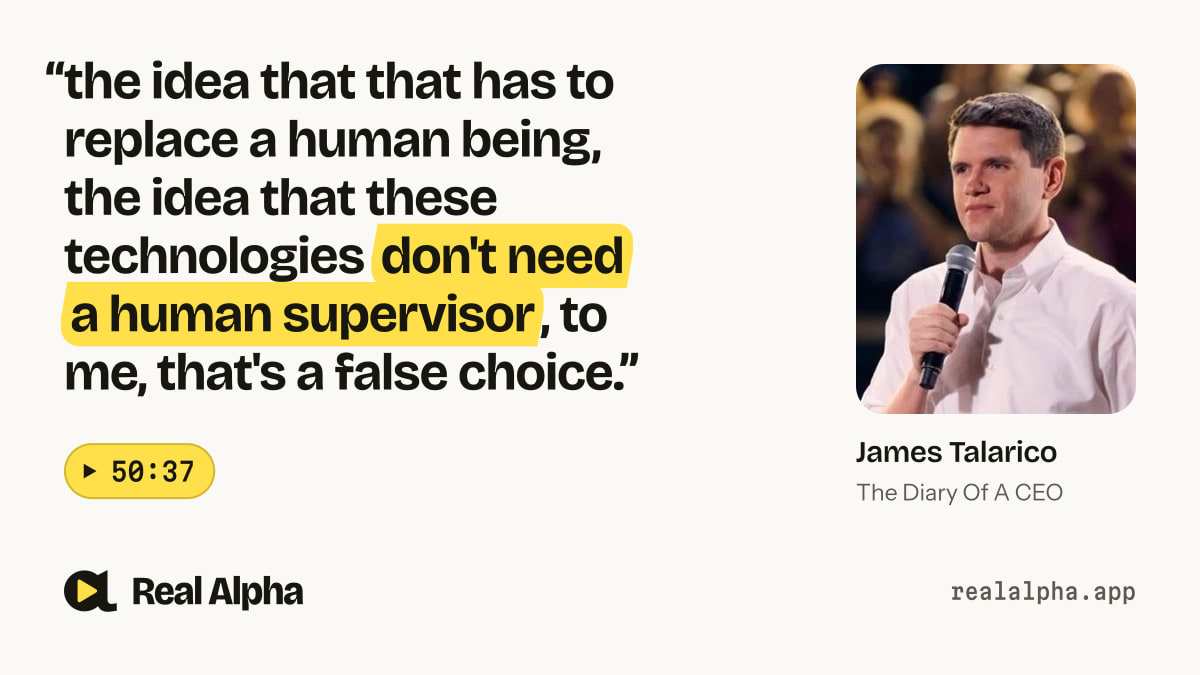
“the idea that that has to replace a human being, the idea that these technologies don't need a human supervisor, to me, that's a false choice.”
 James Talaricoat 50:37 · The Diary Of A CEO
Takeaways
- He argues a person should oversee autonomous vehicles, especially trucks.
- An expert he consulted warned of five trillionaires and 30% unemployment.
- He proposes using AI-company tax revenue to fund entrepreneurship grants.
About this segment
James Talarico argues that autonomous vehicles can improve road safety without removing every driver, comparing oversight to pilots on automated planes. He also discusses a 30% unemployment forecast and grants for human-led ideas.

James Talarico is a Democratic State Representative and former public school teacher.
Passed laws capping insulin costs and expanding child care, and helped overhaul Texas school funding.

Steven Bartlett, Host · Host, The Diary Of A CEO
From “James Talarico: Here Is How They Designed The System To Keep You Poor!”, Nov 2, 2026. Watch the full episode
Answers “Which jobs will AI replace, and which are safe?” See all 241 answers
Answers “Are self-driving cars safe?” See all 12 answers
Thanks. We'll look at and fix what's off.
Transcript
From the transcript The Diary Of A CEO publishes with the episode.
- 49:25
If the technology plays out how they're forecasting and how on the current direction of travel, then if you just think about driving as an occupation, we all watched those videos of these new cybercabs rolling out around Texas where they have new steering wheel, no pedals at all, and two seats in the front and the car just drives itself autonomously. From my rough estimates, approximately 400,000 people in Texas work as professional drivers as their primary payroll occupation.
- 49:52
But if you factor in like gig workers that are on the Ubers, the DoorDashes, which by the way, you know, the founder of the CEO of Uber sat there and told me those jobs are going away. It's more than half a million people that rely on driving as an occupation. Texas is leading the charge towards autonomous vehicles where you need no driver. It would appear to me logically that on this direction of travel, there's going to be significant job disruption.
- 50:14
This is even outside of humanoid robots and so on. And I wonder like how, you know, there's an AI dividend, but I just wonder how people like you are thinking about that level of disruption. Yeah. Theoretically could happen really, really quickly. And rejecting the false choices, right? Because it is possible to benefit from some of these technologies. You know, some of these self-driving cars will make us all safer on the roads, which is great.
- 50:40
Yeah. But the idea that that has to replace a human being, the idea that these technologies don't need a human supervisor, to me, that's a false choice. Why would it need a human supervisor? I mean, I would hope, especially if we're talking about like 18-wheelers barreling down Texas highways, I would hope there's a human being there. to monitor these technologies. If you think about- Even if the data suggests that it's more safe without the human.
- 51:05
You think, I'm all for taking advantage of the safety features. I just think about airplanes, right? The fact that airplanes mostly fly themselves, I'm still very comforted by the fact that there is a trained professional behind the controls in case anything goes wrong. And so, again, if we're making these decisions together instead of just a few billionaire CEOs making the decisions for all of us, then we can reject some of these false choices that are presented to us.
- 51:32
And we can figure out a way to both take advantage of the benefits of these technologies, like making our roads safer, making cars safer, reducing fatalities and ensuring that we are protecting human beings in the process. I just fundamentally reject the idea that we have to choose between those two things. I watched a video the other day of a factory, and they had the humanoid robot doing the packaging process, and then a human next to them.
- 51:55
And they were just demonstrating the productivity difference between this humanoid robot that was flipping the packages versus a person who had to sleep and go to the toilet and all those kinds of things. And it's a video by Figure AI. And the video concludes with the fact that the humanoid robot was more productive, essentially. And it did need to sleep and obviously all those kinds of things. So I think also about that level of work.
- 52:14
And I don't know, I've just, I'm in search of a good answer to this question of like job disruption that seems to be logically on the way. The big frontier labs, their CEOs in AI have all forecasted job disruption increasingly. They change their tone a little bit when it becomes unpopular, right? But if you look through their writing since 2016, they're saying that the economy is going to have to drastically change in light of this technology.
- 52:38
So I spoke with an expert on AI because I'm, you know, when you're in these positions, when you're in elected office, you suddenly realize... all the things you don't know. You're having to make crucial decisions on things that you may not be an expert on yet. And so I'm trying to get smarter on this every day. And I was speaking to someone who's done a lot of work in AI, and he said he's worried that we are headed toward five trillionaires and 30% unemployment.
- 53:05
And that terrifies me, right? As someone who cares about the people in my state, that's not the future I want. And there's still time for us to make these decisions together. What kind of AI future do we want? This is not something we're subjected to. Yes, we're going to see disruption. We've seen disruption from past technologies. But if we're making decisions together as a country, then we can both weather some of those disruptions and we can come out stronger on the other side.
- 53:30
I think about the need to invest in. and double down on what only human beings can do. Doubling down on human creativity, on human ingenuity, right? I've talked about the need for entrepreneurship grants. If we're taxing these AI companies, some of that revenue can go toward investing in folks who have a great idea for a business or an invention or a piece of art. But these people don't know a bunch of wealthy investors.
- 54:00
And so we're gonna invest in the little guy, just like we did with Tesla, just like we did with the internet. And those innovations have more than paid for themselves. And so I want us to do more of that, finding out what is it that human beings alone can do And doubling down on that creativity, that ingenuity. Again, that's just an example of if we all come together and we think seriously about this problem and decide that we're going to make decisions together, the AI future can look very differently than the path that we're headed on.
- 54:35
Do you have faith that elected officials can pass through this and arrive at a conclusion? Because if you think through, I don't know, how social media was handled, we tend to handle it after the fact. That should be a negative example, right? Because we let social media companies run wild and they ended up preying on our children. They ended up hurting our kids. They ended up hurting all of us, not just kids.
- 54:59
And so we should learn from that example and realize that if we're going to do this and if this technology is coming, if this innovation is coming, let's figure out as a community, as a nation, how we're going to respond and what policy frameworks we need to put in place to ensure that, again, AI is making our lives better and easier and less stressful and not hurting people. This is a fundamental belief that I have that the economy is for people.
- 55:26
People aren't for the economy. Right. Right. That is a that is a guiding star for me. And so if if we are headed down a path where people are going to get hurt needlessly because a few guys in Silicon Valley say it's necessary, I think we have to reject that. And our elected officials who in a democracy are tasked with making these big decisions, they need to get in the game. Politics has shifted over the last couple of over the last couple of years.