The alpha, twice a week
That was 4 min.
Get the best new moments in your inbox every Wednesday and Saturday. It's free.
Check your inbox
We sent a link to your address. Click it to finish signing up. Not there in a minute? Look in spam.
or
Odd Lots · 4 min · Nov 6, 2026
Senate control could make future Fed appointments harder
 Skanda Amarnath
 explains why a Democratic Senate would scrutinize Trump’s Fed nominees and why filling a vacancy after Powell may be difficult.
The episode’s best minutes
Full analysis- 14:03Data center growth faces political and economic constraints5 min
- 19:02Senate control could make future Fed appointments harder4 min
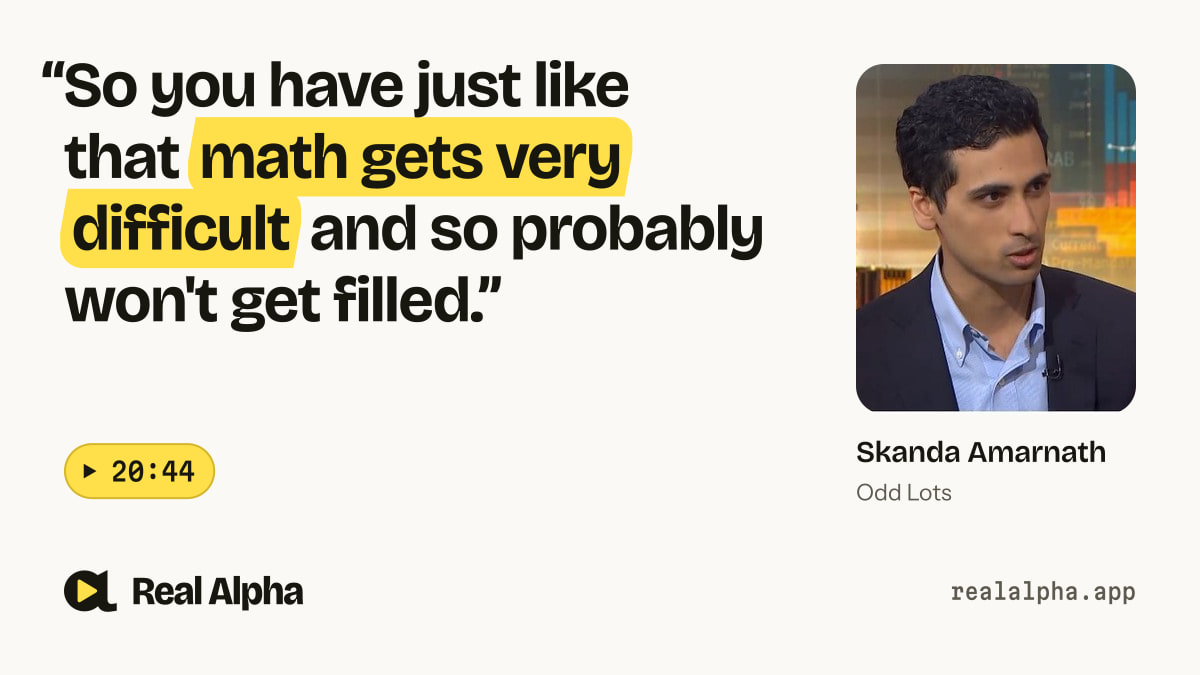
“So you have just like that math gets very difficult and so probably won't get filled.”
 Skanda Amarnathat 20:44 · Odd Lots
Takeaways
- Trump’s earlier Fed nominees faced resistance even under GOP Senate control.
- A vacancy after Powell may be difficult to fill quickly.
- Senate election results can shape Fed appointments for years.
About this segment
Skanda Amarnath explains why a Democratic Senate would scrutinize Trump’s Fed nominees and why filling a vacancy after Powell may be difficult. The Senate’s six-year terms could shape appointments well beyond this election.

Skanda Amarnath is an executive director of Employ America.
Co-founded Employ America, leading economic policy advocacy and developing frameworks for Federal Reserve policy and strategy.
- JW
Joe Weisenthal, Host · Bloomberg
- TA
Tracy Alloway, Host · Bloomberg
From “The Macro Implications of the Blue Tsunami | Odd Lots”, Nov 6, 2026. Watch the full episode
Thanks. We'll look at and fix what's off.
Transcript
From the transcript Odd Lots publishes with the episode.
- 19:14
the pressure kind of filter through the cap stack for sure. Let's talk about Fed, Jared. Going back to Senate control. You mentioned the Senate and its importance to Fed appointments. Can you talk a little bit more about that?
- 19:25
Yeah, so... In the case of before this election, or I guess even now, it's a lot easier to get your nominees through. Generally speaking, your own party is going to scrutinize your nominees to a much lesser degree than the opposition party. We saw several, even under Republican Senate control in, what was it, 2018, 19, 20? There were a number of Fed nominees Trump chose that did not make it. Oh, yeah.
- 19:55
I forgot about all of those. So there was Judy Shelton, Steve Moore, Marvin Goodfriend. Now the challenge with it is I suspect there's going to be even more scrutiny.
- 20:03
Yeah, of course there will be more scrutiny. But who's coming up? Well, there's one Jay Powell. So when does Jay Powell?
- 20:11
His term ends at the beginning of 2028. He has stayed on longer. Yeah, now he can retire in peace, right?
- 20:19
I think the question for him is there's been this on-again, off-again issue of Fed investigations. I suspect he would like to roll off if he felt confident that it wasn't going to do anything to the institution. That's sort of his comfort zone, I suspect, with respect to how the president can influence policy, what exactly is going on now within the building. But I think even if there's a vacancy for that seat, how quickly can that be filled?
- 20:46
I suspect it's going to be very hard if Jay Powell is out of the state until the beginning of 2028. I think it's going to be really hard to fulfill that by the end of the term because you're going to have to get through a lot of Democratic sort of veto gates of sorts. So you have just like that math gets very difficult and so probably won't get filled. That'd be my best guess unless they're able to find a way to really pick a nominee who can win over the trust of Democrats relatively quickly, coordinate that to some degree. I don't know with, there's not going to be any coordination with J-PAL. So I think that's good.
- 21:15
That's itself going to be a challenge for how to kind of manage, navigate that. So you're going to be left with the Fed board composition. But the thing is, with the Senate, it's like, these are six-year terms, right? So it's going to matter, the fact that like, it may be a one-off that Democrats win in South Carolina. It may be a one-off that if it's Mississippi or Kansas. But they're going to be there for a while, and that itself just tilts things for at least, yeah, another four or six years, even as there are other Senate cycles that'll happen. And so if you're thinking about who are going to fill the subsequent seats, that tilt looks a little less favorable if you're trying to tilt it in a partisan direction. Now, look, it really wouldn't be for the best if the Fed board did not take on a partisan character. And I think the Fed board
- 21:59
is less partisan than, say, the Supreme Court. The Supreme Court, we all kind of see that's, like, got some very convenient splits of votes on key decisions that do take on a partisan character. That hasn't been the case, even under, I don't know, Chris Waller will still vote in the same direction as Philip Jefferson. It's not, that hasn't changed so drastically. But even so, you have a president right now who clearly would like to move policy in a specific direction, has been very vocal about that. And I think that's what, there's more sand in the gears here.
- 22:29
There's more More of a challenge, actually, to influence that.