The alpha, twice a week
That was 6 min.
Get the best new moments in your inbox every Wednesday and Saturday. It's free.
Check your inbox
We sent a link to your address. Click it to finish signing up. Not there in a minute? Look in spam.
or
MTS · 6 min · Nov 4, 2026
Sequencing costs make biological data the AI bottleneck
 Samir Kaul
 contrasts the billion-dollar, decade-long genome project with $100 sequencing, then links cheaper genomes to cancer monitoring and larger biology datasets.
In this episode
Full analysis- 17:07Chip scarcity is a poor five-year investment thesis3 min
- 3:49Weak biotech IPO returns make trial speed important4 min
- 11:14Sequencing costs make biological data the AI bottleneck6 min
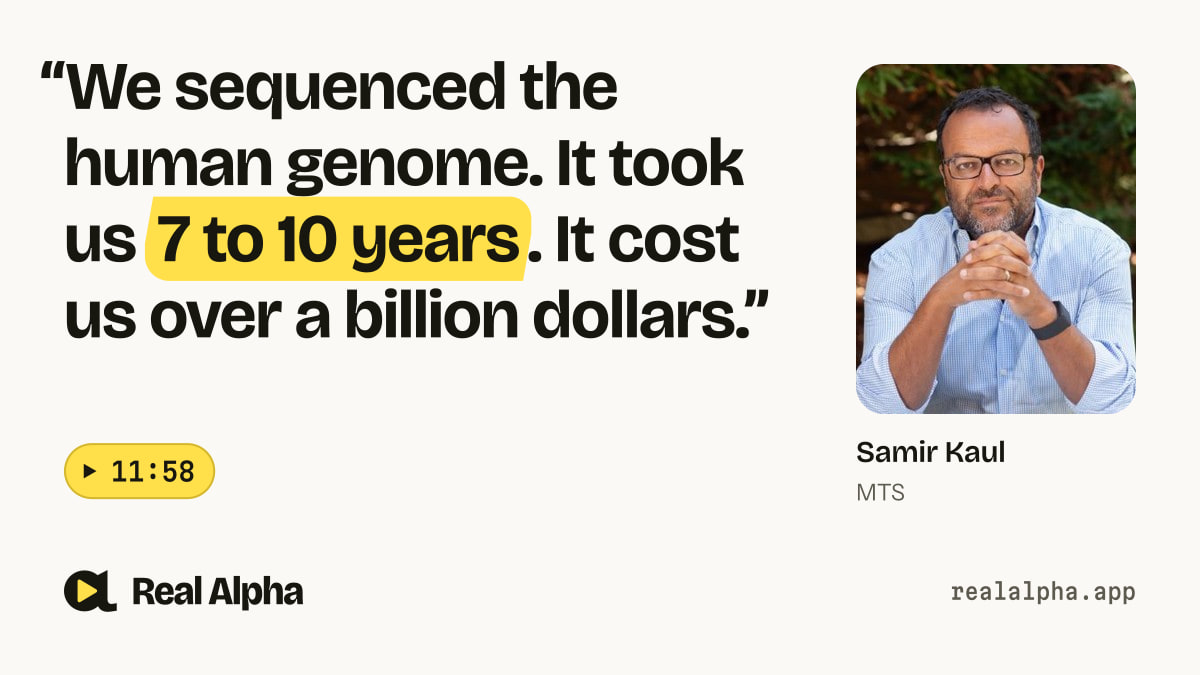
“We sequenced the human genome. It took us 7 to 10 years. It cost us over a billion dollars.”
 Samir Kaulat 11:58 · MTS
Takeaways
- Genome sequencing went from over $1B and 7–10 years to $100 by lunch.
- Blood tests can track tumor DNA without repeat scans or tissue biopsies.
- He sees biological data, not compute, as the bottleneck for AI in biology.
About this segment
Samir Kaul contrasts the billion-dollar, decade-long genome project with $100 sequencing, then links cheaper genomes to cancer monitoring and larger biology datasets. He argues that data, not compute, is the bottleneck in biology.

Samir Kaul is a founding partner at Khosla Ventures.
Co-founded Helicos BioSciences and led investments behind exits including Guardant Health, Nutanix, Oscar and QuantumScape.

Theo Jaffee, Host · Co-founder & host, MTS
One of the first members of a16z's new media team; earlier hosted the Emergent Ventures-backed Theo Jaffee Podcast.

Sophia Dew, Host · Host, MTS
From “Why Chip Supply Shortages Won't Last | Samir Kaul”, Nov 4, 2026. Watch the full episode
Thanks. We'll look at and fix what's off.
Transcript
Transcribed by machine (Whisper) from the episode’s audio, so a word may be off here and there.
- 11:16
Oh, absolutely. Absolutely. You know, we invested in, we were the co-leads of Discovery Loop. This is Jeff Dean and his gang from Google, really the legends, 27 years at Google, everything from, you know, TPUs, TensorFlow, Google Brain, I mean, you know, really everything, almost all the significant achievements at Google, these four folks had their fingers in. And they finally leave after 27 years to do an RSI company looking at how can we improve the scientific method so you now are designing experiments getting results in real time and then continually in parallel designing thousands of follow-on experiments and I just think about how great that was like when I I was doing DNA sequencing in the late 90s.
- 12:01
We sequenced the human genome. It took us 7 to 10 years. It cost us over a billion dollars. And we were, you know, I was taking jazz drives and analyzing them. And now you can sequence a human genome by lunch for 100 bucks. Wow. And that's without AI. Now you're throwing in full AI into the mix. It's going to be amazing what you can achieve. So we talked about picking the right patients. You get a blood draw.
- 12:28
You should get a blood draw every three months. and every three months you should get all the markers and etc they do and see your genome sequenced and see what changes have happened what are you investing in right now that shows that so that's like you know that was my background in dna sequencing so we actually 24 years ago started a company helicos that went public but it was a little ahead of its time uh it still what didn't have the cost parameter we're talking about now and then recently about seven or eight years ago So I partnered with an entrepreneur, Galad Al-Moghi, that I've done five companies with, super genius, great executive, to do Ultima Genomics, which has since raised quite a bit of capital.
- 13:07
But more importantly, it's got real revenue traction and has dramatically increased the cost, the speed, and the fidelity of DNA sequencing, where you absolutely can walk into a doctor's office and leave with your DNA sequence. For people who aren't familiar with DNA sequencing and genomics as a whole why is this really important to innovate here well think of it this way people sit there and look for their a1c numbers their ldl numbers right those are one or two of tens of thousands of markers that we could be tracking and what matters for you may be very different for what matters for me right you said you're mexican i'm from india right our just our dna would mean that there are certain things that you're more likely to be susceptible to and versus me we can measure that now with our DNA is we can measure the changes. You know, cancer, for example, is a
- 13:57
disease of the genome. So something is going on in your genome that causes cancer, tumor cells to propagate. And we can now measure that. You know, even I was on the board of Garden Health. It's a 20-something billion dollar public company now. And the genius there was because the cost of sequencing was so low, you could detect tiny amounts of DNA from the tumor that shed into blood. So as opposed to waiting, biting your fingernails for six months for the next scan, because you can't get a scan more than that, then all of a sudden the risk of getting cancer from the scan is more than actually the cancer you have.
- 14:31
You get a blood test every month, and you can say, hey, has my tumor count in the blood grown or shrunk? Has the markers changed? Has the cancer mutated or not? Such an easier, with just a simple blood draw, non-invasive, not doing a tissue biopsy, not sitting under a CAT scan or an MRI. It's just amazing. No, it's really awesome. We've had founders come on MTS talking about because they made the cost of sequencing so low, you have kids that had cancers or really bad diseases that traditionally you'd have to get a whole slew of experts to be able to actually be able to understand what's happening with their genome. And now with AI, they can get that for free and instantly and really fast and cure all of these diseases. It's pretty impressive. Well, cure diseases might be tough, But certainly, for most cancers, early detection is a lifesaver, truly.
- 15:25
What's unique about what's happening today in the end of 2026 that allows for all of this innovation to happen? Why couldn't this have happened five years ago? Well, in many things you read about in tech, you hear about compute costs and how much data centers are costing. We're spending, I think, almost 3% of GDP or equal to what we spend on defense on data center build-up. So that seems kind of...
- 15:51
In biology, it's not compute that's a bottleneck, it's the data. So, you know, I don't know if you want to say... that piece of DNA data is a token or a GPU or part of the LLM, but that is the bottleneck. And as you get more and more of it, so if you have 8 billion people in the world, you have 400 million people in the United States, so 400 million people are getting their DNA tested for $20, $50 every quarter.
- 16:20
For $200, think about how much information you're getting, which will certainly build into these models to help predict human behavior, how humans respond to drugs, what diseases they may or may not get, much faster than ever before. So how exactly are you getting more of this data? Are products where people are uploading their information? Yeah, because these machines are much cheaper and they process the data faster and they're more accessible and more and more people are doing that.
- 16:45
Wow.