The alpha, twice a week
That was 4 min.
Get the best new moments in your inbox every Wednesday and Saturday. It's free.
Check your inbox
We sent a link to your address. Click it to finish signing up. Not there in a minute? Look in spam.
or
Uncapped · 4 min · Jul 1, 2025
Small on-demand vehicles could replace cars in cities
 Vinod Khosla
 describes a self-driving transit system of small vehicles that fit in a bike lane and arrive on demand.
The episode’s best minutes
Full analysis- 24:41Khosla backed OpenAI by following talent and progress8 min
- 39:55Experts avoid mistakes while entrepreneurs invent the futurePro pick 5 min
- 50:14Small on-demand vehicles could replace cars in cities4 min
- 4 more moments in the full episode
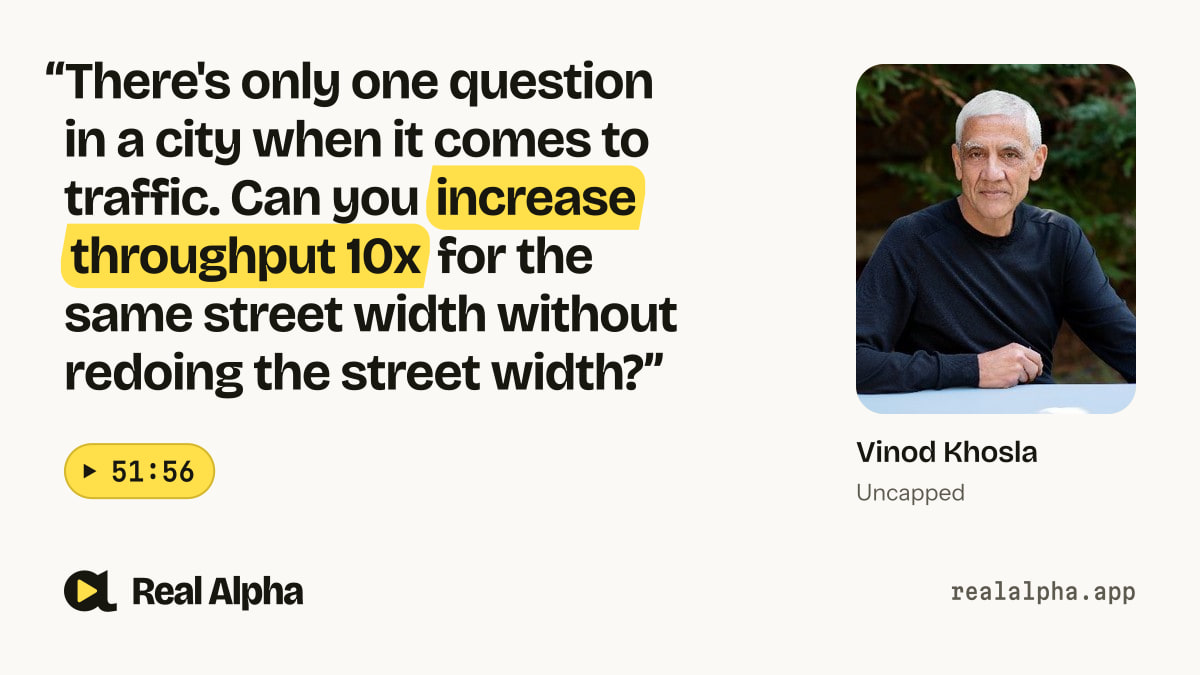
“There's only one question in a city when it comes to traffic. Can you increase throughput 10x for the same street width without redoing the street width?”
 Vinod Khoslaat 51:56 · Uncapped
Takeaways
- Small vehicles can fit in bicycle-lane-width infrastructure.
- On-demand service could be faster and cheaper than transit.
- The system aims to increase street capacity without widening roads.
About this segment
Vinod Khosla describes a self-driving transit system of small vehicles that fit in a bike lane and arrive on demand. He says the approach could move more people without expanding streets, and his startup has won a city project.

Vinod Khosla is an entrepreneur, investor and technologist.
Founded Khosla Ventures, co-founded Sun Microsystems and backed early investments in OpenAI, Stripe and DoorDash.

Jack Altman, Host · General partner, Benchmark
Co-founded Lattice and ran it until 2023, then started his fund, Alt Capital.
From “Vinod Khosla Predicting the Future | Ep. 15”, Jul 1, 2025. Watch the full episode
Thanks. We'll look at and fix what's off.
Transcript
Transcribed by machine (Whisper) from the episode’s audio, so a word may be off here and there.
- 50:18
Yep. Robotics we got. Robotics we got. What else? I'm super excited. So I was mentioning this talk I did. It's called Plausible Tomorrows. So you can Google that too. I have a dozen predictions that look really implausible unless somebody sits down with me and I walk them through each and they say, I see no reason this won't happen. I think by 2050, we can replace most cars in most cities. Self-driving or just don't have cars?
- 50:51
Public transit, that meets the following requirements. It's always cheaper than cars and cheaper than today's public transit. Cheaper than today's public transit without losses for the transit agency. That's always faster than public transit. Because it's like Uber, it's hailed, not scheduled. It's all personal. It's two and four person vehicles, and it fits in a bicycle lane. Not only, by the way, public transit, Fusion, OpenAI, I invested in the same timeframe roughly around 2018.
- 51:32
So I'm very proud of that vintage year. That's a good year. But people said, public transit startup, you must be totally crazy. And I said, Google's doing Waymo is the wrong way to do transit. Because the vehicles are too big or what? No, it just increased congestion, okay? So what should it be? So, and I think Waymo will have a great business for delivering people from transit routes to the left.
- 52:00
smile. There's only one question in a city when it comes to traffic. Can you increase throughput 10x for the same street width without redoing the street width? So we designed a public transit system of self-driving vehicles in bicycle lane width. So it's easy to insert in a city, has 10 times the capacity of a light rail system or a car system. So more capacity than light rail system in a bicycle laneway.
- 52:33
And it's on demand because the cars just, you hail them like an Uber. So turns out every single project we have bid so far, we bid a lot. Four have been decided. We want every single one for a public transit system from a startup. And the startup wasn't invited to bid on any of these projects because nobody knew about us. Yeah. Nobody invites a startup. San Jose invited 32 bidders to build a transit system from the airport to the Google campus and then to the Apple campus in San Jose.
- 53:13
We bid over the transom because most of these bids are open and we won it outright. Think about it. But is this, so what is the, what's the vehicle? It's a little pod. Think Disney World. It's like a little narrow car. Yeah. Yeah, that makes sense. It fits in a bicycle lane. Yeah. By the way, it can fit above a bicycle lane too. Yep. You can go twice as many as cars on a street or something like that.
- 53:37
So it turns out it has way more capacity than cars in a street. Or even if everybody took buses, this would have more capacity. in passengers per hour given for a given street width. Are they also coordinating with each other so the cars are closer together? Is that part of it? Absolutely, you can coordinate, yes. Yeah, so you basically just have- If you build a raised infrastructure, it's so simple, you can do prefab.
- 54:02
Yeah. You don't have to do the Boston tunnel dig for 20 years. Right, wow. You just do a prefab, put it in place. Yeah, that's a good one. It is thinking from first principles. Yeah. That matters. And it leads to, and being ambitious. Okay, and how about medicine?