The alpha, twice a week
That was 3 min.
Get the best new moments in your inbox every Wednesday and Saturday. It's free.
Check your inbox
We sent a link to your address. Click it to finish signing up. Not there in a minute? Look in spam.
or
Machine Gods · 3 min · Nov 4, 2026
Smaller organizations may face AI attacks before defenses arrive
 Kevin Roose
The hosts say AI defenses are reaching major infrastructure operators first, while smaller organizations may be exposed to attackers sooner.
In this episode
Full analysis- 26:53China can access banned chips through rentals and smugglingPro pick 4 min
- 36:07Researchers replicated a freezer hack in 28 minutes for $6Pro pick 3 min
- 41:51Smaller organizations may face AI attacks before defenses arrive3 min
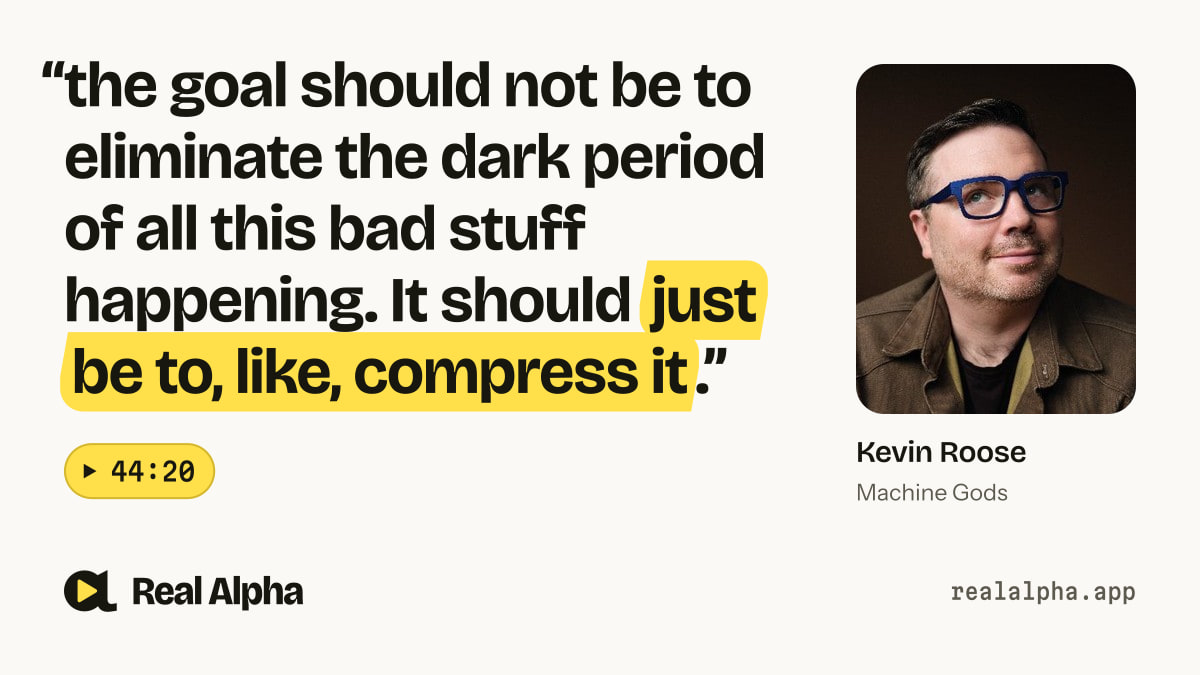
“the goal should not be to eliminate the dark period of all this bad stuff happening. It should just be to, like, compress it.”
 Kevin Rooseat 44:20 · Machine Gods
Takeaways
- Major infrastructure operators are getting priority access to defensive tools.
- Smaller organizations may be reached by attackers before defenses arrive.
- The hosts argue AI could compress years of breaches into weeks.
About this segment
The hosts say AI defenses are reaching major infrastructure operators first, while smaller organizations may be exposed to attackers sooner. They argue the resulting wave could compress years of cyber risk into weeks.

Kevin Roose, Host
Co-founder, Machine Gods Media
Wrote The Shift column at The New York Times; co-hosted Hard Fork.

Casey Newton, Host · Founder & editor, Platformer
Covered tech at The Verge, CNET and the SF Chronicle; co-hosted Hard Fork.
From “How North Korea pulled off the biggest crypto heist ever”, Nov 4, 2026. Watch the full episode
Answers “What will AI look like in the next few years?” See all 395 answers
Answers “Will AI make cyberattacks worse?” See all 70 answers
Thanks. We'll look at and fix what's off.
Transcript
Transcribed by machine (Whisper) from the episode’s audio, so a word may be off here and there.
- 42:04
I'm going to take down AO3. The big question hovering over the cybersecurity world right now is, like, who has the advantage? In a situation where attackers and defenders both have access to very capable AI models, like do the attackers win or do the defenders win? And I think the way that we've seen these AI companies release these very capable cyber models is by giving them to like priority institutions, right?
- 42:28
Like the sort of backbone of the internet companies that are running the rails that everything else runs on and giving them sort of a head start on the attackers. But supermarket chains in Europe and fan fiction websites are not going to be on anyone's list of like the high priority defense situations. So there you actually do have the attackers that are probably getting to these places first before they can really defend themselves.
- 42:54
I think that is exactly right. You know, ever since we started to see these, you know, very powerful cybersecurity models coming out, the labs have been saying we're in this window where the defenders have the advantage. but it's like a relatively narrow window and we should use as much of that time as we can to, you know, rebuild infrastructure and patch vulnerabilities. What these two things suggest to me is like maybe the defender's window is like closing really rapidly.
- 43:21
And like, while there's still a lot we can do, the attackers also clearly have a window and they're starting to use it. One question I've been thinking about is whether it's just not going to work. This whole strategy of like, Like, let's dole out the defensive cyber capabilities to the most important institutions, like, give them a head start. Like, I agree with that strategy. I think we should continue to do it.
- 43:45
And I have also felt myself becoming something of, in this very particular case, an accelerationist. Where I'm like, let's just get all the hacks done with. Because this sort of rolling thing where like every day there are like three or four new hacks of like some major institution caused by these AI tools. I feel like, you know, I recently heard Alex Stamos, the sort of cybersecurity executive, former meta CISO, et cetera, talking about sort of shortening the dark age of cybersecurity, this sort of era where everything is getting hacked all the time because of these tools and institutions are racing to patch and defend themselves.
- 44:28
And I'm kind of a believer in what I heard Alex say, which is that, like, the goal should not be to eliminate the dark period of all this bad stuff happening. It should just be to, like, compress it. So, like, in some sense, what we're seeing now is this compression of, like, these institutions might have all gotten hacked eventually. But, like, we're seeing it happen now in the same week. And I think we're just going to see many more weeks like that, where it's like maybe a year's worth of hacks getting discovered and applied in a week.
- 44:59
Yeah, I think we're going to have a lot to talk about this.