The alpha, twice a week
That was 3 min.
Get the best new moments in your inbox every Wednesday and Saturday. It's free.
Check your inbox
We sent a link to your address. Click it to finish signing up. Not there in a minute? Look in spam.
or
Balance of Power · 3 min · Nov 9, 2026
Sonderling wants technology to make jobs data more transparent
 Keith Sonderling
 says the Labor Department and BLS are exploring technology to modernize data collection and explain revisions, which can reflect late responses.
In this episode
Full analysis- 5:25Congress wants answers on chip transshipment to ChinaPro pick 3 min
- 30:20AI backlash could bring bipartisan pressure on Nvidia3 min
- 13:18An Arizona business owner opened a third restaurant after detention3 min
- 20:18Senate committee math could constrain Trump's cabinet changes3 min
- 37:43Sonderling wants technology to make jobs data more transparent3 min
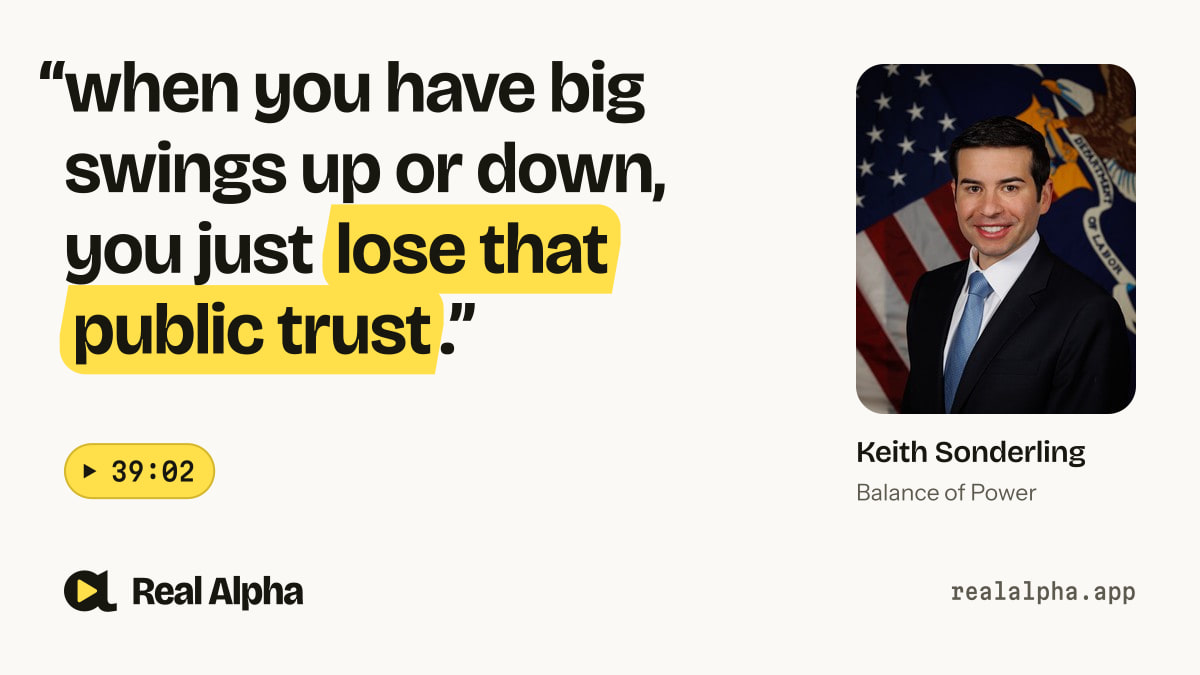
“when you have big swings up or down, you just lose that public trust.”
 Keith Sonderlingat 39:02 · Balance of Power
Takeaways
- BLS is exploring technology for data collection and revisions.
- Late responses can alter estimates after the initial release.
- Sonderling cites past annual downward revisions of 800,000–900,000 jobs.
About this segment
Keith Sonderling says the Labor Department and BLS are exploring technology to modernize data collection and explain revisions, which can reflect late responses. He points to past annual downward revisions of 800,000–900,000 jobs as a reason to restore trust.

Secretary of Labor, U.S. Department of Labor
Became a leading voice on workplace superintelligence as an EEOC commissioner and later led the Labor Department.

Joe Mathieu, Host · Washington Correspondent, Bloomberg
Co-anchors Bloomberg’s Balance of Power and covers Washington; founded and hosted SiriusXM’s POTUS political news channel.

Kailey Leinz, Host · Washington Correspondent, Bloomberg
Co-anchors Bloomberg’s Balance of Power, interviewing presidential candidates, administration officials, lawmakers and regulators on policy.
From “Trump Backs Nvidia CEO After Affair With Suspected China Spy | Balance of Power”, Nov 9, 2026. Watch the full episode
Thanks. We'll look at and fix what's off.
Transcript
From the transcript Balance of Power publishes with the episode.
- 37:46
So let's zoom out and talk about the American labor force or what's happening in the labor market more broadly, because we obviously saw a super strong jobs report on Friday with upward revisions. to boot, but we have seen some big misses and big surprises to the upside in just the last year or so. There is a lot of volatility month to month, and with so many revisions, I wonder what in your mind is happening to our data and why we are getting that kind of volatility.
- 38:12
Well, it's a very big thing that I'm looking at to make sure that there's public trust in the Bureau of Labor Statistics data. We have a fantastic new BLS commissioner, Brett Matsumoto, And the two of us are really looking into ways to modernize that data collection. But to your point, we can't have these massive swings in revisions, up or down. This job report's last two months were revised up. But really, the benchmark revisions, which are the yearly revisions, which during the Biden administration, you saw those $ 800, 000, $ 900, 000 jobs swing downward.
- 38:46
we've made some changes there and to make it more accurate to keep up with modern data collections. And a big piece of this too, which I'm very interested as labor secretary, I know the BLS commissioners, how do we use technology to help us with not only this data collection, but even the revisions and make it as public and transparent as possible? And I think that's been an issue is when you have big swings up or down, you just lose that public trust. And how can we use technology to make sure that we are being very transparent how we're collecting data. And also, technology may help us get more people to actually participate in this very important process.
- 39:21
And the way it's been for a very long time and the reasons you have those changes is that there's, I don't want to call them late filers like tax, but people give us the information after the collection period, but it comes in. So that makes it go up or down too. So we're really working hard on this. We want the data to be accurate because not only does it affect the economy, but more importantly, people really want to know that those opportunities are there and what industries they're there. And that's what in this last job report, what we're so excited about is that continued growth not only of private sector jobs, not only of beating expectations by 100,000, but where those jobs are. And the manufacturing sector continues to rise. We passed 101,000 manufacturing jobs just this year. So that's how we look at the data
- 40:03
and really look very granularly to what industries. And then the industries that are not growing the way we want, what can we do at the Department of Labor to make sure that industry is training the workers to be able to get into those jobs?