The alpha, twice a week
That was 2 min.
Get the best new moments in your inbox every Wednesday and Saturday. It's free.
Check your inbox
We sent a link to your address. Click it to finish signing up. Not there in a minute? Look in spam.
or
Bloomberg Businessweek · 2 min · Nov 6, 2026
Split government could slow spending and ease deficits
 Ira Jersey
 expects spending to track automatic benefit increases, with rising tax receipts potentially narrowing deficits; he doubts the $1.5 trillion defense budget passes unchanged.
In this episode
Full analysis- 0:28AI stocks were priced for explosive growth, not incremental gainsPro pick 3 min
- 7:23A stock selloff alone won't trigger an emergency Fed cut5 min
- 25:17Trump's setbacks are unlikely to make him change course5 min
- 18:27Housing could offset slower data-center construction4 min
- 4:46Data-center projects increasingly need outside financing2 min
- 15:14Canada steel tariffs may settle at 25% with quotas3 min
- 11:58Split government could slow spending and ease deficits2 min
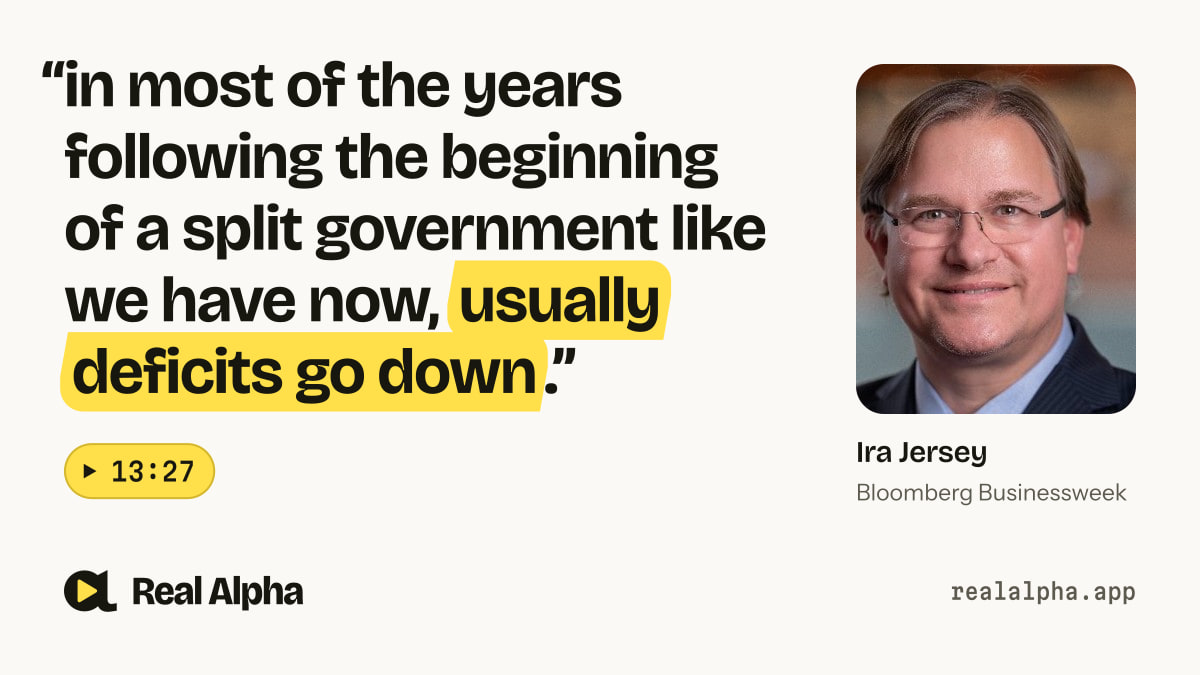
“in most of the years following the beginning of a split government like we have now, usually deficits go down.”
 Ira Jerseyat 13:27 · Bloomberg Businessweek
Takeaways
- Spending may grow no faster than automatic benefit increases.
- Jersey expects split government to put pressure on deficits.
- Cheaper gas could act like a tax cut for consumers.
About this segment
Ira Jersey expects spending to track automatic benefit increases, with rising tax receipts potentially narrowing deficits; he doubts the $1.5 trillion defense budget passes unchanged. He says cheaper gas would free up consumer spending.

Chief US Rates Strategist, Bloomberg Intelligence
Leads Bloomberg Intelligence’s global rates team and analyzes US Treasury markets, Fed policy and fiscal developments.
- CM
Carol Massar, Host

Tim Stenovec, Host · Co-host, Bloomberg
Interviewed leaders including Reed Hastings, Stephen Schwarzman and Mary Barra as a Bloomberg Businessweek co-host.
From “Stocks Plunge as Democrat Sweep Casts Cloud Over AI | Bloomberg Businessweek”, Nov 6, 2026. Watch the full episode
Thanks. We'll look at and fix what's off.
Transcript
From the transcript Bloomberg Businessweek publishes with the episode.
- 12:01
Does anything change in terms of the way you're thinking about government spending over the next two to six years as a result of what we saw on Tuesday? Well, six years is a long time. Well, I say six years because that's what Vice President J.D.
- 12:17
Vance said about control of the Senate. That's his concern. He cited the six years.
- 12:23
I think for the next couple of years, we have to probably think about government spending not going up any faster than the natural increases that come from things like Social Security and Medicare spending and cost of living adjustments. And then if we continue to have decent growth in wages, tax revenue. Will go up. So you could actually see a reduction– It's a modest degree in deficits over the next couple of years.
- 12:48
What about a one and a half trillion dollar defense budget? Does that that's what the president wants. But with a democratically controlled Congress, does that happen?
- 12:58
Yeah, it probably doesn't in the same way that the president might want, you know, and certainly not not in the size that that maybe he's he's trying to achieve. aspirationally get from Congress. It becomes much more difficult. And I don't think that we'll wind up getting a $ 1. 5 trillion defense budget without the president giving up something else. So there's going to have to be some back and forth. Typically, in most of the years following the beginning of a split government like we have now, usually deficits go down.
- 13:39
So that's one reason why I think yesterday in particular, there was a little bit of a relief rally in treasuries just on the idea that, hey, maybe the worst case isn't going to play out. Really quickly, Ira, 30 seconds here.
- 13:52
If the war ends with Iran and oil prices actually start to settle down, would that be just a real big help right now in terms of the US economy and just so many of the issues that are kind of out there?
- 14:03
Yeah, certainly if you saw gas prices come down a lot, that means that basically it works like a tax cut for the consumer. So presumably the consumer will start buying other things other than energy. Stay with us.