The alpha, twice a week
That was 2 min.
Get the best new moments in your inbox every Wednesday and Saturday. It's free.
Check your inbox
We sent a link to your address. Click it to finish signing up. Not there in a minute? Look in spam.
or
Wall Street Week · 2 min · Nov 14, 2026
Stadium subsidies need a business case, not just fan passion
 Mitch Daniels
Former Indiana governor Mitch Daniels says stadium deals should be judged on incremental activity and credible repayment, not political prestige.
The episode’s best minutes
Full analysis- 29:47Care jobs need policy support to become good jobs4 min
- 15:51Stadium subsidies need a business case, not just fan passion2 min
- 42:06Wedding gold also serves as collateral for consumer loansPro pick 4 min
- 5 more moments in the full episode
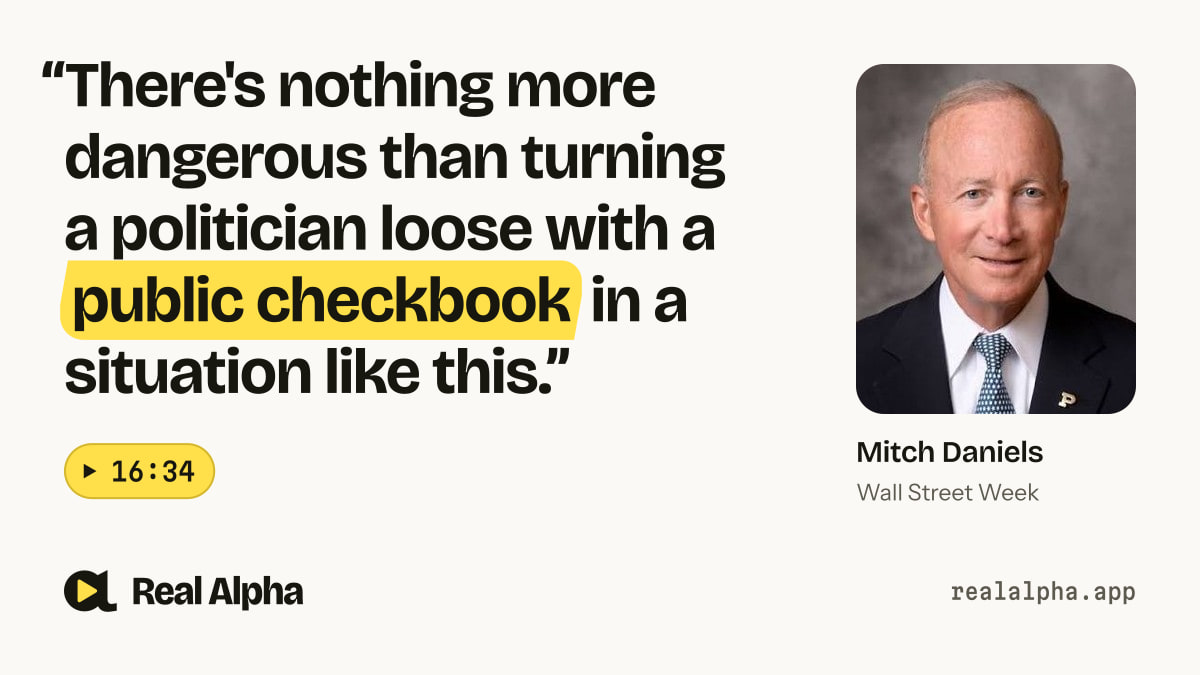
“There's nothing more dangerous than turning a politician loose with a public checkbook in a situation like this.”
 Mitch Danielsat 16:34 · Wall Street Week
Takeaways
- Count spending that would not happen without the stadium.
- Public financing may make sense if new activity repays it.
- Politicians can collect the credit while passing on the bill.
About this segment
Former Indiana governor Mitch Daniels says stadium deals should be judged on incremental activity and credible repayment, not political prestige. He warns that public financing can leave taxpayers with the bill.

Interim president, Purdue University
Led Purdue through a tuition freeze; earlier, governed Indiana and served as an Eli Lilly executive.
- DW
David Westin, Host
From “Nvidia Shakeup, Midwest Stadium Bids, Care Work Gap, India’s Wedding Economy | Wall Street Week”, Nov 14, 2026. Watch the full episode
Thanks. We'll look at and fix what's off.
Transcript
From the transcript Wall Street Week publishes with the episode.
- 15:54
You don't have to look too far to find stadiums built without the business judgment Daniels is talking about. For every successful project, like SoFi Stadium in Los Angeles, there's at least one Edward Jones in St. Louis, which ended up suing the Rams owner after the team moved back to Los Angeles and had left the city and state with large bond payments they couldn't recoup. How is a stadium like another big business deal, and how is it different?
- 16:22
It's different. First of all, because there's an emotional content to it as well as business content. I think that has to be factored in by the decision makers. But the primary reason it's different is because too often politicians are making the decision. There's nothing more dangerous than turning a politician loose with a public checkbook in a situation like this. Incentives, of course, are to do whatever it takes, cut the ribbon, bask in the glory, and then pass the bill on to somebody two or three down the line.
- 16:53
The public should be very, very guarded about this. To me, there are certain rules. No cash. And that's sometimes, sometimes politicians have forked over cash. I just think that's unconscionable. If you want to help with the financing where the prospect is very strong that it'll get paid back through taxes and new economic activity, then maybe. The cost has escalated beyond anything that we saw. There are a lot of folks who walk up on
- 17:24
the street or who will text and tweet and say, just give them what they want. Give them what they want because we don't want them to leave. To us, we believe that there is a balance here, that we can be smart and fiscally responsible to the people we represent, but also put together a package that works for this organization to keep the football club here. But here is the rub. That same kind of preponderance of people who say that we want the Bears to to remain in Illinois, also say, but we don't want to pay for it.
- 17:50
So that is the delicate balance that you find when you deal with sports and economics. And the question now is about creating the economic value to, one, keep the team here, but also to make sure that we're not putting the taxpayers on the hook. The economic development should be competitive, but it should not be desperate.