The alpha, twice a week
That was 5 min.
Get the best new moments in your inbox every Wednesday and Saturday. It's free.
Check your inbox
We sent a link to your address. Click it to finish signing up. Not there in a minute? Look in spam.
or
Upstarts · 5 min · Feb 12, 2026
Start giving back before your company is big
 Melanie Perkins
 describes Canva’s 1% pledge and its giving, then argues that impact should start alongside growth.
The episode’s best minutes
Full analysis- 12:21A big vision helps founders find the next step3 min
- 22:23Values matter when a company is willing to pay for them3 min
- 27:41Start giving back before your company is big5 min
- 4 more moments in the full episode
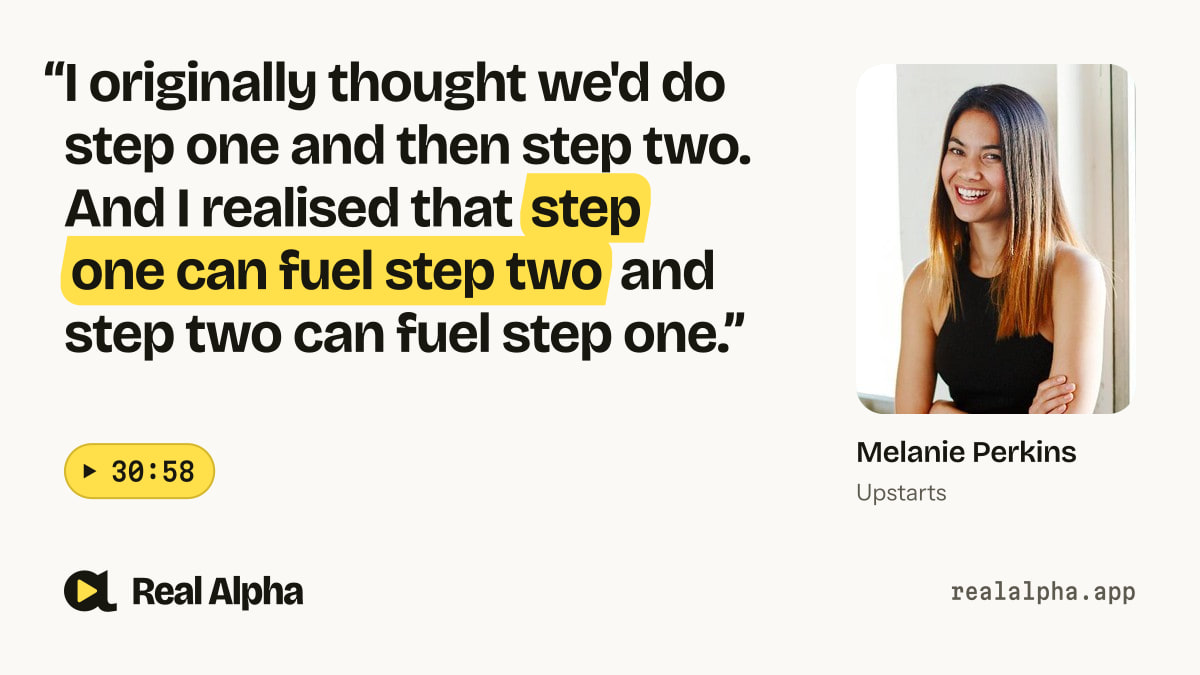
“I originally thought we'd do step one and then step two. And I realised that step one can fuel step two and step two can fuel step one.”
 Melanie Perkinsat 30:58 · Upstarts
Takeaways
- Canva’s 1% pledge covers time, profits, product and equity.
- Its free product for schools and nonprofits has delivered $2.5 billion in value.
- Treat impact as work to learn and scale, not a future windfall.
About this segment
Melanie Perkins describes Canva’s 1% pledge and its giving, then argues that impact should start alongside growth. Early action builds experience instead of assuming money will solve problems later.

Melanie Perkins is co-founder and CEO of Canva.
Co-founded Canva and leads its mission to empower everyone to design, while steering its pledge to do good.

Alex Konrad, Host · Founder & editor, Upstarts Media
Ran Forbes' Midas List for ten years and co-created its Cloud 100 list; founded Upstarts in 2025.
From “Canva’s Melanie Perkins on scaling startup vision and values for global impact”, Feb 12, 2026. Watch the full episode
Thanks. We'll look at and fix what's off.
Transcript
Transcribed by machine (Whisper) from the episode’s audio, so a word may be off here and there.
- 27:44
you're going to learn so much through that process as well. Melanie, could you talk a bit about how you've structured Canva and how you and your co-founders are thinking about giving back and sort of how Canva can be a good actor, you know, beyond the product and the company itself. Yeah, absolutely. So one of the first things we did was take the 1% pledge, which I strongly recommend you do, Alex. It is 1% of your time, 1% of profits, 1% of your product, and 1% of your equity. And even if that's not a lot today, over time, that can really steamroll. And so as a result of the 1% pledge, we gave away our product for free to schools around the world and non-profits and now that's 2.5 billion dollars of value that we've been giving away just um and so i think these things even though they might not seem like a
- 28:34
lot in the early days they become an incredible amount over time feels a little silly as a bootstrap startup but um but that's alex that's exactly why you should do it now because as you do it like it might be worth pretty much nothing today it might be worth not that much at all but then as you grow over time that could become more and more considerable and so doing it now when it isn't considerable is the time to do it for sure and then we also took the uh well cliff and i said that the vast majority of our equity is going to be donated through the canva foundation and so that's 30 percent of canva which is quite a considerable sum now and we've started to deploy it so we've put in over the last few years 100 million dollars to give directly where they give money directly to people in extreme poverty. And that's been extraordinary to see how $500 can mean
- 29:23
that people can all of a sudden get an operation that they need, afford education, health care, just the real basic necessities of life. And we've just pledged another 50 million over the next few years. And through this process, we're learning so much because we don't believe we should be sharing this planet with anyone that doesn't have their basic human needs met. I mean, how insane is that that people don't have their basic human needs met on this planet when it's not lack of money it's not lack of I don't even believe it's lack of goodwill I think we just haven't got well arranged towards achieving these goals of humanity yet and I believe we can and in fact I think for humanity as we think about you know the next few decades, I think there's going to be a bit of a reckoning, like what do we want?
- 30:05
What goals do we want to be achieving? What do we want to be leaving for the next generation? I think there's some pretty important questions, a vision deck for humanity by the 8 billion people here. What is wild success? What is terrible failure? What are the goals we want to be achieving for the world, for our countries and our local communities? I think that that is what we need to do to rise up above a lot of the fray that occurs.
- 30:27
I think it's interesting that you are trying to do it along the way, whereas, you know, I think some of your counterparts in especially Silicon Valley, but broadly across tech might say, let's achieve the global domination fully, whatever that looks like, and then that will have magically solved the problem. Maybe it's abundant energy or it's universal basic income brought by an AGI, but they sort of think about that first and then they're like putting off the impact part, whereas it seems like you're trying to take a more immediate or modular approach there.
- 30:59
I think there's, you know, a couple of aspects to that. I originally thought we'd do step one and then step two. And I realised that step one can fuel step two and step two can fuel step one. And being able to take the 5,000 people in our team who care deeply about, you know, the impact that we're having and then our community of 200, it's actually 260 million people now are like being able to help take their collective energy and to help channel that to do good things on this planet as well.
- 31:27
I think is pretty profound rather than waiting until the end and then I think you know let's take your UBI if AGI comes about are we testing it are we learning from that are we going to actually be able to scale up those things because what we're seeing certainly in Malawi people don't even have access to a phone let alone a smartphone let alone so we're starting to work with you know with our communities one of the things that we're working on is actually giving phones and then making sure that it's translated into Chichewa, the local language effectively, so they can actually access AI. And then we're seeing the impact and working with the community to make sure it's getting accurate information as the farmers are planting their seed, making sure they're able to be tooled correctly. I just don't think these things magically happen without an
- 32:13
incredible amount of work. If you think about the compounding effect of learning through Canva or you know right from the early days of fusion we've learned so much um over the over that period of time but the same applies for these really hard world goals is they don't just like magically happen you know you get And then you can just dump money, and then it just solves the problem. I think that if that were the case, a few things probably would have been solved.