The alpha, twice a week
That was 3 min.
Get the best new moments in your inbox every Wednesday and Saturday. It's free.
Check your inbox
We sent a link to your address. Click it to finish signing up. Not there in a minute? Look in spam.
or
a16z Podcast · 3 min · Sep 30, 2025
Start industry deployments with a critical, well-scoped problem
 Liam Fedus
 describes a land-and-expand approach: work with customers to identify urgent problems and clear evaluations.
The episode’s best minutes
Full analysis- 36:40Start industry deployments with a critical, well-scoped problem3 min
- One more moment in the full episode
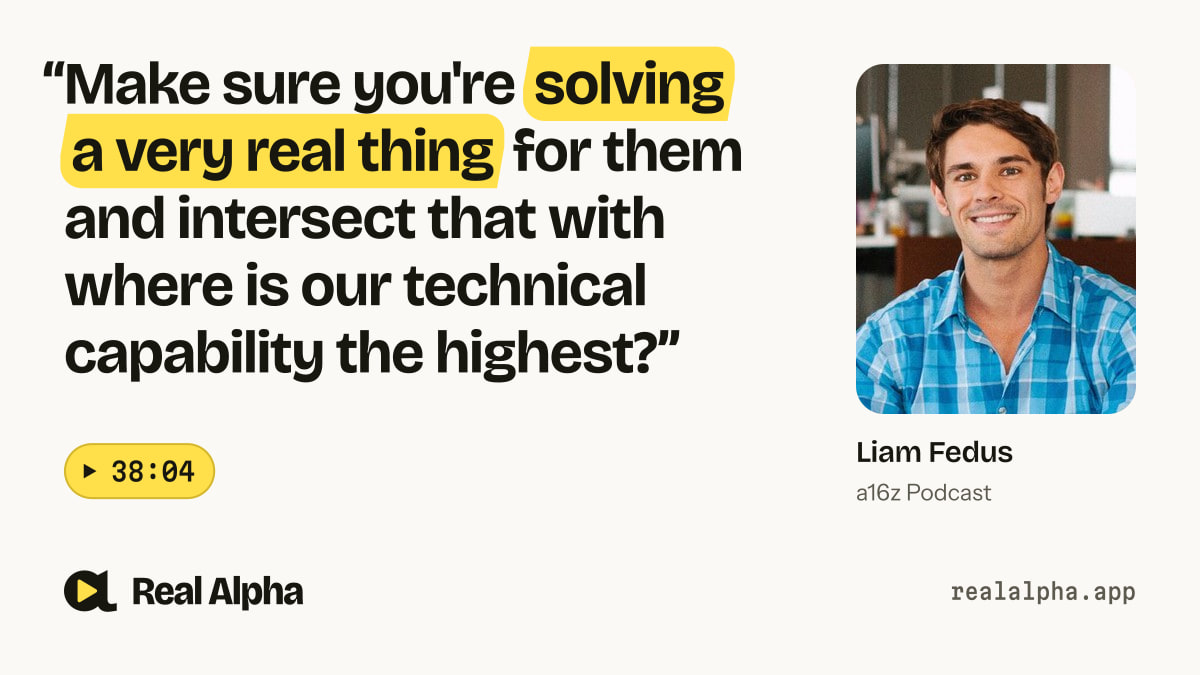
“Make sure you're solving a very real thing for them and intersect that with where is our technical capability the highest?”
 Liam Fedusat 38:04 · a16z Podcast
Takeaways
- Co-define a clear evaluation with the customer.
- Start with a real, well-scoped bottleneck.
- Simulation automation can connect results to design workflows.
About this segment
Liam Fedus describes a land-and-expand approach: work with customers to identify urgent problems and clear evaluations. One example is automating simulations and connecting results to design workflows.

Co-founder & co-CEO, Periodic Labs
Co-founded Periodic Labs, which raised a $300M seed round, after work as one of OpenAI's most respected researchers.

Anjney Midha, Host · General Partner, a16z
Former a16z general partner who helped create Oxygen, its GPU program for startups.
From “Building an AI Physicist: ChatGPT Co-Creator’s Next Venture”, Sep 30, 2025. Watch the full episode
Thanks. We'll look at and fix what's off.
Transcript
Transcribed by machine (Whisper) from the episode’s audio, so a word may be off here and there.
- 36:52
Well, maybe one thing that we've noticed in our conversations with all these companies is they all are looking for their AI strategy. They understand that like the technology is shifting really quickly and they're looking at how they're doing their work and it's not changing as quickly as they think it should be. Some industries also are losing like kind of key expertise in different fields and they're like losing these like senior engineers, senior researchers, and they're like, okay, how do we like preserve that?
- 37:20
But one thesis is understand, you know, kind of thinking about these like APIs and thinking about what are the evaluations? What are the biggest bottlenecks for these companies? Looking at some of the problems they face and we can map that to our systems and we say, well, we think we can dramatically accelerate this. And so it's not coming in and saying, hey, we're going to transform your fab line on day one.
- 37:45
We're going to transform how you're doing everything. Forget everything. It's like, no, we're going to solve a really critical problem. well-scoped, very clear evaluations. You kind of co-draft that with them and just show them how powerful this technology can be when you optimize against the thing you care about. So nothing particularly surprising here, but sort of like a land and expand type method as you might expect.
- 38:11
But really looking for who are the biggest promoters within that company and what are the biggest problems. Make sure you're solving a very real thing for them and intersect that with where is our technical capability the highest? You know, you were on a call this morning with one of the customers in your pipeline. We don't need to name who, but what were some of the things you heard as the most urgent problems that they'd like for periodic to solve?
- 38:35
So one of them was simulations. You know, they spend a lot of time training people on some of these simulations they need to use which is critical for their development. And being able to automate those simulations, I think would be quite enabling. the design process and then kind of like some of the small things like matching the formats being able to feed you know the simulation results into the design pipeline all of these seem quite important and then being able to treat the data together in the same place what else?
- 39:07
Well I think there's